



“Art should comfort the disturbed and disturb the comfortable.”
—Cesar A. Cruz
n independent woman filmmaker from India requires a thick skin, unlike one from the mainstream. Anuparna Roy knows this. She also knows her target audience: “Those who seek stories that stimulate the intellect—stories that go beyond mere entertainment.” Roy tells THE WEEK that she has no doubts about finding a following that gravitates towards unconventional films. Her films may upset or discomfit people, but she is certain they would resonate with audiences at some level. This is not, however, a promise, as Roy is perfectly aware that she is a novice and a “student of cinema”.

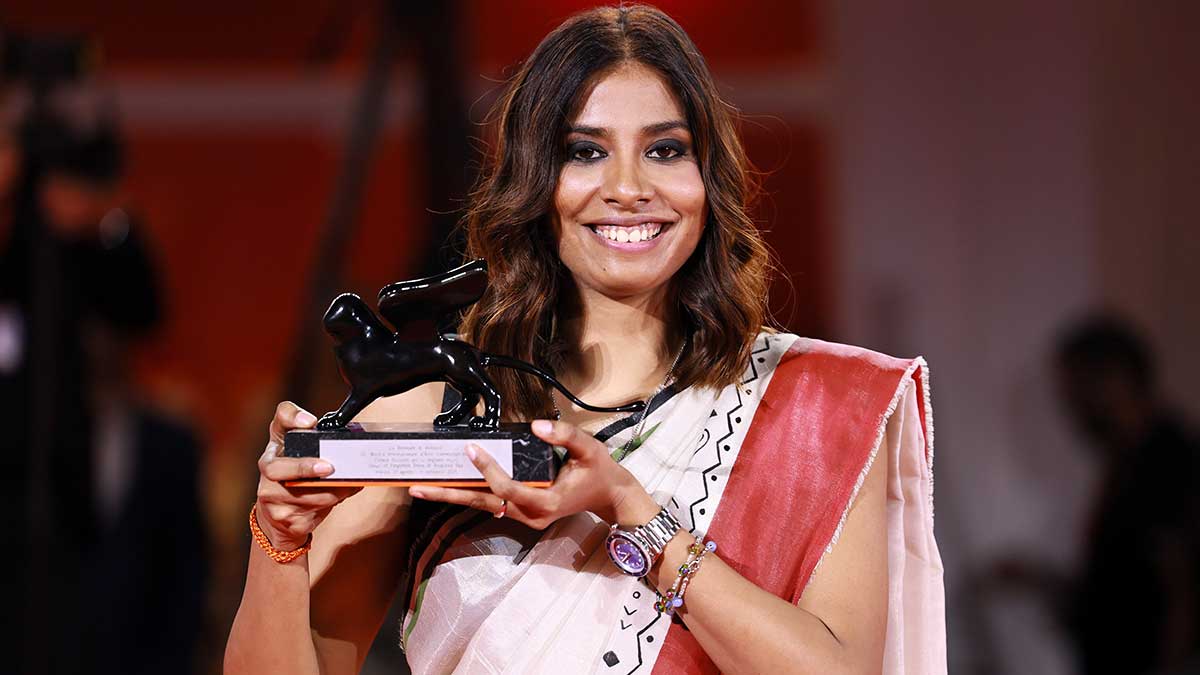
Having just returned after winning the Orizzonti Award for best director at the 82nd Venice Film Festival for her debut feature, Songs of Forgotten Trees, Roy is exhausted, but finds time to speak with THE WEEK. She is only the second woman filmmaker after Mira Nair to be bestowed with a high honour at one of the most prestigious festivals. She is also one of the few with a spine, like her globally recognised Indian contemporary, Payal Kapadia. Like her, Roy, too, aims to tell stories of individuals who live on the fringes of society. And she has already proven herself capable of speaking up at forums where most would remain silent.
In her acceptance speech, Roy, who hails from Bengal, voiced support for Palestine, regardless of what her fellow countrymen would think. There were also the reservations of those who advised her against it. “Every child deserves peace, freedom, liberation, and Palestinians are no exception. It is a responsibility at the moment to stand with Palestine. I might upset my country, but it doesn’t matter to me anymore,” she said. Online brickbats followed, but Roy remains unfazed.
She grew up watching the politically charged work of filmmakers like Alfonso Cuaron (Roma), Nadine Labaki (Capernaum), Jafar Panahi (The White Balloon), Jia Zhangke (A Touch of Sin), and Bahman Ghobadi (Turtles Can Fly). However, she believes that absorbing cinema and literature alone won’t suffice to shape a filmmaker.
“One finds enough events around to provide fodder for scripts,” she notes. “Basically, if you understand your own surroundings—or your own family, even—the sort of inherent drama and politics in your school and college, the administration in and around your village and city, you will have enough content, irrespective of how timid, marginalised, and limited that world is,” she says. “Of course, the required motivation to think outside the box is found in films, especially foreign ones, but one needs to keep in mind that the geographical, economic, and political situations in a foreign land are different from those in one’s motherland.”
Initially, Roy wanted to become a writer. Before foraying into filmmaking, the literature graduate dabbled in journalism, hoping to find a “direct connection to filmmaking”, but later gave it up when she found none. Taking up various jobs, including one in the IT sector, enabled her to save enough to make a short film, Run to the River, in 2023. She landed an opportunity to direct her debut feature film with support from her parents, friends and filmmakers. Notably, maverick director Anurag Kashyap is one of the backers of Songs of Forgotten Trees.
The film revolves around two migrant women from different worlds who share an apartment in Mumbai, and is shaped by Roy’s “memories about women surviving systems designed to erase them”. Hailing from a village where girls were married off at an early age, she recalls two events that left an indelible impression: her grandmother marrying a 30-year-old man at the age of nine, and a friend who was married off at 13. The latter was never seen or heard from again.
These experiences, says Roy, inevitably powered her sensibilities as a filmmaker. In her film, Roy focuses on the bond between two women unrestrained by societal shackles. Before someone brings up comparisons with another women-centred film, Kapadia’s All We Imagine As Light—which became the first Indian film to win the Grand Prix at Cannes—Roy clarifies that her film has different intentions. While acknowledging inspirations like Kapadia, Rima Das, Kiran Rao, Mira Nair and Zoya Akhtar, Roy believes in bringing her own voice to the stories she wants to tell.
She knows the Venice honour is a momentous one and she says the atmosphere filled her with a sense of renewal. The avenue, she feels, is one that fosters strong enthusiasm for cinema and stimulating conversations. The cherry on the cake was sharing the stage with some of her favourite filmmakers and actors, like Jim Jarmusch, Joaquin Phoenix, and Julia Ducournau. Would she like to recommend a festival film that greatly impressed her? The answer comes without hesitation: Park Chan-wook’s No Other Choice.
