

She had loving parents, good friends, a comfortable lifestyle and got straight As in school. But Elaniv grew depressed around puberty. She had trouble concentrating, started self-harming, and became despondent beyond medical help. On March 1, 2021, she took a handful of psychiatric pills. Her mother Tania Gainza, a therapist, found a note in the kitchen: “I’m sorry. I can’t take it any more.”
It was Elaniv, and other such troubled teens, that compelled Matt Richtel, a Pulitzer-winning science reporter at The New York Times, to write How We Grow Up: Understanding Adolescence. In it, the father of two pre-teens uses recent research and personal accounts to explore this period of rebellion.
He explores two ideas—the universal purpose of adolescence and why adolescence is undergoing unprecedented change.
Re-framing adolescence as not merely a troubled phase but also a biologically and culturally vital period, Richtel says that rebellion is natural and important. “They are experimenting so they can participate, adapt and lead—so they can take the baton (from the older generation),” says Richtel. This is not rebellion but diversification. Adolescents are like startups in a world that requires new ideas, he says.
As for the “unprecedented change” this generation is going through, he introduces the term ‘Generation Rumination’ to describe teens who, more than preceding generations, dwell inwardly. They are pressured by a virtual world and early puberty to engage in excessive introspection and worry. This, he argues, explains the jump in the number of young adults (20.8 per cent) identifying as non-heterosexual in the US.
“They are looking inward at all things—‘What is gender anyway? Are they more than social and personal constructs?’—and they are being urged in this direction by forces well beyond their control. Biology and neurobiology on one side and a changing environment on the other,” argues Richtel.
He claims that risks related to exploration in the physical world—teen pregnancy, drunk driving, smoking—have fallen, and the risk is now in the virtual world. In the chapter ‘The Displacement Effect’, he observes that the screen is a thief of sleep, exercise and in-person activity, and wonders if teenagers are replacing drugs with smartphones.
Citing US surgeon general Dr Vivek Murthy’s special advisory on ‘the epidemic of loneliness and isolation’, Richtel adds that loneliness is a predictor for many challenges like anxiety, depression, and, later in life, heart disease and dementia.
Murthy argues that social media plays a role in social isolation. “It is one thing to be 50 or 60 and dealing with information flowing to us 24/7 on our phones, but it’s another to be 13 or 14, still developing your brain, your relationships, your sense of self, and to have predominantly a negative flow of information coming to you,” Richtel recalls from his conversation with Murthy.
The author notes that, as per research, fear leads parents to blame commonplace problems on mental health disorders—seeing imperfect grades as attention disorder, worry as anxiety, sadness as clinical depression. The children don’t need parental friendship as much as leadership and guidance, especially in enforcing device limits, and basic rules like bedtime and getting homework and chores done.
“The adolescent is our future. And the future is uncertain,” says Richtel, urging readers to hand the baton to the next generation with grace, love and compassion.
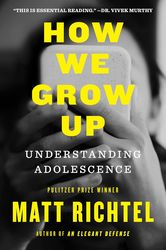
HOW WE GROW UP: UNDERSTANDING ADOLESCENCE
By Matt Richtel
Published by HarperCollins
Price Rs499; pages 336