



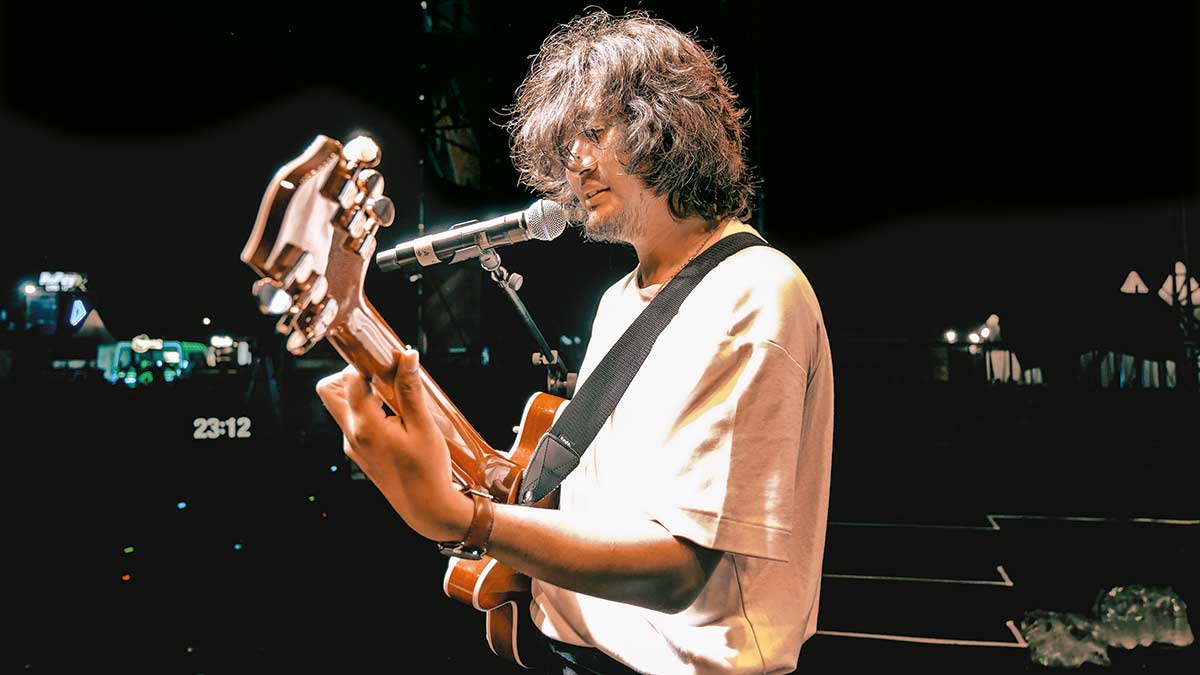
In his live shows, when Taba Chake sings in Nyishi—a tribal language spoken by fewer than three lakh people—fans across the world sing along. His voice, weaving indie-folk, pop, jazz and tribal influences, dissolves language barriers and carries emotion straight to the heart.
The 32-year-old recently released ‘Khud Ko Miloon’, the first of 13 tracks from his album of the same name. True to his style, the song leans into philosophy—raw, real, and reflective. “My songs are not just about sounding nice. I want people to think,” he tells THE WEEK. “To pause and ask themselves: ‘Am I confused? Am I lost in this glossy, glamorous era of social media?’ Because the real world isn’t that. I try to bring people back to reality, back to themselves.”
The singer-songwriter says his songs draw heavily from his own journey. Since 2009, he has been away from his home in Arunachal. “I remember selling my dad’s old Hyundai Santro just to leave Arunachal, step outside the northeast and pursue music,” he says. “I kept moving—Tamil Nadu, Bangalore, Delhi, Kerala, Pondicherry, Goa, and finally Bombay. Each place taught me something about life, music, passion, discipline and control. But I feel like it’s not enough. There’s always another chase. Now I’ve seen money, but even that doesn’t stop me from wanting more. I don’t even know why.”
He is critical of the ‘greedy’ side of himself and of human nature, and his music, he says, is about slowing down and embracing simplicity. That spirit seeps into the space where his latest songs were born—a tiny home studio in Arunachal, barely the size of a bathroom, with a colourful world map on the wall reminding him of both the vastness he sings of and the simplicity he holds on to.
In 2019, Taba released his first album, Bombay Dreams, which had 10 tracks and got over 30 million streams across platforms. Then, during the pandemic, Taba returned home. “I realised I didn’t want to live in a way that drained my soul or body,” he says. “You can live anywhere in the world, but eventually, there’s always this pull to come back home.”
It was only during the pandemic that his parents and extended family discovered the global reach he had built with songs like ‘Shaayad’, ‘Walk With Me’ and ‘Kahani’. Taba says his mother has always been his sounding board. “Whenever I write a new tune, I play it for her, and she’ll tell me if it feels good or not,” he says. “She doesn’t really follow my achievements or the numbers, but she understands the music itself.”
He traces his earliest influences to his mother and an uncle who loved listening to songs on cassette players. This uncle had a wide taste—Korean and Chinese, Hindi film songs, Kishore Kumar, Pakistani bands, and western folk and pop. “I grew up hearing MLTR (Michael Learns To Rock), Jack Johnson, Bruce Springsteen, Don Williams—you name it. Williams, in particular, was special. I’d listen to him on my Walkman for hours,” he recalls.
Taba says that during his boarding school days, a teacher taught him MLTR’s ‘Sleeping Child’. “I honestly thought it was a gospel song then,” he chuckles. “Later, during the holidays at my uncle’s place, I was listening to MLTR and suddenly realised—wait, this is the same song my teacher taught us! That was around 2002, when I first picked up the guitar. But I didn’t connect with it right away.”
That changed in 2006, when one of his classmates returned to school with a guitar and played Bryan Adams’s ‘Summer of ’69’ in front of a crowd. “I was blown away,” he says. “I thought, if he can play like this, I want to as well. From that day on, I wanted to be a musician.”
When Taba first started learning guitar, he says he looked “pretty normal”. But by 2007–08, after diving into metal, his image changed. “I grew my hair to my waist and wore only black,” he says. “I didn’t drink or smoke, but my look made people think I was spoilt or rebellious. Nobody trusted me.” His first metal band was called Tormentor, followed by another named Third Eye Aggression.
During this time, Taba felt there was little space in Arunachal for a career in music. “Everyone wanted to be a doctor, contractor, or government officer—and those are all good paths, but I felt I had to step outside that world if I wanted to do something truly different,” he says.
In the coming months, Taba will tour from Amsterdam to London to San Francisco. But wherever he goes, he takes a piece of Arunachal and its nature. “I’ve asked myself why nature comes up so often in my writing,” he says. “The answer is simple—I can’t escape it, and I don’t want to.”
Language also plays a part in his process. “If I’m in my village, meeting family, or reconnecting with my roots, Nyishi comes out,” he says. “If I’m outside, English feels more natural. And when I want to express something deeply emotional and raw, I find Hindi—and often Urdu—carry that weight best. There’s something about the words, the texture of the language, that captures the essence of feelings in a way that’s hard to explain.”
He has also written in arguably the purest language of all—love. One of his most popular songs, ‘Walk With Me’, was co-written with that “someone special”, who is now his partner. “I was finishing Bombay Dreams in Delhi,” he recalls. “She was studying there. One night, I was returning from the studio, strumming and humming ideas on the metro. When I got home, I played the melody for her. She said, ‘You have so many songs about life and philosophy, but no love song. Let’s write one together’.”
And so they wrote: ‘Hello dear, you’ve been pulling me closer/Let’s write about you and me.’
“It came together in just five minutes,” Taba smiles. It became one of his most popular tracks outside India.
Taba has been largely insulated from the noise on social media. Yet, he admits that when songs like ‘Walk With Me’ were released, he did wonder if he could have leveraged social platforms more effectively. “But even without that, the song reached people in ways I never expected,” he says, reaffirming his belief that good music will always find its ears.
