


Despite having very different triggers, the Bengal famine of 1943 and the migrants’ crisis of 2020 bear striking similarities. Both dealt a crushing blow to the poor, led to mass displacement, exposed the indifference of authorities, and resulted in unimaginable human suffering. It was the Bengal famine that spurred Monkombu Sambasivan Swaminathan to become a plant geneticist. Two decades later, and after having almost run out of food on more occasions than one, India witnessed a one-of-a-kind Green Revolution, with M.S. Swaminathan as its architect. It transformed the country’s very fate “from that of a begging bowl to a bread basket,” writes Priyambada Jayakumar in MS Swaminathan: The Man Who Fed India. The biography was launched around his birth centenary on August 7.
“He was a man who loved taking up new technology. The reason why the 2020 Covid lockdown spurred him as my subject was because I caught a tweet by him on the migrants’ crisis, on humanity walking helplessly with their lives on their backs,” Jayakumar tells THE WEEK. And as she writes in her author’s note: “Meanwhile, a totally different epidemic of hunger was quietly unfolding everywhere—for in India, no wages equalled no food.”
It isn’t that no books have been written about Swaminathan. But they are “dreadfully dry with dry agricultural facts on wheat in them. Who’s interested? Bring the man behind it. That’s what the book intends to do,” says Jayakumar.
From Gandhi to Marcos
Jayakumar’s is a very readable book, which maps the journey of the man, by placing him in the personal and political environments he found himself in. For example, the profound impact of Gandhian philosophy and India’s freedom struggle is reflected even years later in the 1980s when, as the head of the International Rice Research Institute in the Philippines, he helped student protesters with buses to join the “peaceful revolution” against the totalitarian regime of then president Ferdinand Marcos. “He was a product of history,” says Jayakumar, also a relative of Swaminathan. “History gave him a chance, and he was able to grab it with both hands.”
The seeds of revolution
“The paddy fields in Monkombu stoked Swaminathan’s nascent interest in agriculture,” writes Jayakumar, and the Bengal famine further shaped his course. But few know that he cleared the civil services exam in his first attempt and was appointed to the Indian Police Service.
“Fate, however, had other plans for him. Around the same time in August 1949, he received a fellowship from UNESCO to study plant genetics,” notes Jayakumar, and the rest is history.
A striking aspect of Swaminathan’s journey was how often he brushed shoulders with the leading scientific minds of his time, the most instrumental being Nobel laureate Dr Norman Borlaug, who had developed a high-yielding short-stalked variety of wheat in Mexico—“exactly what India needed and what Swaminathan was looking for”.
But bringing the seeds to India was no simple task. The bureaucracy of the 1960s, coupled with scientific scepticism and political mistrust, made the process arduous. What eventually changed the tide was the coming together of the 3S.
Politics of hunger & the 3S
The book absolutely shines in capturing the political and geopolitical landscapes India found itself in, bearing an indelible impact on Swaminathan.
“In 1949, Nehru urged all Indians to supplement their rotis with a mix of sweet potatoes to curb hunger,” writes Jayakumar. Such was the hunger that in early 1950, India’s dependence on the US for food was to the tune of two million tonnes. The wars of 1962 and 1965 only deepened the crisis.
But something shifted during this period. On June 9, 1964, prime minister Lal Bahadur Shastri asked C. Subramaniam, then minister of steel, to take over the “less glamorous” agriculture ministry. “Shastri had found absolutely no takers for the ministries of agriculture and food and was heavily banking on the eminently qualified Subramaniam to bail him out of a tight corner,” writes Jayakumar. And Subramaniam brought in “B. Sivaraman, a brilliant civil servant who had vast field experience in agriculture and irrigation in Orissa”.
“C. Subramaniam lobbied politically for Swaminathan and his scientists in Parliament while B. Sivaraman was the details man. It was this trio of the Ss who put together a plan that would turn India’s fate from that of a begging bowl to a bread basket,” notes Jayakumar.

But political winds shifted again. In 1966, Shastri died unexpectedly, and then came Indira Gandhi, and also the US’s Food for Peace Act of 1966 or Public Law 480 (PL-480). While essentially intended to send shipments of surplus commodities to nations in need, on concessional terms, it was also a tool for diplomacy during the Cold War. President Lyndon B. Johnson once limited the shipment for critical famine aid to India for 48 hours to pressure it to tone down its rhetoric on the US’s involvement in the Vietnam war. The situation was so dire that in 1966, “an average of three ships a day carrying grains and food supplies from the US would dock at various Indian ports, and the food would be immediately distributed and consumed. India was effectively importing three-four million tonnes of wheat annually from the US, which meant that almost one-fifth of American wheat was being exported to India!” writes Jayaram. The world wrote off India with doomsday prophecies and Malthusian theories.
It was after one such phone call with Johnson in 1966, after he had stalled yet another urgent shipment of food, that Gandhi told her principal press adviser H.Y. Sharada Prasad, “I don’t ever want us to have to beg for food again,” notes Jayakumar. She then asked Swaminathan how soon he could get her 10,000 tonnes of wheat to “get the bloody Americans off my back”.
It didn’t take long.
By 1968, India stunned the world. “Absolutely no one was prepared for the astounding amount of wheat harvested that year—except the man who foresaw it,” writes Jayakumar. “The wheat surplus was so massive that schools were closed early for summer holidays so that the government could utilise empty classrooms to house all the extra grain! Even cinema halls were emptied to store the surplus wheat! Trains, too, ran out of available wagons,” she says.
Along with political will, what also worked for Swaminathan was that he appealed to the farmers’ intelligence to adopt the high-yielding variety of seeds. After the first rotis from that wheat turned out to be red, they were put through radiation to turn them amber. “Many farmers have told me that they have a photograph of Nanak and Swaminathan at their homes,” says Jayakumar.
Politics of today
“India’s first example of self-reliance or atmanirbharta, which has become so relevant today, began with the Green Revolution,” notes the author.
Another striking revelation in the book is Swaminathan’s work with India’s archrivals—China and Pakistan. While heading the IRRI in the Philippines, he was often approached by countries struggling with rice production to set up the IRRI in their countries. “The first one he helped set up was in the People’s Republic of China,” says Jayakumar. And in 1984, he was invited to the inauguration of Pakistan’s agricultural research institute in Islamabad as a keynote speaker.
It raises a searing question: if such cross-border collaboration were to happen today, would Swaminathan escape being labelled a gaddar (traitor)?
A Frankenstein’s monster?
While the Green Revolution was the need of the hour in the 1960s, its long-term impact is now visible—a depleting water table, overuse of fertilisers and pesticides and widespread land degradation, especially in Punjab and Haryana.
“He knew he had unleashed a Frankenstein’s monster, but at that point, he needed that Frankenstein,” says Jayakumar. “You cannot do any magic if the people are hungry. Food is the ultimate currency of life. But yes, Swaminathan was upset about the pitfalls of the Green Revolution.”
In fact, he had warned against the over-exploitation of water and fertilisers in 1968, and later coined the notion of Evergreen Revolution, which intends to prevent environmental harm while ensuring crop yields.
Here, Jayakumar points out that it is not the science but policies, such as subsidies, which have caused the problem. “Policies are very heavily politicised, with India no longer at the heart of them,” she says. “Today, policies are made simply with one eye on the next elections, and not to sort India’s problems.”
M.S. SWAMINATHAN: THE MAN WHO FED INDIA
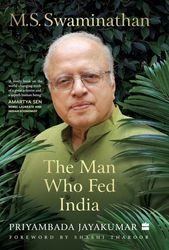
Author: Priyambada Jayakumar
Publisher: HarperCollins India
Price: Rs799; pages: 324