


The title of writer Manu Joseph’s first work of non-fiction is as provocative as the man himself—Why the Poor Don’t Kill Us. It is something I bet you haven’t thought of. Still, it is one of those invisible things that becomes glaringly visible once someone points it out to you. After all, we live in one of the most unequal societies. As Joseph points out, we make the poor “squeeze into a steaming, humid, unreserved train compartments, so many of them per square foot that if they were cows it would be illegal to transport so many in that space”. We make our maids “squat like frogs” by bathroom sinks to pull out our hair clogging it. We make men get into manholes where they die sometimes after inhaling poisonous gases. So why don’t the poor “crawl out of their catastrophes and finish us off”? In this case, you can judge the book exactly by its cover, because it is this precise question that Joseph sets out to answer.
Joseph has a unique vantage point, because he was once poor himself. He was born in Kerala, but grew up in Chennai. “By the time I entered high school, my family had slipped from lower-middle class to absurdly poor,” he writes. “I was poor in the sense that even Medha Patkar would have called me poor.” He told THE WEEK that anytime his parents wanted him to meet someone important, they would dress him in the school uniform, because that was the best dress that he had.
Even though he had scored the highest in maths and science in his board exams, he chose English literature in college—a stream he recalls, those days had become a refuge for boys with learning disabilities, the blind, and those who were on their way to becoming Catholic priests—for a dishonourable reason: he was confident he could bulls**t his way to a literature degree. He knew that was necessary because he had to work part-time to feed himself and pay the fees. “Eventually, I did get by without ever seriously studying Chaucer or Shakespeare, about whom I wrote many impressive essays in exams,” he writes. “Now and then, I sold Primus Kabsons stoves and Eureka Forbes products in showrooms, and Funskool toys door to door, and milked college festivals for speaking and writing cash prizes.”
Why the Poor Don’t Kill Us is a sharp and suave critique of Indian society and the hypocritical way we treat our poor. Like the way the middle class today claims to be nicer to their servants than their parents. “The new conscientious sahib even exclaims on social media how cruel it is that maids are ‘expected to be invisible’. The madam, though as conscientious, is unlikely to say that, or let the maid use the toilet or the cutlery,” he points out. You might disagree with much of what Joseph says, but you will still find him gripping, mainly because of his characteristic wit. Take the way he describes the vulgarity of an Indian five-star buffet. “The whole buffet scene is like a rave party, with distressed waiters dealing in sugar and maida; and the addicts wanting more and more, shouting for the attention of dealers, asking why something is taking so long, how long must they wait; how long must their poor starving children wait before the next fix. The anxious addicts of food are aware that waiters here are too powerless to ever tell them, ‘It’s a buffet you fat f**k, go and take it yourself’.”

So why, according to Joseph, don’t the poor bump off the rich? He cites several reasons. One is the chaos and ugliness that surround us. Most nations try hard to look richer than they are; India, in plain sight, is a lot poorer than it is in reality, he writes. Our country’s ugliness gives the poor a sense that they belong to it, too. “The Arun Jaitley stadium in Delhi looks so third-rate and ugly, it would reassure 95 per cent of Indians that the nation has not left them behind—something the suave former finance minister himself could not do in his lifetime,” quips Joseph.
Another reason is the way our politicians protect us. Politicians, he writes, are culturally closer to the poor than intellectuals, humanitarians and activists. A corrupt politician is useful to the poor and in that way, saves us from their anger. Take the matter of bribing. Joseph recounts the time in 2006 when a group of IIT graduates decided to enter Tamil Nadu politics. “They posted on their website an introduction to their ideology, in English—‘Reality is a continuum. Knowledge system, in shortest, is fragmentation imposed upon the continuum of reality’,” he writes. “They were trying, through the language of a humanities professor, to defy the chief minister of Tamil Nadu, the great veteran Karunanidhi. Karunanidhi offered every poor family of Tamil Nadu a free colour television. Of course he won the elections.”
Right from his first novel, Serious Men, about a dalit man who makes up a story about his son being a mathematical genius (which won the Hindu Literary Prize and the PEN Open Book Award), Joseph has been interested in stories of the poor. “I find it very interesting because of the whole spectrum of injustice,” he tells us. “It bothers me the most because the people who speak for the underdogs are usually the beneficiaries of inequality themselves.” Not that he himself claims to be a saint. In fact, it is a central argument in his book that most reforms happen when people act in self-interest, and not because of the charitable deeds of activists and humanitarians. “This is why I say, the young who are of sound mind, and this is an important classification, should quit full-time activism, refuse to work in non-profit organisations, sack themselves as humanitarians, and be suspicious of the hyper-morality that emanates from the west,” he writes. “They should instead make money, or do well in the material world in other ways, or at least start a doomed business. They are more useful to society this way.” He might have a point. His book deals with the many ways in which the rich are protected from the wrath of the poor. But who’s going to protect the poor from the patronising ‘charity’ of the rich?
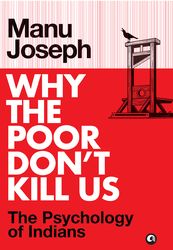
WHY THE POOR DON’T KILL US
Author: Manu Joseph
Publisher: Aleph
Price: Rs599; pages: 266