



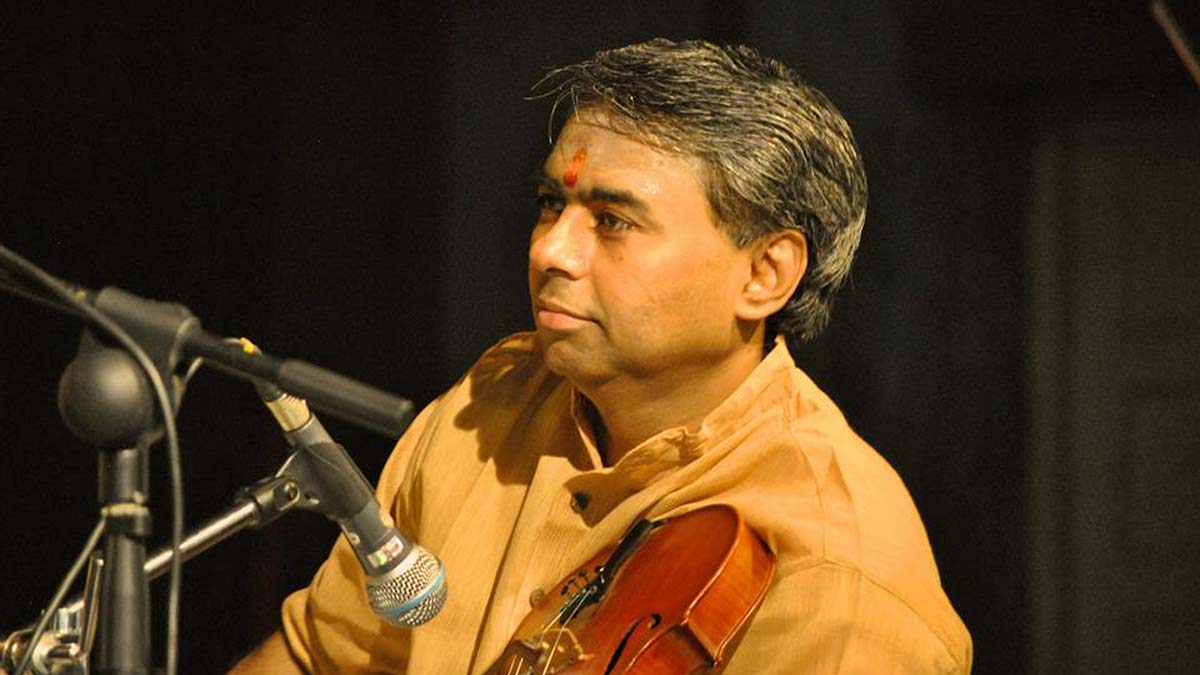
Rudrapatna on the banks of the river Kaveri in Karnataka has been the cradle of an amazing number of classical musicians—vocalists, violinists and veena players. The name of this beautiful hamlet is visible in the initials of well-known musicians like R.K. Venkatarama Shastry, R.K Srikantan, the Rudrapatnam Brothers R.N. Thyagarajan and R.N. Tharanathan, R.R. Keshavamurthy, R.K. Suryanarayana and R.K Padmanabha.
Most of them have performed all over the country. Shastry migrated to Chennai in the 1930s and played the violin for legendary vocalists of his time. His brother R.K. Srikantan, an acclaimed vocalist, received the Sangita Kalanidhi award of the Music Academy, Chennai, 30 years ago. Shastry’s grandson R.K. Shriramkumar, a violinist like him, is the latest winner of the award, considered the highest accolade in Carnatic music. He will receive the award at the annual music festival in December.

Shriram is a music scholar and a highly regarded teacher, and he told me with unaffected reverence: “My greatest blessings are my gurus.” Gurus such as Savitri Satyamurthy, his own grandfather and V.V. Subramanyam, another renowned violinist. The famous vocalist D.K. Jayaraman was another guru.
He performed with illustrious musicians such as Semmangudi Srinivasa Iyer, M.S. Subbulakshmi and D.K. Pattammal, absorbing their chasteness and knowledge. He is noted for his purist approach in his performances, rendered with a supreme sense of sensitivity and integrity. He perhaps evolved in the womb listening to Subbulakshmi, who sang for his mother’s seemantham, the baby shower ceremony. His grandfather was Subbulakshmi’s violin accompanist for several years, and eventually a youthful Shriram could accompany her till her last days.
Shriram said Subbulakshmi’s personality deeply influenced and shaped his musical thought and acumen. He learnt several compositions from her and observed her all-encompassing grasp of the music universe that transcended the Carnatic world. He absorbed her concert etiquette and how she structured the concerts to suit the audience — whether at a sabha, a temple, a wedding or an international forum. He was fascinated by her deep insight of raga and bhava, her magical voice, her perfect articulation and diction, her ecstatic abandon in every octave, her inexhaustible repertoire of mesmerising bhajans, abhangs and devotional slokams, her renditions in myriad languages, her rigour and practice till perfection was attained, and above all her humility, gentleness and magnanimity.
Assimilating musical ideals from other great musicians as well, Shriram carved a niche for himself. He has been the most sought after accompanist for the current stars of the Carnatic world. Memorable are his performances with Vijay Siva, Sanjay Subrahmanyan, P. Unnikrishnan, Sudha Ragunathan, Bombay Jayashri, S. Sowmya and T.M. Krishna. He also performs alongside his talented students to encourage and inspire them, thus sustaining a guru-shishya legacy.
Shriram was the violin accompanist when T.M. Krishna gave his first concert at the Music Academy at age 12; he is a decade younger than Shriram. Krishna received the Sangita Kalanidhi award last year, and has collaborated with Shriram while exploring, innovating and expanding musical horizons.
I was curious to know how the conservative, tradition-bound and deeply religious Shriram handled T.M. Krishna, who is an unconventional vocalist, iconoclast, activist and political commentator.
Shriram was candid. He said he had engaged in debates with Krishna on the latter’s thoughts on music, and on his accusations of brahminical prejudices against people of lower castes, of casteist politics of the sabhas and so forth. He said that he vehemently differed with Krishna on many grounds and that it was not fair to blame Brahmins for every ill. Though his views could be diametrically opposite, the conversations never got personal and cost their long relationship, he said.
I asked him about Krishna’s unconventional way of commencing a concert with a tanam or an alapana of a composition in the vilamba kala (slowest pace) instead of the traditional varnam, or ending a concert with a poem or Urdu ghazal on Kannaiah Krishna. Did it not unsettle him? Saying no, Shriram explained: Though unconventional in presentation, Krishna’s renditions of compositions or manodharma keep up the integrity of the Carnatic genre. He is immersed in the music and transports the accompanists and the audience to a trance, with tears streaming down their cheeks.
History has numerous examples of great music, art and literature produced by geniuses who enjoyed creative freedom and did not rebel against the monarchs or tyrants of their time. In the modern age, despots around the world have used arms and algorithms to convince people that servitude is good for them. But, for the artist who is also an activist, freedom is as much primal as hunger. For their art to be fecund, they have to draw from the joys and sufferings of the people and have fealty to the eternal passions of humanity. They cannot remain silent about violence, injustice and discrimination against the voiceless, even if their activism distrurbs the solitude that is essential for their creativity.
Shriram had no ambiguity about where he stood on an artist being an activist. Those who felt drawn to activism could do so, he said. But he had the firm conviction that one could also serve society by purely following one’s art. With a passionate, devoted and dedicated engagement with art, he said, artists can make the world happier and peaceful. “I must choose my way as directed to me by God and do His bidding,” he said.
As the poet John Milton wrote, “They also serve who stand and wait.”
