



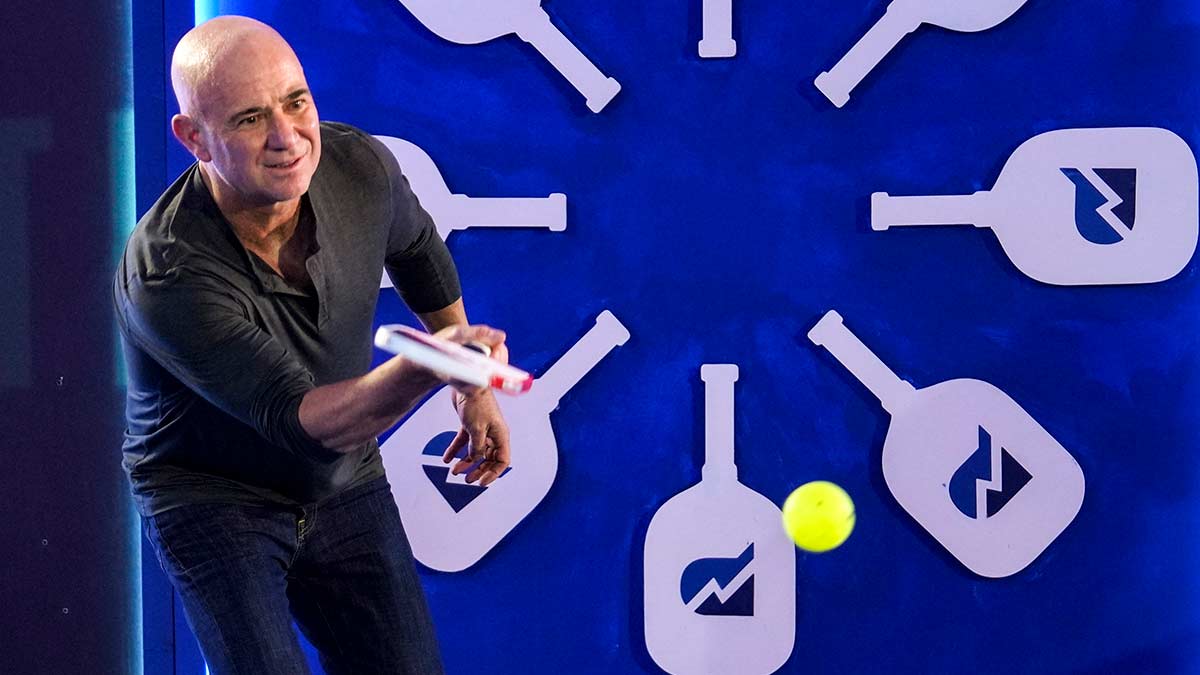
From July 29 to August 3, Navi Mumbai hosted the Monsoon Pickleball Championship 3.0, touted as India’s biggest indoor pickleball tournament, with a cash prize of $60,000 (around Rs52.6 lakh). The event was held across 17 airconditioned indoor courts. Then comes season 2 of the Global Pro & Challenger Pickleball League in December and several other tournaments—cementing pickleball as India’s latest sporting obsession. What began as a humble pastime a decade ago, and picked up pace during the pandemic, has now snowballed into a full-fledged movement. Tournaments are being held nearly every weekend across the country.

A sport once seen as a gentle game for retirees in the US has transformed into a high-energy, youth-friendly, and fiercely competitive phenomenon in India. And the numbers are telling: the All India Pickleball Association (AIPA) claims there are now over 5 lakh active players in the country.
Pickleball—a hybrid of tennis, badminton and table tennis—is played on a smaller court with a paddle and a perforated ball. It is easy to learn and requires little formal coaching, which adds to its appeal. Jaipur-based Niraj Sharma, a former tennis hobbyist, took to pickleball in 2016. “At the time, we did not even have dedicated courts—we would use portable nets and mark out lines on tennis or basketball courts. But once I tried pickleball, I was hooked. Unlike tennis, where it is tough to master backhand strokes even after years, pickleball is more accessible. A novice can play with a pro and still enjoy the game,” says Sharma, who has since won multiple medals in international tournaments.
Fitness trainers say the sport is catching on with those in their 30s and 40s seeking a cardio-intensive social activity that does not require years of skill-building. It is also increasingly popular with children and teens. The sport’s popularity in India spiked during the Covid pandemic, when tennis courts were too big, gyms were risky, and people longed for a safe, outdoor group activity. That is when the pickleball paddle began replacing gym bags.
Now things are getting serious. India has hosted several national tournaments in the past two years, with international participation rising steadily. Players are training for global events. In urban India, pickleball is no longer a fringe activity—it is a lifestyle.
“We now sell around 50,000 pickleballs each month. Sales have touched Rs4 crore annually, up from just Rs5 lakh a decade ago,” says Manish Rao, India head at Franklin Sports, a US-based company. “There is adrenaline, there is strategy, and there is a rush when you smash a perfect drop shot. And unlike other sports, you don’t need a big team or a fancy club membership to play.” Rao is also a board member of the Global Pickleball Federation and mentor to the Indian Pickleball Association.
The ecosystem is growing fast. Startups are selling specialised gear. App-based platforms are adding pickleball courts. Coaching classes are mushrooming across metros. Rao says Ahmedabad alone has around 500 courts. Since a tennis court can be divided into four pickleball courts, many new housing societies are opting for pickleball infrastructure instead. “It takes up less space and builds more community,” says Sharma, who started with a Rs1,000 paddle in 2016 and now owns paddles worth Rs1.5 lakh. “A good paddle now costs between Rs20,000 and Rs22,000,” he says.
But more than just a sport, pickleball has become a social movement. Week-night games, WhatsApp groups, Facebook communities—it is all part of the culture. “We are like a mini family,” say most players. Win or lose, there is always tea and fellowship afterwards.
The sport also bridges generations. “I play doubles with an 85-year-old former colonel and a 16-year-old school kid,” laughs Sharma. “And we all yell the same when we win a point.” The colonel, Vijay Agarwal, who learnt the sport at the age of 84, says, “It would be wrong to call pickleball easy. It is challenging for those who play competitively and casual for those who play for fun.”
Celebrity heft has also helped fuel pickleball’s rise in the country. A viral video showed Akash and Shloka Ambani taking to the paddle. Karan Johar is the brand ambassador for the Global Sports Pickleball Indian Open 2025, and Aamir Khan has a court in his backyard. Other celebs who play pickleball include Kunal Kemmu, Riteish and Genelia Deshmukh and Samantha Ruth Prabhu.
As interest surges, the demand now is for better infrastructure and formal support. Coaches and players alike stress the need for structured grassroots programmes, school tournaments, and recognition by national sports bodies. Whether played competitively or for fun, India’s love affair with pickleball proves that sometimes the biggest trends come from the smallest courts.
Among those caught in its grip are Kasturi Vighne, a Mumbai professional and Dr Spandan P.V., a veterinarian from Bengaluru. Both national-level players—she representing Maharashtra and he, Karnataka—pickleball gave them more than a game, it gave them each other. “We met through pickleball, and eventually got married a year and a half ago,” says Vighne.
They have both been playing since 2018, and now juggle full-time jobs with daily practice sessions. “We do 9-to-5 jobs, but our day begins and ends with pickleball,” she says. For Vighne, what began as a workout alternative quickly became a passion. “I was a gym freak when I spotted someone playing the game one day,” she says. “I tried it out for fun, but I stopped going to the gym after that. I’ve never stopped playing pickleball.”
Spandan, meanwhile, had already represented India in three major racquet sports—table tennis, badminton and lawn tennis—at the national level. But after his work schedule forced him to step away from competitive sports, pickleball brought him back to the court. “It is easy to learn but difficult to master,” he says.
For the couple, it is not just a sport, but a shared lifestyle. “The best part is that it is a community sport—you can play with anyone, anywhere, at any level,” says Vighne. Together, they coach, compete and continue to fuel India’s pickleball craze—one match, one drop shot and one partnership at a time.
