

Former civil servant R. Mohan’s second book—Story of Schisms and Isms; Kerala: From the Twilight of Monarchy to the Present—is a monumental work that encapsulates extensive research, thinking and reflection on the evolution of politics in Kerala, from the days of the maharajas to the present. The material for the book was collected over 10 years, with the writing itself taking a full year.
Interestingly, as the book reveals, the story of schisms and isms started in Kerala long before Independence, as the maharajas and diwans experimented with controlled democracy. Drawing from historian Elamkulam Kunjan Pillai’s research, Mohan notes that Hindu society in Kerala was originally casteless, divided into five desams (palai, kurinchi, mullai, marutham and neythal). The stratification of Hindu society appears to have come much later with the influx of Brahmanism.
Hindu society in Kerala was divided into two broad communities—the Nairs and the Ezhavas. Meanwhile, Christianity and Islam, having arrived early, grew deep roots. No single community could secure a majority on its own in democratic elections. This led to the formation of powerful societal organisations that played dominant roles in Kerala’s political landscape, most notably the Nair Service Society and the Sree Narayana Dharma Paripalana Yogam, which represented the interests of the Ezhavas.
Unlike much of India, the Congress was never the dominant force in pre-Independence Kerala. The Travancore State Congress was formed only in 1938, though in Malabar, the Indian National Congress had been present since the second decade of the last century. The seeds of the communist movement were sown in Travancore as early as 1931. Over time, several other political parties sprang up, such as the Praja Socialist Party, which even briefly formed a government. Social movements, like the temple entry agitation and the workers’ agitation in Alappuzha, which culminated in the Punnapra-Vayalar uprising, deeply influenced the evolving political discourse.
India’s first election, based on universal adult franchise, was held in February 1948 in Travancore-Cochin. In 1952, the first-ever coalition government in India was formed in Travancore-Cochin when the Indian National Congress and the Travancore Tamil Nadu National Congress joined hands. But the government collapsed soon. Political instability marked Kerala’s early post-independence years, with frequent spells of President’s rule.
After the formation of linguistic states, Kerala made history in its first election by choosing the world’s first democratically elected communist government—led by E.M.S. Namboodiripad. The communists came to power again in 1967, but the political scene remained turbulent. The Communist Party split nationally, and the Congress was divided in the state. From 1970, Kerala enjoyed relative political stability, with the United Democratic Front (led by the Congress) alternating in power with the Left Democratic Front (led by the CPI-M) every five years.
In the last chapter, Mohan examines the paradoxes that continue to challenge Kerala’s governance. Despite relatively high per capita income, the state struggles with poor public finances; despite high literacy rates and an early commitment to universal education, its higher education sector lags; despite strong decentralisation policies, local governance falls short. And powerful interest groups continue to hinder decision-making.
Mohan’s writing is fluent, and his knowledge immense. This is more than a book—it is a compendium on the evolution of Kerala’s polity.
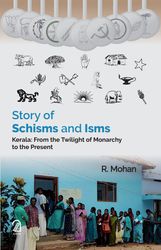
STORY OF SCHISMS AND ISMS; KERALA: FROM THE TWILIGHT OF MONARCHY TO THE PRESENT
By R. Mohan
Published by Aakar Books
Price: Rs1,295; pages: 396