



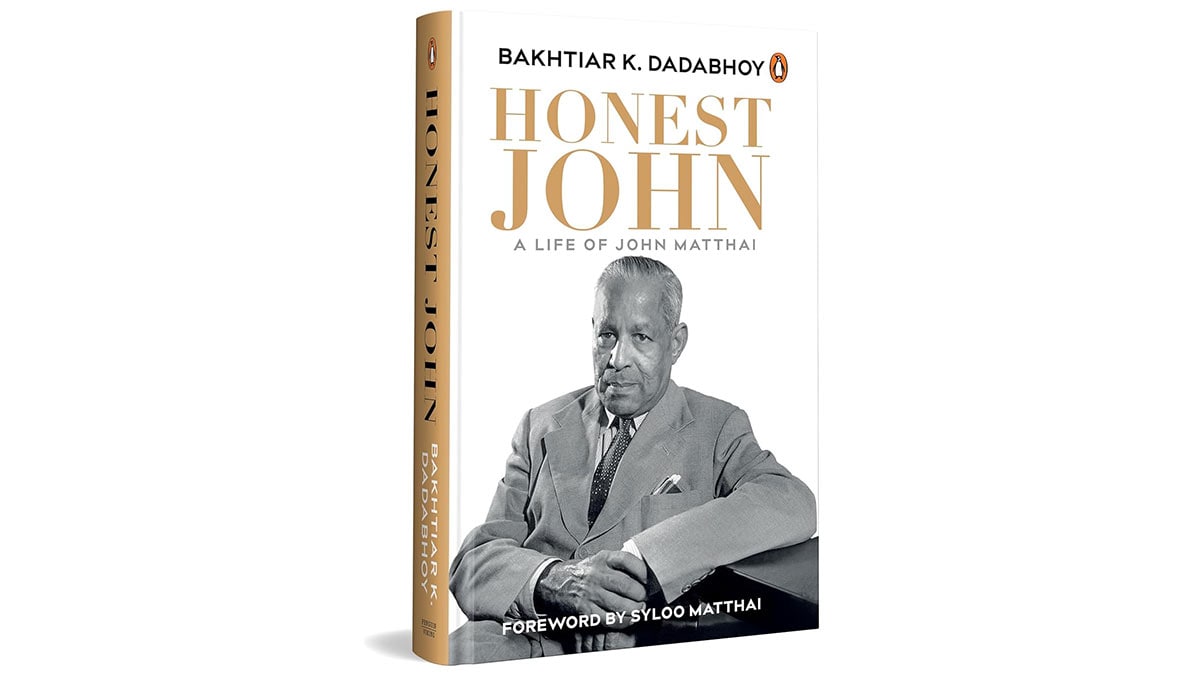
Bakhtiar K. Dadabhoy’s book Honest John is an excellent biography of a towering personality who played a crucial role in the development of post-Independence India, whose life, for the most part, remained in the shadow of more flamboyant characters of the time, like Jawaharlal Nehru and J.R.D. Tata. John Matthai was independent India’s first railways and transport minister and later, its second finance minister. He also worked for the Tatas for many years.
Dadabhoy calls Matthai a man of “unimpeachable and uncompromising honesty”, and this is backed by the testimony of various stalwarts. The viceroy Lord Wavell described him as level headed and probably the most capable and intelligent of the ministers who formed part of his interim government. Lord Mountbatten, the country’s first governor-general, found him “an absolutely first-class man, balanced, reasonable and with a sense of humour”.
Matthai was no doubt a rare jewel in the crown of independent India, but this does not mean he did not have flaws, which Dadabhoy is unafraid of revealing. One instance that brought this out was the tiff with Nehru, over which he resigned as finance minister. It started with a disagreement in the formation of the Planning Commission, which Nehru felt was of paramount importance and Matthai disagreed. He felt it would tend to become a “parallel cabinet” and increase the discussions inside the government which would delay important decisions. Nehru seemed to bear no ill-will towards Matthai, and even as he extended the olive branch, Matthai, for some reason, refused to yield. In a statement he issued, he did not pull any punches in criticising Nehru on various fronts, including by detailing his disagreement with the prime minister on the Indo-Pakistan Pact of April 1950.
The clash certainly did not show Matthai in the best light. He was a stalwart economist, leader and administrator—a man who was unafraid to stand by his principles, even if it meant incurring the displeasure of his contemporaries. It makes the title of the book a fitting one. In the foreword, Siloo, Matthai’s daughter-in-law, recounts how, when he was vice-chancellor of Kerala University, Matthai would use the official car, but would not allow his wife Achamma to travel with him. She would have to follow in another car.
And, apparently, honesty runs in the family. Dadabhoy recounts an interesting story involving Matthai and his soon-to-be-famous grand-nephew, Verghese Kurien, ‘the father of the white revolution’. Kurien was the grandson of Matthai’s sister, Mariamma Jacob. After receiving a bachelor’s degree in mechanical engineering, Kurien’s mother persuaded him to join the Tata Steel Technical Institute in Jamshedpur as a graduate apprentice when Matthai was a director there. When Matthai visited his grand-nephew at the apprentices’ hostel, Kurien’s colleagues became quite in awe of him, treading too carefully around him. He found it “unbearably oppressive” and told Matthai he no longer wanted to stay in Jamshedpur because he was merely the boss’s grand-nephew. Though Matthai told him that he was considered the best apprentice and his prospects at Tata were excellent, Kurien left Jamshedpur, much to Matthai’s displeasure, and later went to study at the Michigan State University in America on a government scholarship.
The appeal of Dadabhoy’s book is not just in outlining the life of Matthai, but also bringing alive that tumultuous and exciting era of nation-building in the initial years after independence. One area in which more could have been written, however, is about Matthai’s personal and family life. Although Dadabhoy does recount in some detail the tragic death of Matthai’s daughter in the US, more anecdotes from his family life would have been interesting. Despite this, Honest John is a formidable accomplishment, mostly thanks to the author’s deep research. It is a piercing look at an extraordinary man who lived at a time when honesty and integrity were still valued in a statesman and politics was not yet a textbook description of Dante’s Inferno.
HONEST JOHN: A LIFE OF JOHN MATTHAI
By Bakhtiar K. Dadabhoy
Published by Penguin Random House
Price Rs999; pages 333
