


Perhaps it is a good thing that so many advocates of handlooms and saris are finding ways to express their enduring love for the six-yard staple. Noted cultural doyenne, author and publisher of Seminar magazine, Malvika Singh finds India’s history and its notable moments in her own collection of saris. Her new book―Saris of Memory―is as much a personal stroll down memory lane as it is a chronicle of India’s history. All of this, with the beautiful sari as a front-and-centre mirror of it all.
“The book certainly is a series of short memoirs that come together as a larger collective,” Singh, 75, tells me over the phone just a couple of days after her gorgeous book has been sent to me as a gift from Ally Mathan, of Bengaluru’s The Registry of Sarees. “I wanted to record the different things I have been doing for nearly 70 years. I wanted to tell the story of my life in a very exciting India, from the mid 1950s to now. So there is a lot of social change, a lot of interesting things. And, yes, I wanted to leave this for my grandchildren. Social media is a lot of recycled emotions, one needs to see things through the eyes of authentic ordinary people. My generation did exciting things, which should not be forgotten.”
Singh is the daughter of noted journalist and CPI(M) veteran Romesh Thapar and his wife Raj Malhotra.

Using the sari as a metaphor, the book is a journey of Singh as well as of the early days of India as an independent nation, the inter-relation between its history and its textiles. There is also the influence of former prime minister Indira Gandhi, and the current Congress chief Sonia Gandhi (both women owned a vast repository of India’s local handlooms from possibly every district and tribe). “I was very fortunate that I grew up in a home where my parents were involved in so many things, from theatre to journalism. They were also activists at a certain time,” she says.
Thapar’s English journal CrossRoads was once part of a major litigation in the Supreme Court. CrossRoads versus the state of Madras became one of the landmark judgments that argued for the freedom of press and found favour with the Supreme Court in 1952.
“I got involved with meeting and listening to people who did so many important things. All of them wore handlooms, no one wore chiffon,” Singh recalls. Her family moved from Bombay’s posh Breach Candy area to New Delhi then, and started Seminar. “John Bissel [founder of Fabindia], Pupul Jayakar [handloom and handicraft revivalist], modernist artist Riten Mozumdar were all friends. “Jayakar trained us. She sent us to trips within India to discover the country. We slept in our sleeping bags in village homes,” Singh recalls. “It was carefree and exciting, we had no comfortable silos.”
Singh, who went to the National School of Drama (NSD) and acted in Shekhar Kapur’s Masoom, has made documentary films for Air India, Rajasthan, and tiger conservation. Singh says her saris and she have conversations. What are these conversations?
“I use the sari as my second skin. I am not conscious when I wear it, because I wear it every day. Every sari I look at reminds me of something that happened in my life. For example, a sari that was gifted to me at my 50th birthday reminds me of the friend that gifted it. And the sari becomes a witness to our conversations.”
Singh believes Indian handlooms have got a new lease of life today. “Weavers are creating old designs again, new colour palettes are being added,” she says. “We are enjoying what is pure and real again. Now, I find that interventions are minimised, weavers are taking so much more effort. Artisanal India has reached a point where there’s a lot of excitement in not just textiles, but even walls of homes are getting painted by Gond artists for example.”

Designer Sabyasachi says the wedding lehenga is dead, and that sensible practical working girls now want to wear the sari when they get married, simply because they can wear it more often. Does Singh agree? “The lehenga became a fad for weddings, but only certain regions in India wear lehenga. In Punjab, we wear Patiala salwars for weddings; in Maharashtra they wear green navvaris, Kerala wears a white sari. The original lehenga has diluted itself,” she says. “But I feel a sari can be worn at a wedding or a sit-down dinner. There is no fad or fashion to a sari, it is timeless and trend-less. It has survived because it is unstitched, versatile. I have even worn one when trekking in Nagaland, I just tucked it a little higher. Jayakar taught me this, to dress in an outfit I can wear from day to evening.”
Singh says her favourite saris remain the finest count khadi cotton saris. “Handspun and handwoven, nothing can compare to how soft and glossy it is. I love a Venkatgiri in fine cotton, and I love jamdanis from Bengal. I also love Kanjeevaram cottons,” she smiles, saying she still can’t stop picking up a sari or a piece of textile whenever she travels. “I will pick up a sari when I go to Jodhpur, or if I go to Pali, I’ll pick up a cheent fabric (chintz), and make a kaftan or a petticoat out of it, and wear it under a transparent white sari.”
Singh is quick to add that she has done no research for the book. “I did not refer to a note or a letter or a book, I only tried to refer to the correct chronology. And I went back to the manuscript only once,” she says.
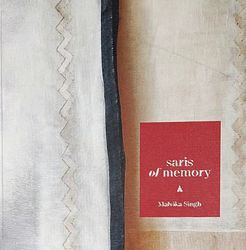
Saris of Memory
By Malvika Singh
Published by The Variety Book Depot
Pages 260; price Rs3,500