



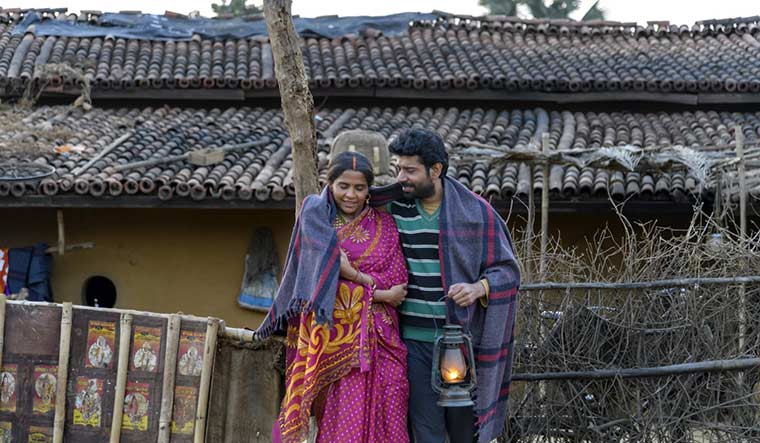
Economist-filmmaker Suman Ghosh first read about Aadhaar—the Union government’s project to issue a unique identification number to all residents in India—in 2011, much before controversies over privacy and data theft surfaced. “I found it very novel—a 12-digit number will signify whether you are Indian or not, apart from the benefits of it,” says Ghosh over a call from the US, where he is a professor of economics at Florida Atlantic University.
Now, taking the biometric ID card as a motif, Ghosh is exploring the intriguing canvas of India in his latest flick, Aadhaar. “There is an India, which is dominated by superstitions and beliefs, and then there is the digital India, the India Shining that everyone is pushing the country to be,” he says. “These inherent contradictions within the country, within the psyche of the people, fascinated me. Through Aadhaar, I wanted to explore and celebrate the vibrancy of the country.”
Premiering at the Busan International Film Festival, the film revolves around the experiences of a Jharkhand man, Pharsua (Vineet Kumar Singh), who tries to secure an Aadhaar card. When a group of government officials arrive in his village to promote Aadhaar, Pharsua becomes the first to have the card that everyone is reluctant to have. However, he realises that there are some serious consequences for having it. At Busan, the film will be featured in the category ‘A Window on Asian Cinema’ on October 6.
Ghosh points out that while scripting, his focus was not to dissect the pros and cons of Aadhaar. “My film is not an academic paper,” he says. But he is quick to add that the film subtly portrays everything pertaining to the issue—the controversies, the privacy of people being invaded and the harassment faced by them.
Ghosh’s first film, Podokkhep (2006) received two National Awards including Best Feature Film in Bengali. That motivated Ghosh to make more films in Bengali. Aadhaar is his first film in Hindi. “The transition [to Hindi] was not planned,” he says. Ghosh adds that his decision to choose Jharkhand as the backdrop to tell the story was also not deliberate. “Maybe I heard a story from Jharkhand, maybe I liked the type of Hindi that is prevalent in the state that is sweet and raw, but I cannot really pinpoint a particular reason for that,” he says.
After deciding on the subject, he had to find a producer who would understand his vision. Manish Mundra’s Drishyam Films, which produced critically-acclaimed films like Ankhon Dekhi (2013), Masaan (2015) and Newton (2017), soon came on board with the project. The casting for the film was done in early 2018. Singh’s performance in his 2017 film, Mukkabaaz, had made him an apt choice for the role of Pharsua. “We could sense his acting prowess,” says Ghosh. “We felt that he can internalise our lead character who is from a village in Jharkhand.”
Jharkhand helped Ghosh discover the Indian hinterland. Shooting in the state was not an easy choice though. There was a level of scepticism because the region is prone to Naxalite attacks. However, Mundra hails from Deoghar, in and around which the film was shot, and his familiarity with the area and its people came handy. But being unaware of the region, Ghosh went and stayed in Jharkhand four times before the final shoot, to acclimatise himself with the place. “Those experiences were incorporated in the script very organically,” he says.
Ghosh’s last film, The Argumentative Indian (2017)—a documentary on Nobel laureate Amartya Sen—got embroiled in a long battle with the Central Board of Film Certification. Considering Aadhaar takes up an issue much debated politically and legally, one wonders if it made him conscious at any given time. “Not really,” he says. “Aadhaar is not a political film at all. Aadhaar was a programme started by the UPA government, which was later taken up by the NDA government. There is no political division, as such, of who owns Aadhaar. And, I doubt that the film will ruffle the feathers of anyone concerned.”
He adds: “We are yet to apply for a censor certificate. But Amitosh Nagpal [co-writer] and I, even after knowing that certain parts can be sensitive, never held back in writing the dialogues for the film.”
