



On April 27, AAP leader Arvind Kejriwal wrote to Justice Swarna Kanta Sharma of the Delhi High Court, questioning the impartiality of the court and saying he and his lawyers would no longer appear before her bench in the liquor policy case. His confidant and former Delhi deputy chief minister Manish Sisodia followed suit. Both invoked Mahatma Gandhi and the idea of satyagraha—recurring themes in their political responses whenever confronted with crisis.
In his carefully worded letter, Kejriwal praised the judiciary as a key pillar of the republic, and also cited precedents of judges who had recused themselves when their children practised in the same court. He argued that the empanelment of Justice Sharma’s children as counsel for the Union government—an opposing party in the case—created a reasonable apprehension of bias that had not been addressed. Sharma had already rejected the recusal plea, observing that the allegations relied on insinuation rather than proof.

Such confrontations between political leaders and the judiciary are unusual. Kejriwal’s stance is defiant, and at times theatrical. But it also reflects the mounting pressure on him: he is fighting a criminal case, watching key party colleagues defect, and trying to hold together a party that seems to be unravelling—especially after a significant electoral setback in Delhi and ahead of a crucial contest in Punjab.
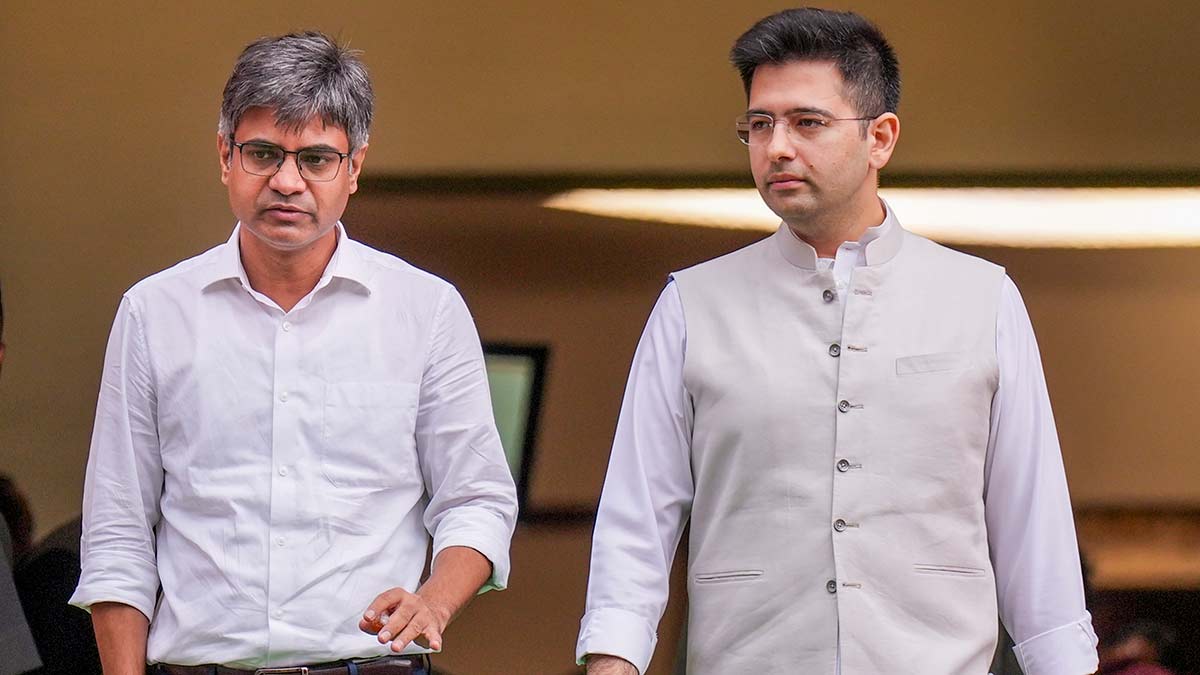
The day Kejriwal sent that letter, Rajya Sabha Chairman C.P. Radhakrishnan allowed the merger of seven of his party MPs into the BJP. The defectors were Raghav Chadha, Sandeep Pathak, Ashok Mittal, Harbhajan Singh, Swati Maliwal, Vikramjit Singh Sahney and Rajinder Gupta. The AAP’s strength in the house fell from ten to three, while the BJP’s rose to 113. In Punjab, six of seven Rajya Sabha seats are now held by the very party the Bhagwant Mann government will face in the next assembly polls.
The courtroom confrontation and defections together capture the current state of AAP—one of the youngest and most successful political formations in recent decades. Founded out of an anti-corruption movement, it positioned itself as a moral alternative to traditional parties. Today, it faces accusations—even from former insiders—of becoming structurally weak, personality-driven and transactional.
The exodus of its parliamentary party members was triggered by Chadha’s removal as deputy leader of the AAP in the Rajya Sabha, widely seen as a demotion. The party leadership felt he had grown so close to the ruling dispensation that he was stopping short of directly attacking the government. Chadha denied the charge, saying his focus was on raising people’s issues rather than creating disruption. He invoked a popular line from Durandhar: “Ghayal hoon, isliye ghatak hoon.” (“I am injured, therefore I am lethal”).
Within weeks, Chadha secured the backing of six MPs—enough to cross the threshold required under the anti-defection law embedded in the tenth schedule of the Constitution. While individual defections invite disqualification, an exception exists if two-thirds of a legislature party agree to merge with another party. Critics argue, however, that the first condition—a formal merger of political parties—has not been met. This is likely to become the central legal dispute when the AAP challenges Radhakrishnan’s decision in court.
Behind the numbers lies a deeper organisational breakdown. Insiders describe a party in which communication had broken down and senior leaders felt excluded. Pathak, in particular, was reportedly marginalised after the Delhi election loss. Kejriwal reportedly anticipated the split. He held individual meetings with some of the wavering MPs and, according to sources, urged them to resign rather than defect.
External pressures also played a role. Enforcement Directorate raids on Ashok Mittal, the chairman of Lovely Professional University, reportedly added to the unease within the party. Maliwal had already become a public critic of Kejriwal, and the Rajya Sabha nominations of Mittal, Singh, Gupta and Sahney had triggered resentment within the party. Many workers argued that the AAP had squandered the opportunity to send long-serving members, nominating instead businessmen with resources but limited political connect. Few within the AAP mourn the defection of these outsiders; the real wounds are the departure of Chadha and Pathak.
Chadha, who was central to the party’s national communication strategy, described his departure as an exit from a “toxic” environment. His absence from Delhi when Kejriwal was arrested in the liquor policy case was widely noticed within the party and reportedly accelerated his marginalisation.
Pathak’s departure has created a deeper anxiety within the AAP. Unlike Chadha, Pathak was never a television regular or a mass politician. He belonged to the technocratic class that gave the AAP its aura of competence. Having risen from a humble background to study at Cambridge, Oxford and the Massachusetts Institute of Technology, he symbolised the idealism that drew many middle-class Indians into the anti-corruption movement. As general secretary (organisation), he held one of the most powerful positions in the party and, along with Chadha, was regarded as a party strategist.
Leaders in Punjab say Pathak understood the state’s political machinery better than many local politicians. Both Chadha and Pathak were instrumental in selecting candidates who later became MLAs. The party is keeping a close watch on them amid fears that defections may continue.
The erosion in the AAP has been gradual. Early figures like Yogendra Yadav and Prashant Bhushan accused the leadership of abandoning internal democracy, while Kumar Vishwas distanced himself after falling out with Kejriwal. Former party leader Ashutosh argues that the current rupture is the inevitable outcome of how the party evolved internally. According to him, the party shifted from a movement-driven organisation to a transactional structure. “Whoever is useful becomes important. Whoever is no longer useful is pushed aside,” he said.
The AAP’s larger challenge is ensuring political survival in Punjab. The party’s Delhi unit chief Saurabh Bhardwaj said it had earlier survived the exit of prominent leaders. “This (the defections) will not affect the party, but the people of Punjab feel betrayed.”
Since the reorganisation of Punjab in 1966, only once has a ruling party retained power for consecutive terms. The AAP hopes to break that pattern by replicating its Delhi model of governance, particularly in health care and education.
But structural challenges persist. The anti-sacrilege law in Punjab, focused on preventing desecration of the Guru Granth Sahib, has raised legal concerns for its narrow scope and potentially intrusive provisions. The law, in principle, responds to genuine Sikh grievances. Chandigarh-based analyst Pramod Kumar noted that even though there were incidents of other holy books being damaged, the legislation addressed only one. “The law’s provisions are extremely strong and may even interfere in personal relationships people may have with holy books,” he said.
Then there is Amritpal Singh, the self-styled preacher and Lok Sabha member who is currently imprisoned. The Punjab government does not want him released, fearing that his return would cause law and order issues. But his political presence remains polarising and could reshape electoral dynamics.
As the AAP in Punjab labels the defectors “traitors”, Kumar argues that the exodus of party MPs weakens the party’s internal stability and legitimacy in the eyes of voters. Meanwhile, the BJP is expanding its footprint in the state, leveraging the influence of defectors and positioning itself as a dominant force. The party has announced its intention to contest the Punjab assembly polls in 2027 independently. Observers believe Chadha could eventually be accommodated in the Union government, a move that would provide him with greater political visibility in the state. Even if a tactical understanding with its former ally Shiromani Alkali Dal materialises in the run-up to the polls, the era in which the BJP functioned as the junior partner in Punjab politics appears to be over.
For the AAP’s original supporters, many of whom were drawn by the promise of fundamental reforms in politics, the pressing question is whether the party still represents the alternative it once claimed to be. Ashutosh offered a cautious assessment. “Never underestimate Kejriwal, and never write the obituary of any politician too early,” he said.
He pointed out that the AAP still had a government in Punjab, held around 10 per cent of votes in Gujarat, and remained active in Delhi and Goa. But he also added a warning: “Everything now depends on the 2027 Punjab polls. If the AAP loses the state, the party would face a real existential crisis.”
