


In September 2023, when the government called a special session in the new Parliament building, speculation ran wild. Was India being renamed Bharat? Was a Uniform Civil Code coming? Simultaneous elections? It was a month after the monsoon session had ended, and the government was giving nothing away.
When the veil finally lifted, it was women’s reservation. The Nari Shakti Vandan Adhiniyam—mandating 33 per cent reservation for women in Parliament and assemblies—was passed with overwhelming support.
However, there was a catch. The implementation was tied to a fresh census and a delimitation exercise that would follow.
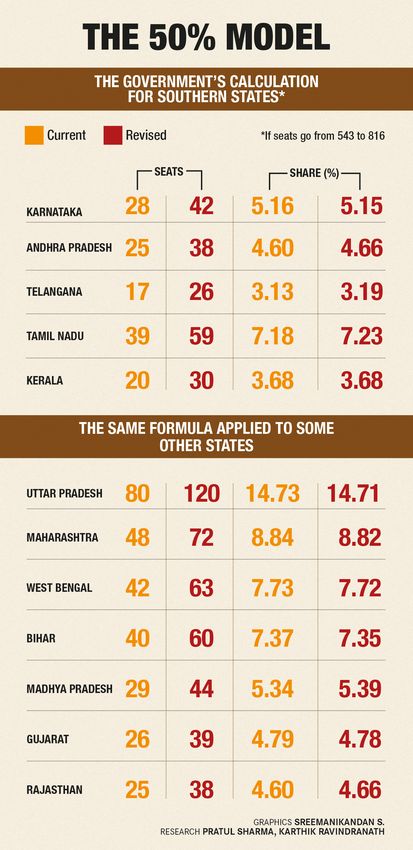
Three years later, it was déjà vu. The government called a three-day special session less than two weeks after the budget session, and presented three new bills. This time, there was no secrecy—it was the same cause. However, the plan was to use 2011 census data instead of waiting for the completion of the ongoing census, and to expand the Lok Sabha from 543 to 850 seats after delimitation. Under the proposed formula, the government had offered to increase the number of seats in all states and Union territories by 50 per cent, bypassing the existing population-based formula. This would keep the overall share of each state the same, thus preserving their political heft.
However, when the constitutional amendment bill was put to vote in the Lok Sabha, it failed to get the two-thirds majority needed to pass. The government fell 54 votes short. This was its first defeat in its twelve years in power.
The following day, Prime Minister Narendra Modi was on television, “apologising” to the women of India while accusing the opposition of betrayal.
The opposition, including the Congress, the Trinamool Congress and the DMK, hit back, extending their “assault on federalism” argument and bringing up delimitation in their speeches in Tamil Nadu and West Bengal. Both sides had secured campaign points.
But, between the two sessions, what had been achieved?
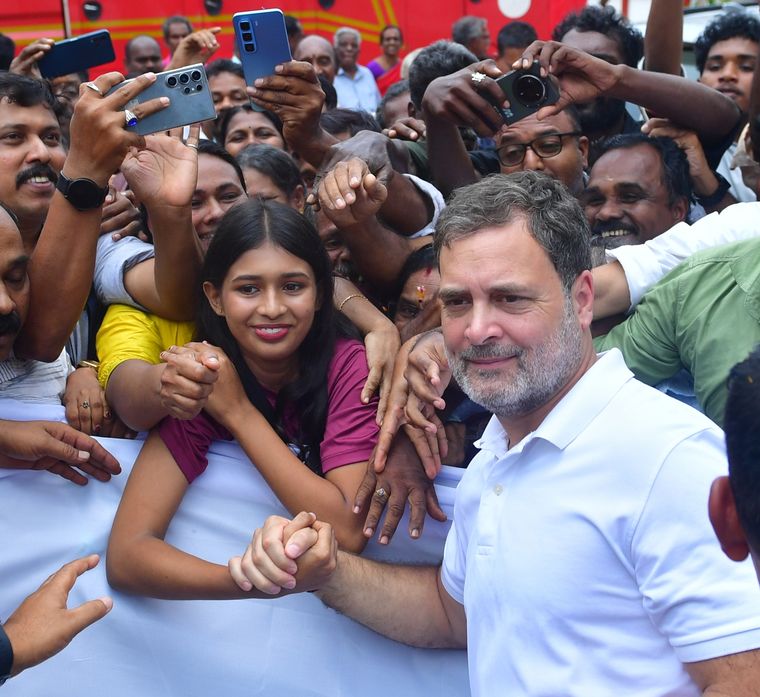 Helping hand: Rahul Gandhi during a Women’s Day event in Kerala on March 8.
Unlike in 2023, when there was overwhelming support for reservation, the narrative this time veered towards delimitation. The Congress leadership asked the government to delink delimitation from women’s reservation and implement it within the current 543 seats. But, going by the government’s assertions, it seems intent on proceeding with delimitation—it argues that, as the exercise has been frozen for 50 years, constituency sizes had increased, which makes rationalisation necessary. Both arguments hold, but serve their own political purpose.
“Since 2023, people were looking forward to it. Women’s reservation had already been passed, but there were bottlenecks that had to be removed,” said BJP spokesperson Gopal Krishna Agarwal. “Second, the overall number of seats should not be reduced to account for seats for women. Hence, the government decided to increase the overall total. Third, the PM wanted to advance it to 2029. That was the only intention. We had thought the opposition would support the women’s reservation bill, but they didn’t.”
The BJP argues that women have been waiting for reservation, particularly in the southern and eastern states, where they decide polling patterns. “The issue will have resonance in the West Bengal polls, but women also know what the Modi government has done for them over so many years, starting from Jan Dhan accounts, Ujjwala Yojana, Beti Bachao and Beti Padhao,” he added. “This will work alongside the main issues of illegal migrants and law and order. In Tamil Nadu, women make independent decisions. They also want reservation.”
The opposition was not convinced. The Congress launched a parallel nationwide campaign centred on its women workers and held news conferences blaming the BJP. “The Congress had requested an all-party meeting to discuss the delimitation proposal, but the government did not share any details before the session. We were not aware of their intentions,” said Alka Lamba, the Congress women’s cell president. “Even Sonia Gandhi maintained that the focus of discussion should have been on delimitation and the implementation of women’s reservation, as the legislation had already been passed.”
The timing of these bills—just ahead of polling in Tamil Nadu and West Bengal—was crucial. Assam and Kerala had already voted, but the BJP is confident of retaining the former and is a bit player in the latter. In Tamil Nadu, though, the delimitation issue is a powder keg; Chief Minister M.K. Stalin burned a copy of the bill. As for Bengal, the BJP could have—had the bill passed—claimed to have moved the needle for women voters who have powered Mamata Banerjee to three consecutive victories. As the margins are narrow in the eastern state, every vote counts.
So, whether the bill passed or not, the BJP had an effective campaign tool, said sources.
But beyond the ongoing elections, the real issue is that delimitation does not have an easy resolution. The opposition fears that delimitation based on 2011 data would lead to constituency boundaries being redrawn in a manner that doesn’t reflect the India of 2026—especially with the complex equations a caste census would throw up. Rahul Gandhi had already alleged that the BJP government had altered boundaries in Assam and Jammu and Kashmir to its advantage.
But as the BJP sees it, the formula for delimitation ticks all the right boxes. By creating 307 new seats (from 543 to 850), the government could reserve about 280 for women (one-third) without any sitting male member losing his constituency. This could prevent any revolt or the chance of male parliamentarians fielding their female relatives to retain influence.
More important, the BJP feels that its proposal—50 per cent increase in the number of seats for each state—would end any debate on the southern states being politically weakened. “The narrative created by the opposition about a north-south divide, claiming delimitation would reduce their share, has been addressed by the proportionate increase of 50 per cent across all states. So that argument will no longer hold,” said Agarwal. “The other argument about a caste census, raised by [Samajwadi Party president] Akhilesh Yadav, has no relation to women’s reservation.”
The Congress says that it would continue to campaign for early implementation of the women’s quota, but also insists on opposing the use of 2011 census data. “Delimitation should be carried out only after a fresh census, including a caste census, is conducted in 2027,” said Lamba.
THE WAY FORWARD
The defeat of the bills is open to varied interpretation, depending on which side of the ideological divide one stands. “It’s not a setback,” said Agarwal. “It’s just that the timeline is not being advanced. Otherwise, the constitutional amendment has already been done.”
The issue will return during the monsoon session, and the government will be under pressure to clarify its stance so that the timeline is clear.
As things stand, if no new formula emerges to include reservation for the 2029 elections, the existing timeline stays. The census is an ongoing exercise, and after the delimitation that follows, women’s reservation would only be implemented in 2034, at the earliest.
Will the country, especially the women who have campaigned for it since 1996, wait another eight years?
Women’s reservation was a rare cause that brought together women MPs across party lines. “Women make up nearly half the population, yet their presence in Parliament remains low,” said women’s activist Ranjana Kumari. “How long can this delay be justified? There will be petitions, public meetings and direct conversations with lawmakers. We will make sure this does not disappear from public debate.”
While the current discourse is focused on women’s reservation and delimitation, this parliamentary session has given a sense of what could happen when the government pushes for another polarising issue requiring constitutional amendment: simultaneous polls. The opposition has tasted blood.