


KOLKATA
On a humid afternoon in Kolkata’s Entally, Shamim Akhtar sits at a wooden table, documents spread out before him with almost ritualistic care. Aadhaar card, passport, electricity bills, old voter slips—each one a marker of continuity, of belonging, of a life lived within the system. For over two decades, he has voted in every election. This year, his name is gone. His wife’s name remains. “No one is telling us why,” he said. “If I was a voter last year, how am I not a voter this year? How can my wife be recorded as my wife if my own name does not exist there?”
That question, simple, almost naive in phrasing, is today one of the most politically charged in West Bengal. What is unfolding under the special intensive revision (SIR) of electoral rolls is no longer just an administrative clean-up. It is a moment of deep political, constitutional and social consequence—not merely about correcting errors, but about patterns of exclusion, and whether minorities, migrants and women are disproportionately bearing the cost of being written out of the electorate.
At first glance, the numbers suggest efficiency. Of more than 60 lakh cases flagged for adjudication, over 99.6 per cent have been resolved. But beneath this lies a stark reality: nearly 27 lakh voters—around 45 per cent of adjudicated cases—have been declared invalid. In a state with just over 7 crore voters, this is not marginal correction. It is structural transformation.
Supreme Court lawyer Gaurav Ghosh, a voter since 2009, found his name struck off the final list. “It’s not just about a missing name on a list, it feels like being quietly erased,” he said. “I never had an issue for years and then suddenly I am told I don’t exist on the rolls. No explanation, no real hearing, just silence. The system almost seems to work as ‘delete first, explain later’.” If this can happen to someone with documents and a voting history, he asked, what about those more vulnerable?
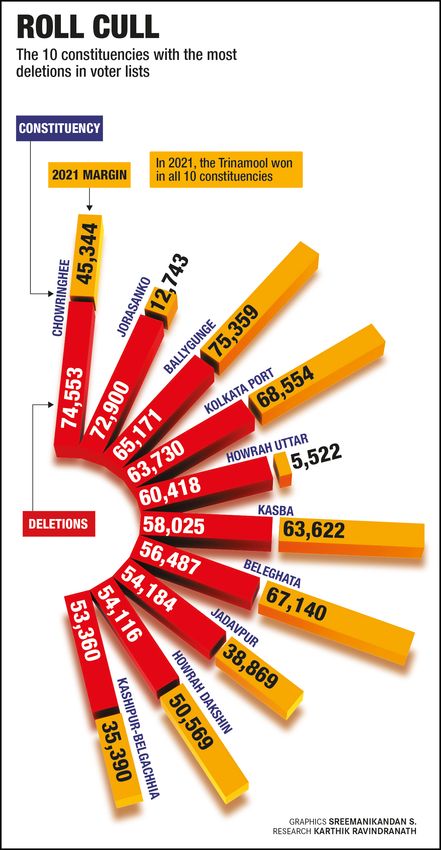
As West Bengal’s electoral contest tightens, small shifts could have big consequences. In 2021, the Trinamool Congress led the BJP by more than 60 lakh votes. This fell to around 42 lakh By 2024. Even in 2021, seven constituencies had victory margins of under 1,000 votes; another 36 saw margins below 5,000—the BJP won more of these sub-5,000 margin seats than the Trinamool. This is where roll revisions can come into play. If certain groups are disproportionately affected the balance in seats with narrow margins could shift. Parts of the Trinamool’s support base—minorities, economically weaker sections—are more vulnerable to exclusion during large-scale verification.

Data from Trinamool-held Manikchak, Mothabari and Samserganj reveals a pattern. In Manikchak, where Hindu and Muslim voters are almost equal, around 97.4 per cent of those under adjudication are Muslim. In Mothabari and Samserganj, where Muslims are in a clear majority, this rises to nearly 98 per cent. In Samserganj, more than 55 per cent of all Muslim voters have been flagged; adjudication rates are 38.7 per cent in Mothabari and 25.7 per cent in Manikchak.
By comparison, in BJP-held Baharampur, where Muslims are 27 per cent, they form around 61 per cent of those flagged. But the total adjudication rate is just 4.7 per cent. In all three Trinamool seats, the number under adjudication exceeds the 2021 winning margin. In Baharampur, the flagged number is well below it. While this alone proves nothing, it shows that the scale of adjudication could matter in close contests.
Moreover, the emergence of smaller parties and figures like Humayun Kabir could divide the Trinamool’s vote further.
The geography of deletion is also revealing. Murshidabad—a border district with a complex migration history and significant minority population—has over 4.5 lakh invalid voters and the highest volume of complaints. North 24 Parganas and South 24 Parganas record 3.25 lakh and 2.22 lakh, respectively. Purba Bardhaman has 2 lakh-plus removed. In Nadia, nearly 78 per cent of adjudicated cases have been rejected—the highest proportional purge in the state. In Cooch Behar, invalidation rates exceed 45 per cent. These clusters overlap with regions marked by demographic complexity, minority populations, migrant communities and economically vulnerable groups.
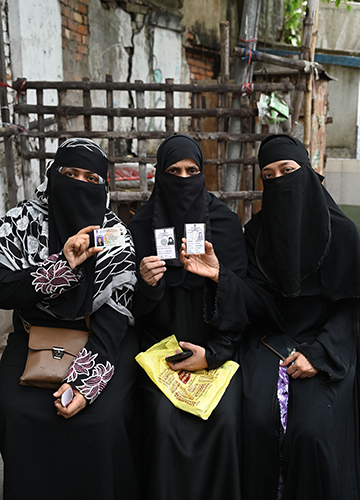 Identity crisis: (From left) Tabassum Naz’s parents are on the electoral roll, but she is not; Nooraisa Khatoon said she had all the documents, but her name was deleted; Rukhsar Naaz—three of her nine family members were deleted | Salil Bera
Sabir Ahamed from Sabar Institute, who has been studying the data, said what they have found cannot be dismissed as random. “In many areas with a high concentration of minority voters, there were unusually large numbers of deletions—entire pockets affected,” he told THE WEEK. “More troubling is how quietly it’s happening. People only realise their names are missing when they go to check, or when it’s too late.” He added that many of the affected had been voting for years, but were suddenly asked to prove their identity and citizenship, often with documents they may not have easily. “For many, especially the poor or migrants, it becomes difficult,” he said.
On the ground, the process has created its own confusion. Many voters were told to go to the sub-divisional officer to file appeals, only to find the process had shifted to colleges. For those unused to paperwork or long-distance travel, this meant repeated trips, long queues and uncertainty about whether appeals have been accepted.
In Entally, Akhtar’s story echoes across lanes and neighbourhoods. Names flagged, documents submitted, hearings attended—and then, without clear explanation, names disappeared. “You are not rejected,” said Akhtar. “You are just removed.”
In Moti Jheel, Sultana Begum counts seven missing in her household—individuals with documentation, voting history and roots in the locality. Families have been split in ways that defy logic: husbands deleted while wives remain, parents retained while children are removed, siblings divided by an invisible administrative line. “If there is a mistake, why only some names?” asked Sultana.
In Maniktala, the Poddar family—small business owners who have voted for decades—said they complied with every requirement, but still found their names gone. For working-class families, compliance is not free. It involves lost wages, repeated travel and time away from work. The poor cannot afford to go again and again and if they miss one date, their name is gone.

In Kolkata’s mixed neighbourhoods, migrant communities—particularly those who moved decades ago from Bihar and Uttar Pradesh—describe a similar unease. The Sahoo family, settled in the city for generations, said multiple members were deleted despite documentation and hearings. Their experience reflects a broader anxiety: that long-settled migrants are being treated as administratively provisional.
Women emerge as another vulnerable group. Married women face documentation mismatches because of name or address changes; many lack independent identity documents. When verification standards tighten, these gaps become decisive—a quiet but significant form of disenfranchisement.
Individual testimonies compound this picture. Wasim Islam said four family members were placed under adjudication and then deleted. Shahin Alam, voting since 1977 and a retired jute mill worker on pension, said his daughter and son-in-law’s names were removed despite submitting documents. Faijal Mahmood’s wife is on the list, while he is not. Mohd Rafiq is in the same situation. Rukhsar Naaz said three of nine family members have been deleted. Tabassum Naz said her parents’ names are there but her’s is gone. Gulshan Ara, born in 1994, has voted in every election since turning 18. Now her name is missing.
Mahmood, 50, holds up documents that once seemed sufficient. “We get ration, everything is linked,” he said. “If my name is gone, does that mean my citizenship is gone?” Mohd Shahid’s name is missing despite voting multiple times and submitting records dating back to 2002; his brother, sister, and father have also been removed. Said Nooraisa Khatoon: “I had all the documents. Still, my name is deleted. We have done everything. We are hoping it will be corrected.” Talat Jahan’s name appeared in the 2002 voter list; she has voted regularly since. It has now been removed.
Several residents said they are unclear about where to go next—where tribunals will sit, how appeals will be heard. Some said the deadline passed before they understood the change. “The BLO is not answering calls,” said Rafiq. “Voting is our right. Why would we not want to vote?”
As evening falls, Akhtar gathers his documents and places them back into a plastic folder. He will go again—to the tribunal, to the office, wherever he must prove what he already knows. “We are not asking for anything else,” he said. “We just want to vote.” He pauses, before adding: “Voting means you belong.”
The BJP’s West Bengal president Samik Bhattacharya told THE WEEK that the SIR was essential to ensure the integrity and accuracy of electoral rolls. “For too long, issues like duplicate entries, illegal inclusions and outdated records have weakened the credibility of our voting system,” he said. Trinamool spokesperson and Lok Sabha MP Kirti Azad countered: “The way SIR is being carried out raises serious concerns about fairness and intent. A routine administrative exercise is turning into a tool that risks excluding genuine voters, particularly from marginalised communities. We are seeing confusion over documentation, lack of clarity in the process, and instances of long-time voters suddenly finding their names missing.”
Union minister Bhupender Yadav, the BJP’s West Bengal election in-charge, said that electoral rolls cannot remain static. “Genuine voters have the opportunity to verify their details and ensure they are not left out,” he said. “A clean and updated voter list makes the process more transparent and strengthens confidence in elections.”
Beyond statistics lies something more intangible: fear. The voter ID card is the most widely accepted proof of identity—used for ration cards, bank accounts, mobile connections and government benefits. Its disappearance creates a ripple effect of uncertainty. Even if legally unrelated, these systems are intertwined in lived experience. The Election Commission maintains that those declared invalid can appeal before tribunals and seek reinstatement. But awareness is limited, deadlines are tight, and access is uneven.
The judiciary’s role has added another layer. Constitutional scholar Gautam Bhatia has argued that the Supreme Court appears to be stepping into an administrative role rather than confining itself to constitutional adjudication—a concern that intensified when the Court asked the Calcutta High Court to oversee aspects of the process. The blurring of this boundary has sparked debate about institutional limits and the proper scope of judicial intervention in electoral matters.
Former chief election commissioner S.Y. Quraishi told THE WEEK that he finds it difficult to understand how electoral rolls that were good enough to conduct elections just recently are now being treated as questionable. “These are lists on which people voted, governments were formed, and results were accepted by all. So what exactly has changed in such a short time?” he asked.
He added that his concern was not just about the technical process, but the message it sends. “Elections are not only about counting votes—they are about ensuring eligible citizens are able to vote without fear or confusion,” he said. “If people feel that their names can be removed or challenged without clear reason, it creates doubt. Once the trust in the credibility of the system is shaken, it becomes difficult to restore. That is why such exercises must be handled with extreme care, transparency and fairness.”
A comparison with Bihar is instructive. Similar revision work there did not generate this level of noise or confusion. The process stayed largely routine, with no large-scale complaints of people being suddenly left out.
West Bengal is different. Politics here is more tense, and questions of identity and migration already sensitive. And what the state is witnessing is not merely a revision of electoral rolls. It is a test of recognition. For the Election Commission, it is about accuracy. For political parties, it is about advantage. For the courts, constitutional balance. But for millions of citizens, it is more fundamental—whether they are seen and counted, and whether they belong.
In the weeks ahead, some names will return to the rolls. Appeals will be heard, errors corrected, bureaucratic gaps filled. But the deeper shift may not be so easily reversed. This process has revealed administrative fragility and democratic vulnerability—how easily the line between inclusion and exclusion can blur, and how quickly trust erodes when that line is not clearly drawn.