



HOW INDIA IS affected by the Iran war and the spreading conflict in the Middle East comes down to a glass of water. Or rather, what you think of it. Is it half full? Or is it half empty? In this case, it also depends on how long that glass of water is going to stay like this.
For many, the glass is emptying fast. “I had to wait for over an hour and pay extra to the attendant to fill petrol,” said Rajeshwar Sharma, who hails from a village in western Uttar Pradesh. Many in cities have been reporting difficulty in procuring LPG gas cylinders, though the government says restrictions apply only to commercial usage. Long queues and frantic scenes have been reported at petrol bunks in many states, while social media posts about India’s oil reserves drying up within days have sent people into panic mode.
Petroleum Minister Hardeep Singh Puri, however, tried to assure that the glass is full: “The energy requirements of our citizens are being fully met. India is in a comfortable position. There is no room for anxiety or speculation in this regard,” he told the media. “India is navigating the trilemma of energy availability, affordability and sustainability even in the face of the current geopolitical challenges.”
Beyond these three worries, however, India could take multiple hits across the board if the war prolongs. “From agriculture and manufacturing to aviation and trade, the effects of the war may soon be felt far beyond the battlefield—reaching markets, industries, and households across India,” said Jigar Trivedi, senior research analyst (currencies & commodities), IndusInd Securities.
But first, the good news.
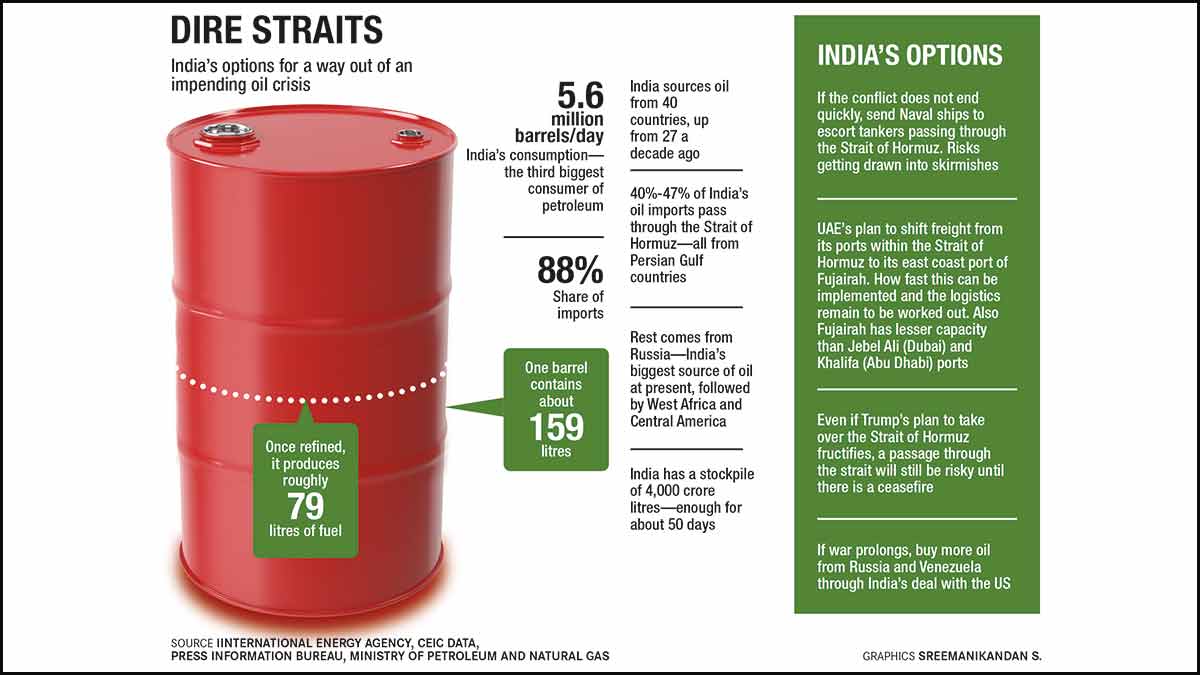
Despite many moves like squeezing out more domestic oil and gas, looking for alternative energy sources and blending ethanol in petrol, about 88 per cent of India’s fuel needs are met with imports. Half of this pass through the Strait of Hormuz, a narrow strip of water between the Arabian peninsula and mainland Iran. Iran has used it to block ship movements to step up pressure on the US.
“India thankfully has alternate channels for supply chains, including for energy needs; it will ensure the Indian economy will not have a crippling effect,” said Garry Singh, president of IIRIS Consulting, a Gurugram-based risk advisory.
With the US ‘allowing’ India to continue buying oil from Russia for 30 days, supplies are expected to be stable for the time being—Russian oil comes from its western ports like Primorsk and traverses the Suez Canal to India’s Arabian seacoast ports, bypassing the Strait of Hormuz.
Another saving grace is the imperative on the US to ensure there is no global shockwave because of Iran’s energy-squeezing tactics. And with a deal already in place to buy more oil from America, the import of Venezuelan oil into India is also expected to rise rapidly. Reliance Industries has already purchased fresh shipments of crude oil from the South American nation under the new arrangement, with bigger tankers being arranged to reduce the cost of the long transportation.
With too much focus on fuel availability and inflation, many are missing the part where the glass worryingly appears ‘half empty’, when you consider industries ranging from chemicals to fertilisers as well as sectors like aviation, electronics and IT. This is where the bad news starts.
The Middle East is not just an oil exporter to India—about a fifth of India’s exports go to this region. India’s trade with the UAE alone is more than $100 billion. “The Middle East is a critical market for Indian exporters, particularly in engineering goods, energy-related equipment, and infrastructure supplies. Any geopolitical escalation in the region creates uncertainty, which can temporarily slow down project investments and procurement decisions,” said Sarvadnya Kulkarni, CEO & founder, General Instruments Consortium.
India has a flourishing trade with the Gulf states right from spices, agricultural produce and food products to electronics and IT Services. While goods trade is already at a standstill, any long-term impact to these countries’ economies could translate to services contracts drying up. “If the conflict prolongs, exporters could face a combination of higher logistics costs, insurance premiums and potential delays in project execution across the region,” said Kulkarni.
The significance of Dubai as an aviation and air cargo hub has accentuated the pain in sectors ranging from air travel to the gems and jewellery sector, which uses Dubai for transit. “This has disrupted global logistics corridors linking Asia, the Middle East and Europe,” said Jitendra Srivastava, CEO, Triton Logistics & Maritime. “Dubai and Abu Dhabi act as critical transit gateways for Indian exports moving to Europe, Africa and North America. When those hubs slow down, cargo quickly piles up at origin points, which is already visible in India.”
Middle East carriers like Emirates, Etihad and Qatar Airways ferry more passengers from India to foreign destinations than Indian carriers. Their disruptions, along with the closure of airspace across much of West Asia, has not only seen airfares shoot up, but left international travel from India in limbo.
“Aviation is a high fixed investment business and because of that the interest costs keep on building up. If your operating profits get very low, then business becomes less viable,” said Vikas Prakash Singh, PGPM director, Great Lakes Institute of Management, Gurugram. “But India is one of the largest players, so financiers may be ready to renegotiate the contracts.”
That adjustment will be crucial, if fuel prices keep going up. “Higher jet fuel prices are already emerging as another pressure point for airlines,” said Srivastava. It is a bogeyman that had nipped a few Indian airlines in the bud in the past.
The crucial question is, how longer and deeper an impact do we have to brace ourselves for.
Many believe that inflation is not much of a worry. “India’s inflation is already very low. So there is a lot of room for us to remain comfortable, even if the inflation doubles,” said Singh of Great Lakes. “Moreover, there could be a little more interest rate cuts in order to reduce the pressure on costs.”
But one worry remains. Foreign portfolio investors pulled out more than Rs20,000 crore from Indian markets in just the four days after the war broke out. A bigger worry is the tanking rupee—will it finally hit the dreaded 100 mark against the dollar?
Remittances could also be hit, and this has larger ramifications for India’s GDP growth. Nearly 40 per cent of this comes from the Gulf and any significant drop could be damaging. Also, large scale loss of jobs and Indians coming back unemployed from the Middle East would not only be a heavy burden on India, but starkly slow down consumption that is central to its economic growth.
