



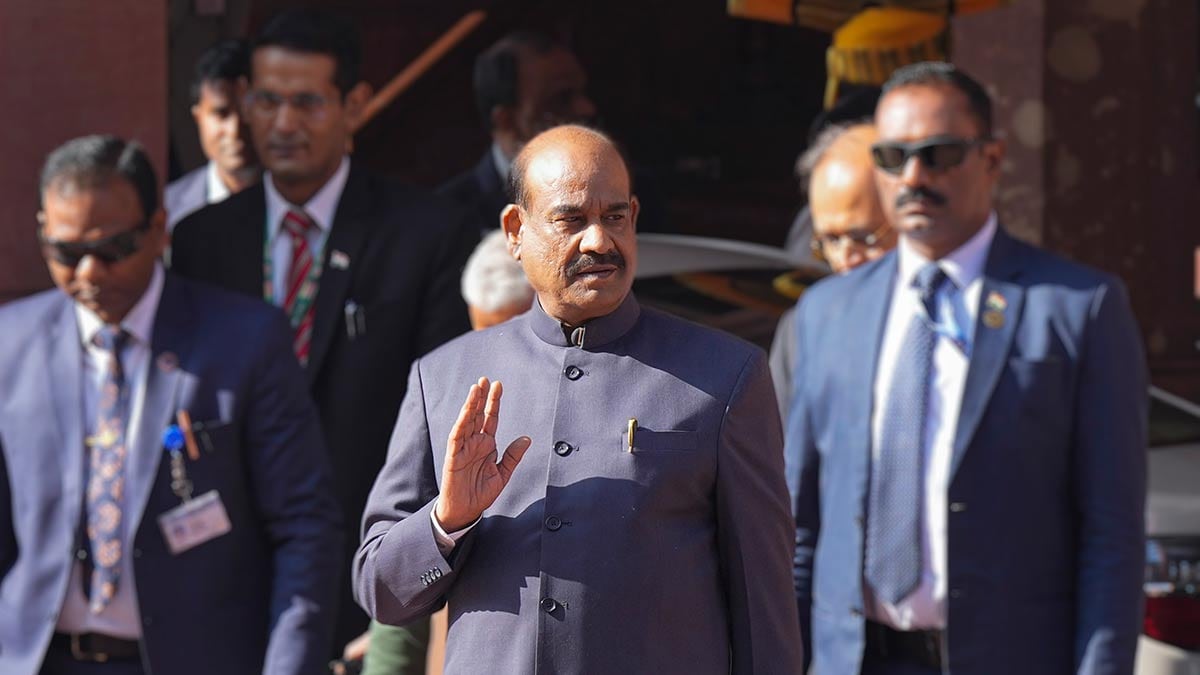
THE SPEAKER’S CHAIR sits above everything else in the Lok Sabha, with a commanding view of the house. So when that chair is challenged, the stakes are of a different dimension altogether.
The no-confidence motion against Speaker Om Birla is only the second one taken up for debate and vote—the first being against the first Speaker G.V. Mavalankar. That it comes less than 14 months after a similar motion against then Rajya Sabha chairman Jagdeep Dhankhar tells its own story.
“The relationship between government and opposition appears irretrievably broken,” said P.D.T. Achary, former secretary-general of the Lok Sabha.
The opposition motion against Birla listed four instances of alleged partisan conduct: Leader of the Opposition Rahul Gandhi was not allowed to complete his speech (questioning the handling of the 2020 Galwan clash); eight opposition MPs were suspended; BJP MP Nishikant Dubey was allowed to make personal remarks; the speaker said he had credible information that the prime minister faced threat from opposition members.
The motion had technical flaws (wrong dates) and could have been rejected, but Birla took the moral high ground, directing the secretariat to seek a corrected motion and put it to vote. He will not attend proceedings until the issue is settled on March 9.
With numbers stacked in the government’s favour, the motion could be set for defeat. But it is an extreme step adopted by the opposition to get “heard”.
“What option did we have?” asked Congress Lok Sabha member and whip Mohammad Jawed. “Look at the debate telecast. It mostly shows the treasury benches. Whoever wants to can say anything and it is allowed. But, the leader and MPs of the opposition are not allowed to speak.”
The ruling party rubbished the opposition’s claim. “Whoever does not agree with me, we will oppose them, whether it is the speaker, the court, the Army, the media,” said former law minister and senior BJP MP Ravi Shankar Prasad, referring to Gandhi and the opposition’s attitude.
Jawed said that historically there has always been a deputy speaker, but that position remains vacant. “There is no dialogue,” he said. “Parliament has effectively become like ‘Mann ki Baat’, the prime minister speaks without listening.”
Prasad countered that the opposition, particularly Gandhi, did not respect democratic process or propriety, constitutional dignity or parliamentary rules.
The debate that took place following the no-confidence motion against Mavalankar in 1954 offers insight into the gravity of the situation. Prime minister Jawaharlal Nehru had argued: “A motion of this character is an extraordinary procedure, which could only be justified under extremely grave circumstances.”
Achary said that traditionally, parliamentary affairs ministers served as the bridge—maintaining dialogue, negotiating, sometimes even meeting opposition demands and reporting to the prime minister. “Kotha Raghuramaiah [was] a model parliamentary affairs minister (two terms under Indira Gandhi),” he said. “He was always moving, often sitting on opposition benches, soft-spoken, creating a feeling of togetherness.”
Parliamentary Affairs Minister Kiren Rijiju argued that while it was easy to engage with opposition parties like the Samajwadi Party, the Trinamool Congress and the DMK through dialogue, “it is the Congress which disrupts Parliament by throwing papers and displaying banners”.
“The real problem is Rahul Gandhi and those around him,” he said. “When Rahul Gandhi insists the house should not function, smaller opposition MPs suffer because their speaking time is lost. The government must still pass essential bills in the national interest, but the loss is to smaller opposition parties who cannot raise constituency issues.”
The motion serves a political purpose—sending a message that the Congress will continue opposing the BJP government. With a significant presence of non-NDA MPs in the Lok Sabha, the voting could also accentuate fissures within the opposition ahead of assembly polls in five states.
Birla, a three-term BJP MP from Kota, Rajasthan, became speaker in 2019 and was re-elected in 2024—the first since Balram Jakhar was elected for a consecutive term (1980-89). Credited with several positive initiatives, Birla has been a disciplinarian with a focus on restoring order in the house. The criticism of him is that he is lenient towards the treasury benches, while the opposition receives stricter treatment, like expulsions and expunged remarks.
Achary said large majorities make governments immune to the voices of the people. “We saw that during the Indira Gandhi years,” he said. “Even then, informal dialogue survived. But now it is harsher, as opposition leaders are being termed anti-nationals by ministers.”
The Lok Sabha has seen diverse speakers. Rabi Ray opened proceedings to broadcast, exposing Parliament to the country’s gaze. In 1996, an opposition MP became speaker for the first time—P.A. Sangma, a five-time tribal MP from Meghalaya, who brought humour, informality and command of parliamentary rules. He held the balance, as a Lok Sabha publication recorded, not just between treasury and opposition benches, but between individual members.
Somnath Chatterjee made firm decisions to uphold discipline. The CPI(M) veteran, regarded as one of Parliament’s finest debaters, had his authority rarely challenged—until fellow communist Varkala Radhakrishnan tested the limits. When the MP spoke beyond his allotted time, Chatterjee rebuked him: “Varkala ji, you had been a good speaker, but you are a bad member.” The reply was immediate: “Sir, it is the opposite in your case—you had been a good member, but a bad speaker.”
In 2008, when the left parties withdrew support for the UPA government, Chatterjee refused to step down, saying his role as speaker was above party politics.
The speaker’s authority, Achary said, does not flow from the numbers on the treasury benches. “Freedom of speech in the house is sacrosanct; Parliament’s existence rests on frank and fearless debate,” he said. “Article 105 guarantees this freedom. It is the presiding officer’s duty to ensure members can speak fully and without unnecessary fetters.”
