



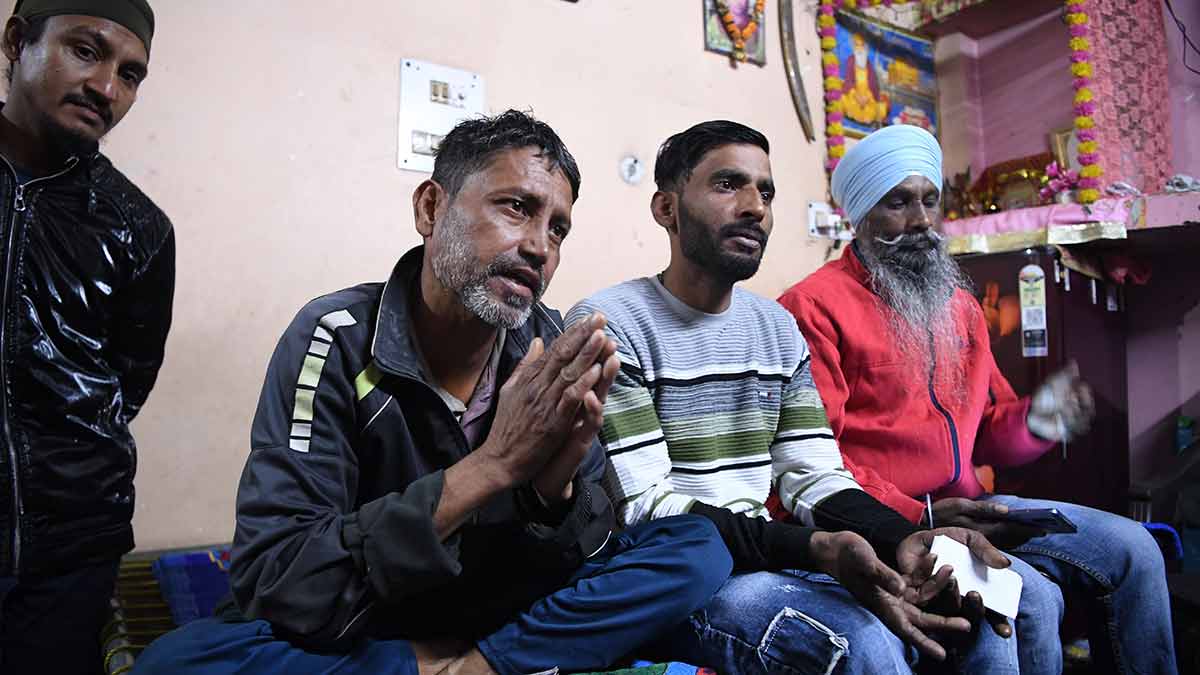
IN KALYAN PURI in east Delhi, just a few kilometres from the affluent Noida, a quiet crisis is unfolding. In these dense slums and skeletal structures, women sit in hopeless silence while their men move desperately from one contractor to another, searching for a day’s work.
This is the human cost of the pollution lockdown. Since early November, when the Commission for Air Quality Management (CAQM) implemented the Graded Response Action Plan (GRAP), a majority of Delhi’s construction labourers—both skilled and unskilled—have been out of work.
Every morning, Sanjay Turah, 40, walks to the local ‘labour chowk’, waiting hours for a contractor who never arrives. A migrant from Bihar, he lives in a single room with his wife and four children. “It has been more than a month since GRAP was implemented, and we have been out of work,” Turah said. “We have no food, yet we are expected to pay Rs3,000 as rent. They say it doesn’t matter if you don’t eat, but the rent must be paid. So we don’t eat.”
Though GRAP measures are annual, this winter presents a grim shift. Despite all three tiers of government now being under BJP rule, there appears to be no effective plan to address pollution at its source—vehicular emissions—rather than penalising the construction sector.
The Rs10,000 compensation promised by Labour Minister Kapil Mishra is failing to reach those in need, as it is largely restricted to locals. Of the estimated 12 lakh labourers in Delhi, more than 80 per cent are non-residents.
Then there are other systemic hurdles. If a labourer works at a site in Noida (in Uttar Pradesh) or Gurgaon (in Haryana), the labour department’s online portal often refuses registration unless a Delhi-based site address is provided.
Delhi BJP chief spokesperson Abhay Verma said it was a process and all those registered with the Delhi government as labourers would receive the money. However, those facing technical issues with registration or those who are not yet registered will not get it, he said.
“The problem deepens with the requirement to provide contractor details. Contractors often refuse to share their name or phone number,” said Silvain Singh, a graduate working in rebar fixing. “If an officer calls for verification and the contractor doesn't respond, the registration is rejected.”
Unsurprisingly, the bureaucratic vacuum has invited corruption. Workers report being coerced by middlemen into paying between Rs1,000 and Rs2,000 for a registration process that officially costs Rs25. Parvinder Singh, a migrant labourer, said private shops charged Rs1,500 for renewals that take months to process. “We don’t know what is happening with our life. Unless there is a solution, we won’t have any money,” he said.
For some, the situation is even more dire. Chote Lal, 35, a migrant from Maharashtra, hasn't had a proper meal in three days. “I don’t have a labour card because I am not a resident of Delhi. For the past 15 days, I have been sleeping under a metro bridge,” he said.
For Delhi’s construction workers, the question is no longer when the air will clear, but how long they can survive the wait.
