


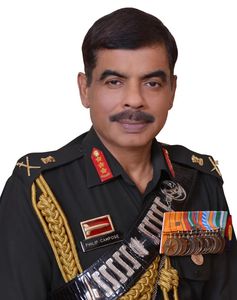
 Lieutenant General Philip Campose (retd)
As a veteran who served as an officer in the Indian military for over 40 years, I find the recent case of Lieutenant Samuel Kamalesan, a Christian junior officer of the Protestant denomination, whose dismissal from the Indian Army was affirmed recently by the Supreme Court, somewhat perturbing, yet instructive. He was dismissed from service after being deemed a ‘misfit’ for refusing to enter a ‘regimental gurudwara’ along with his Sikh subordinates, in keeping with an important Army tradition of officers periodically attending prayers with their men. This episode forces us to examine the delicate balance between individual faith and collective duty in the Indian Army, an institution that consists of men and women of all castes, creeds and cultures, and defines itself as ‘secular’ in a deep and profound sense of the word.
Reportedly, Kamalesan insisted that his faith did not allow him ‘worshipping gods other than his own’. The primary question, therefore, was whether visiting the place of worship of another faith, whether to show respect or in a display of solidarity as in the Army, or to extend support during moments of joy or grief, as many of us are invited to do even in civilian life, was tantamount to being forced to worship ‘other gods’. Also, whether a military officer of a combat unit who is expected to influence his men positively and motivate them can afford to allow rigid interpretations of personal faith to come in the way of this primary duty.
At first glance, the notion of a secular Army might evoke images of religion being kept strictly private, outside the mess halls and barracks. But in the Indian Army, secularism has never meant exclusion of religious expression. Rather, it means equal respect for all faiths and a willingness, as officers, to embody that respect publicly when leading men of varied religions.
The Indian Army’s approach in this regard is not one of exclusion but of equal embrace, a sarva dharma sambhava ethos, as embodied in our Constitution and codified into regimental life. This is because the religion of troops is viewed not merely as a private individual affair. It is an essential ingredient in the psychological and emotional construct of a fighting Army unit where the officers show spiritual solidarity with those whom they lead in war and peace in the interests of performing their duties optimally, irrespective of their own religious persuasion.
Let me start with a snippet from my personal experience as a young officer. In mid-1975, after having been commissioned as a Second Lieutenant six months earlier, I reported to my battalion, a Gorkha battalion with troops who follow the Hindu faith, in Mizoram. At that time, Mizoram, a Christian majority Union territory, was facing an active insurgency, and my battalion was deployed as a network of company and platoon posts in its area of responsibility for counter insurgency operations. After a quick orientation over a few days at the battalion headquarters, I moved on foot to my ‘air maintained’ platoon post situated on a hill near a village in the rural interiors where I stayed for the next six months. For those six months, by day, I lived, dined, played and prayed with my platoon of about 35 men, while by night we carried out our operational duties.

As part of our daily routine, every evening after our volleyball game, I attended prayers in the makeshift platoon mandir where I led the aarti. What is important to note is that I did it not because I was commanded to do so. It was simply the natural thing to do, symbolic of my secular upbringing, schooling at a liberal Jesuit institution in Delhi, as well as the close bond between the officer and his command in the secular environs of the Indian military which I had experienced and imbibed during the four years of pre-commission training at the military academies.
Once I had settled into my counter insurgency duties, when possible, I would also attend Sunday service in the village church accompanied by some of my troops.
Twenty years later, in 1995, I once attended a ‘prayer parade’ in the form of Sunday service with Christian troops of a battalion of the Assam Regiment at Nasirabad, a cantonment town in Rajasthan. All officers of that battalion, whether Hindu, Sikh or Muslim, used to attend that Christian ‘prayer parade’ regularly. At that time, I was commanding another combat unit at the same station and attended ‘mandir parade’ regularly in a show of solidarity with my command.
This was the model we followed throughout our service, leading or joining prayers with our men while also following our personal faith in private or attending prayers in our places of worship. Hundreds of Christian officers have served successfully in combat units of the Army without allowing matters of faith to come in the way.
The Army has historically accommodated multiple faiths. Battalions, regiments, headquarters and regimental training centres maintain temples, gurudwaras, churches, mosques and sometimes a sarv dharm sthal, a common prayer hall intended to transcend individual religions and unify the unit.
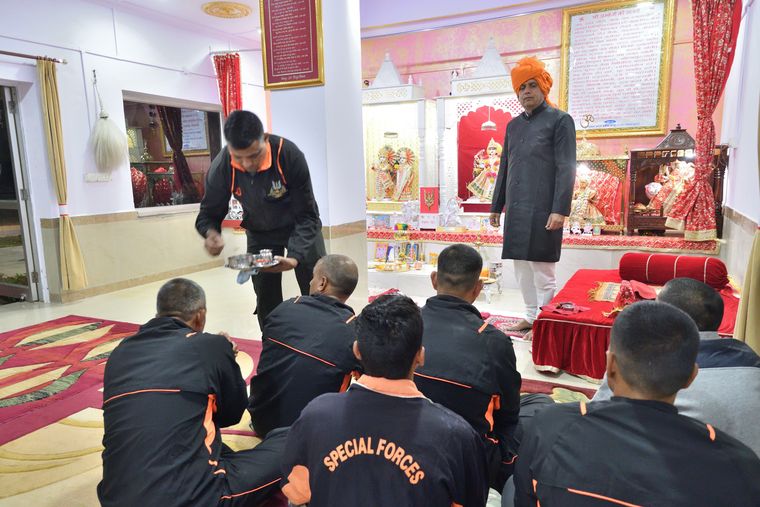 In god we trust: Commandos at a temple located in the 10 Para headquarters in Jodhpur | Sanjay Ahlawat
The presence of such religious spaces is not for promoting any faith. It is for providing a place to pray in solidarity. When troops pray, perform rituals or recite war cries invoking their deities, these are symbolic acts of regimental identity, tradition and shared purpose. In such moments, faith becomes secondary to fraternity. The religion of the soldier temporarily becomes the religion of the unit and by extension the responsibility of its officers.
This is secularism in the Indian military context, not suppression of religion but its transcendence into a unifying, supra personal identity. The ‘uniform before faith’ ethic recognises that in war and service what binds men together is not shared creed but shared purpose.
When an officer dons the uniform, he does not merely lead. He becomes the embodiment of the battalion or regiment. In that role, personal faith cedes ground to collective unity. Participation in regimental rituals, whether at a temple, gurudwara, mosque, church or a sarv dharm sthal, is symbolic of an officer’s solidarity with his men. It signals that he is one of them. Multiple officers have noted that soldiers will follow an officer to the “ends of the earth” once they feel he is one of them.
For many soldiers, the sight of their commander standing with them in prayer becomes a powerful motivator, a reassurance of unity beyond doctrine. For the Hindu, Sikh, Christian or Muslim officer, it is not about changing his or her faith or worshipping ‘other gods’. It is about command presence, solidarity, showing respect and trust. Those intangibles, respect and trust between commander and commanded, are critical in combat when lives hang on cohesion and morale.
In Lieutenant Kamalesan’s case, the conflict between personal conscience and military duty came to a head. Commissioned in 2017 into the 3rd Cavalry Regiment of the armoured corps, he led a ‘tank troop’ of Bravo Squadron comprising Sikh troops. The regiment maintained a temple and a gurudwara reflecting the religious composition of its troops.
Kamalesan perceived that his Christian faith forbade him from entering the gurudwara and participating in religious rituals. While he did come to the outer area during religious parades, he refused to go inside. The Army counselled him. Even a Christian pastor reportedly advised that participation would not violate the doctrines of his faith. Yet he held firm in his perception.
In the view of the Army and later the courts, including the Supreme Court, this refusal was not a matter of faith but of gross indiscipline and breach of essential military ethos. The Supreme Court observed that the Army is a secular institution and the secularism it practises demands that officers respect the faith of their troops even if the faith differs from their own. The dismissal was upheld and the Court labelled the officer a “misfit”.
I believe the military’s secularism, as truly practised, transcends narrow arguments over faith. It places institutional unity, operational effectiveness and regimental cohesion above individual commitments pertaining to personal faith.
The Army’s regimental sarv dharm sthals, temples, gurudwaras, mosques and churches exist not for propagating religion or doctrinal supremacy but for spiritual solace, morale, solidarity and the forging of trust between men who might otherwise have little in common beyond the uniform. In that context, to treat religion rigidly as purely individual and refuse to share in the rituals of one’s men undermines that unity. It reduces faith to dogma rather than allowing it to become a bridge.
When a non Sikh officer stands in a Sikh gurdwara with his troops or a Hindu, Sikh or Muslim officer participates in a Christian prayer, it becomes a powerful testament to what the Army truly is, a living embodiment of unity in diversity. That is the secularism that needs to be cherished, not indifference, but inclusion, mutual respect and collective identity.
For all men and women in our forces who follow varied faiths, the Kamalesan case should be viewed not as a warning against believing but as a lesson in understanding secularism and religious harmony in the Indian context and the nature of service in the Indian military. When you don the uniform, you pledge loyalty not just to God but to the men you lead and to the flag that binds you. When you visit places of worship of other faiths in line with your military duties, you are not placing ‘other gods’ before your own. You still retain loyalty to your own faith. That loyalty may demand sacrifice even over personal religious preferences. But that is not sacrilege. It is the highest expression of faith, when belief does not become a barrier but a bond between you and your men, between faiths, between hearts.
Any officer who cannot make that sacrifice, who places interpretations of his personal faith over collective duty, may appear to remain true to his creed. But he may find himself unfit for the unique secular ethos of the Indian Army.
The writer was Vice Chief of the Indian Army.