


OPTING TO REBALANCE power equations within its Bihar unit marks no small shift for the Congress. For years, the grand old party in the state has operated under the shadow of the Rashtriya Janata Dal (RJD), gradually ceding both electoral and organisational ground. But the appointment of Krishna Allavaru—a relatively young 52-year-old leader replacing 74-year-old Mohan Prakash as the state in-charge in February—quietly began to alter the old order, signalling a more assertive tone in the party’s renewed politicking.
Allavaru’s appointment carried a clear message from the Congress’s national leadership that it intends to reclaim autonomy over its state unit, free itself from dependency on the RJD, and chart an independent course for its leaders. A similar intent to seed a new crop of politicians is seen in other states, particularly in Assam, where the assembly polls are some six months away.
The party’s initial push in Bihar—Rahul Gandhi’s Vote Adhikar Yatra that began two months earlier—created ripples across three fronts: among voters, against the NDA, and within the Mahagathbandhan. This momentum emboldened the Congress to demand more space within both the alliance and the state.
The RJD, however, resisted this expansion by slashing the Congress’s seat share from 70 in 2020 to 54, with six additional “friendly contests”. The RJD may have expected the Congress to withdraw from these contests, but the latter stood its ground, sending a strong message to its cadre and signalling that its assertion will shape the party’s approach in other states.
In Bihar, Allavaru’s appointments have gradually unsettled the older generation of Congress politicians. The choice of Kumar Gaurav, a former Jharkhand Youth Congress president in his thirties, underlined this generational shift. Tasked with managing election operations, liaising with allies and handling feedback, Gaurav’s rise was seen as a reward for mobility and effectiveness. In essence, the Congress has placed younger leaders in decisive roles to test and groom its next generation.
More than a dozen of the party’s candidates joined only in recent months, and among the 60 seats it is contesting, younger aspirants dominate. The strategy appears aimed at nurturing new leadership to make the state unit more dynamic and self-reliant.
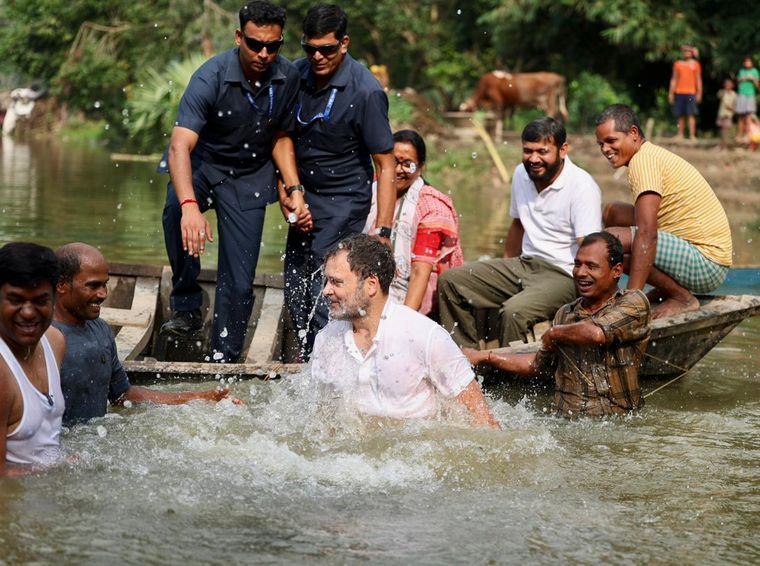 Deep impact: Rahul Gandhi during an interaction with fishermen in Begusarai, Bihar, on November 2. Also seen are Vikassheel Insaan Party chief Mukesh Sahni (extreme left) and Congress leader Kanhaiya Kumar (on the boat, wearing white T-shirt) | PTI
Although several long-time members have called the ticket distribution controversial, insiders say the process was strategic. Congress legislature party leader Shakeel Ahmad Khan said efforts were made to balance the old guard and the young, while ensuring representation of backward and extremely backward communities. For the first time, young leaders from these communities have been given prominence—a sign that high command wants younger people from across castes to build an activist, autonomous and effective organisation at the grassroots.
This recalibration has not been without friction. Some senior leaders have expressed discomfort at the speed of the transition, prompting the high command to dispatch Avinash Pandey, the UP in-charge, to pacify dissent. Yet the message from Delhi remains firm: discipline and loyalty to the new order.
Feathers were ruffled when the sons of former ministers and established power players in the state unit were sidelined for lack of ground activity. Ticket distribution, once influenced heavily by entrenched networks and legacy families, is now controlled by the central leadership. The sons of former state unit chiefs Madan Mohan Jha and Akhilesh Prasad Singh were denied tickets; Akhilesh’s son, Akash Singh, even accused Allavaru on social media of favouring new entrants over loyal workers—a post later deleted.
A senior MP, reflecting on the generational shift, said most veterans had grown less mobile and did not have the curiosity needed for understanding and overcoming electoral challenges. Others, demoralised by successive defeats, have slipped into inertia. Within the high command, Rahul Gandhi’s aides have also taken note of seniors who appear reluctant to carry forward his political narrative.
There have been similar problems in Haryana, Maharashtra and Madhya Pradesh. Efforts to consolidate support and mobilise cadres in these states have been limited. In Bihar, however, Allavaru has reversed that pattern, ensuring the high command’s directives are executed seamlessly. This model of tighter coordination is likely to be replicated in the upcoming elections in Assam and Kerala. In Assam, the appointment of 43-year-old Gaurav Gogoi as state president has set the stage for building a new network of young leaders.
The party, therefore, has attempted a bottom-up leadership model—a shift evident in the new system where district presidents are being empowered, even as it centralises decision-making within the high command. Former Madhya Pradesh chief minister Digvijaya Singh told THE WEEK that the party has given opportunities to new leaders “which will help it assess operational effectiveness in them and aid future-building”.