



IN 2005, BIHAR had two assembly elections. The first gave a fractured verdict. And the second a seismic shift, ending the reign of Lalu Prasad's Rashtriya Janata Dal (RJD). That era was defined by three socialist titans—Lalu, Nitish Kumar and Ram Vilas Paswan—once allies, later rivals.
Two decades on, Nitish remains a towering figure, steering the National Democratic Alliance (NDA) as its chief ministerial candidate. Yet, the 2025 elections signal a profound change, not just in leadership but in the very fabric of Bihar’s politics, as a new generation steps into the fray.
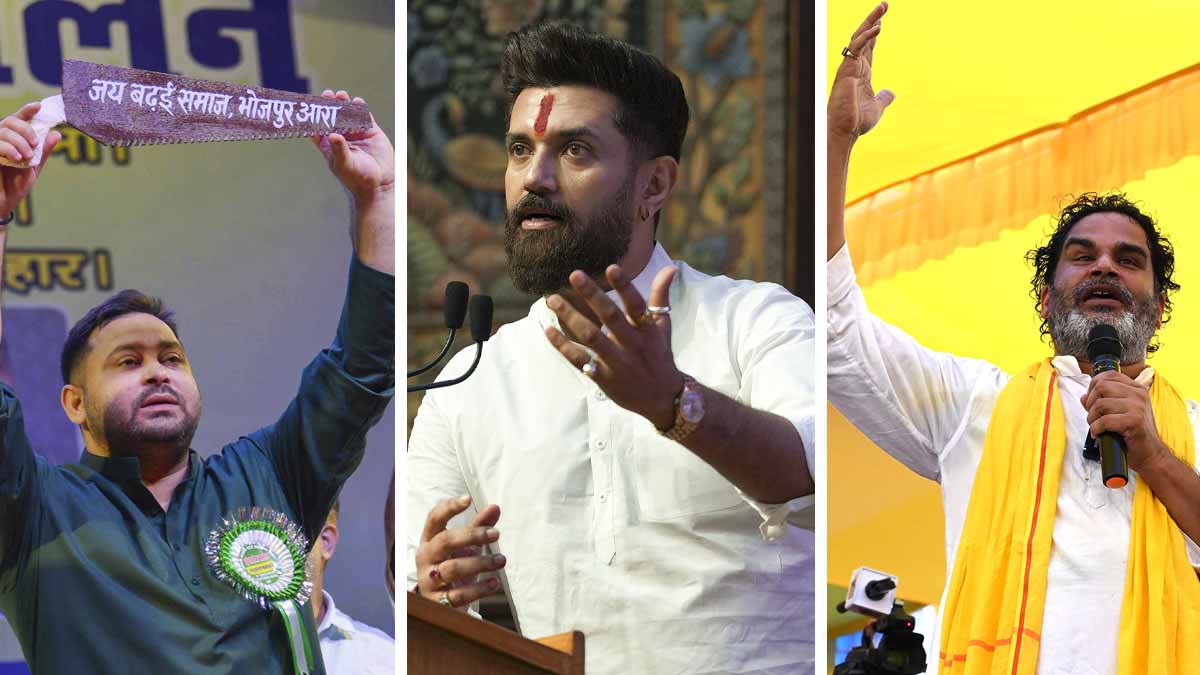
In politics, a generation is measured not just in years but in the churn of leadership. Demographers might peg it at 25 years, genealogists at the span between fathers and sons. By either yardstick, Bihar stands on the cusp of a transition. The state’s political shift began in 1990 with the Mandal Commission’s fallout, propelling Lalu to power. The 2025 contest is defined by three younger leaders—Tejashwi Yadav, Chirag Paswan and Prashant Kishor. They hold the key not only to forming the next government, but to reshaping the state’s politics.
This November, Bihar’s two-phase polls will see 14 lakh first-time voters, with those under 30 comprising more than 20 per cent of the 7.43 crore electorate. These Gen Z voters have no memory of Lalu’s 'jungle raj' or the early promise of Nitish’s 'sushasan'. While caste legacies have long dictated Bihar’s electoral battles, a rising, aspirational youth could redefine the state’s political narrative.
All three leaders are heirs, albeit in distinct ways. Tejashwi, son of former chief ministers Lalu and Rabri Devi, carries the mantle of the Mandal-era social justice movement. Chirag, son of the late Ram Vilas Paswan—a dalit leader who served as union minister on several occasions—seeks to reclaim his father’s legacy. Kishor is not a dynast but a master strategist, and has inherited the machinery of modern campaigning, having orchestrated Narendra Modi’s 2014 triumph, Nitish’s 2015 victory and Mamata Banerjee’s 2021 win.
All three began their political journeys around 2014 and now they converge with the ambition to lead Bihar’s restless youth. Tejashwi, 35, is the most seasoned of the trio. A legislator since 2015, twice deputy chief minister, and now leader of the opposition, he commands the RJD’s formidable Muslim-Yadav vote bank. He embodies generational change in OBC politics and is the opposition’s de facto chief ministerial face, though its ally Congress has been reluctant to formally endorse him as it seeks to revive its own influence in a state it once dominated.
Tejashwi's crowd-pulling prowess was evident in the boisterous turnout at the Vote Adhikar Yatra, led by Rahul Gandhi, and his own Bihar Adhikar Yatra. Yet, his challenge lies in expanding beyond the Muslim-Yadav base, which the RJD is addressing by fielding more non-Yadav OBCs, dalits and upper-caste candidates.
Both the NDA and Kishor’s Jan Suraaj party aim to chip away at Tejashwi’s Muslim-Yadav base, but that will not be an easy task. “He has shown he is not only young and energetic but also has a vision for Bihar centred on social and economic justice,” said RJD spokesperson Nawal Kishore. “Even during his time as deputy CM, he delivered on jobs and the caste census.”
In a state plagued by economic stagnation, unemployment and migration, Tejashwi has tailored his promises to the youth: a domicile policy, 65 per cent reservation, a youth commission, free exam forms, student scholarships and an end to paper leaks. He bears both the advantage of his father’s legacy and the burden of its negative associations. Yet, he has cultivated an image as an assertive yet courteous leader eager to govern. “The people of Bihar have accepted him as their leader. Nitish Kumar has no fresh ideas. Whatever promises we make, Nitish Kumar steals them. The CM has no roadmap for development. There will be massive change in Bihar once the RJD wins. Tejashwi is the best and only challenger in the state,” said Kishore.
Chirag, 42, began his political ascent in 2014, winning the Lok Sabha seat once held by his father. In 2020, he strategically fielded candidates against Nitish’s JD(U) while remaining loyal to the BJP. He stepped out of his father’s shadow after Paswan's death, crafting an independent image to reclaim the dalit vote. His legitimacy was cemented when the NDA awarded his Lok Janshakti Party (Ram Vilas) five Lok Sabha seats in 2024, all of which it won.
Chirag projects himself as a champion of inclusive growth, appealing to the 25–45 age group—nearly 45 per cent of Bihar’s population—hungry for jobs and clean governance. His public sparring with Nitish, questioning the chief minister’s law-and-order record while accepting his candidature, positions him as both insider and challenger. Increasingly, Chirag employs Hindu symbolism and 'Bihar pride' rhetoric to transcend his dalit base. “Our leader has made clear that this time there is no vacancy for the CM post. But next time, he will be chief minister,” said LJP spokesperson Vineet Singh.
Prashant Kishor, 48, is a product of modern campaign machinery. Through his Jan Suraaj initiative, he has recast himself as a reformer-politician. His two-year padyatra across Bihar, preaching change and promising a new politics, aims to break the state’s bipolar electoral contest. “It is a watershed moment in Bihar’s politics. Unlike past elections dominated by identity politics, this time the core issues are corruption, forced migration and unemployment,” said Jan Suraaj spokesperson Vivek Kumar.
Transitioning from strategist to leader is fraught with challenges. As a Brahmin, Kishor lacks a caste base, unlike Yadav or Paswan, whose communities have long shaped Bihar’s politics. He also lacks a tested cadre but brings unmatched electoral acumen. Modelling himself on Arvind Kejriwal’s early years, Kishor blends movement-building with sharp attacks on political rivals. Contesting all 243 seats—a feat unmatched in recent Bihar elections—he appeals to first-time voters, students and the educated middle class, urging them to vote for “the future of their children”.
Kishor’s promise of systemic change faces the test of Bihar’s caste arithmetic. Yet, his entry injects unpredictability. Whether he damages the NDA or the Mahagathbandhan more will only be clear after the elections.
Meanwhile, the BJP and the JD(U) rely on caste arithmetic and state largesse, including recent cash incentives for women and youth and major infrastructure announcements. Bolstered by the mass appeal of Modi and Nitish, they are confident their governance record will ensure continuity.
Bihar’s youth are restless, and Tejashwi, Chirag and Kishor embody distinct visions—social justice, aspiration and technocratic reform. The 2025 polls may not displace the old guard, but they mark the first time a trio of younger leaders competes to capture Bihar’s political imagination.
