



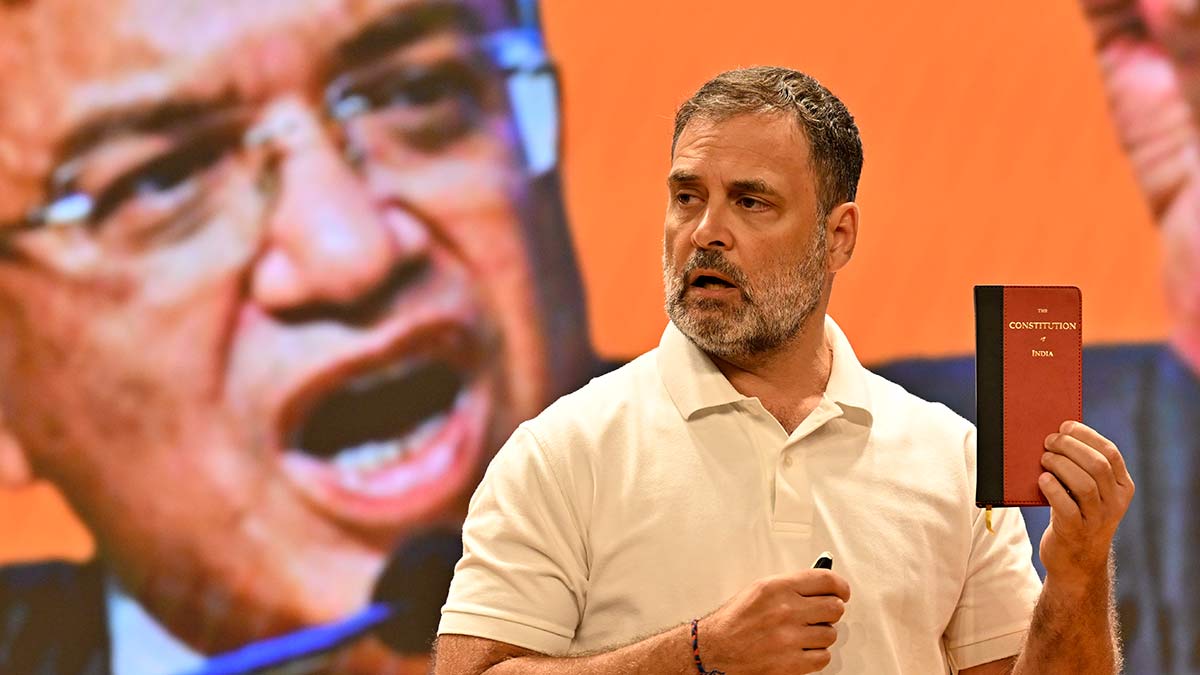
WITH LEADER OF the Opposition Rahul Gandhi’s vote-theft allegations and a nationwide voter roll revision looming, the Election Commission faces one of the most turbulent tests of its credibility. The EC’s image of being the umpire of Indian democracy has been challenged as it prepares for a nationwide special intensive revision (SIR) to clean up electoral rolls.
In his recent news conference in Delhi, Gandhi accused the EC of presiding over vote theft in two assembly constituencies—Rajura in Maharashtra and Aland in Karnataka. His charge is that the names of genuine voters have been deleted, and bogus names mysteriously added.
The EC has termed the allegations “incorrect and baseless”. But timing of the allegations means the SIR—to be held before the assembly polls in Bihar, West Bengal, Kerala and Assam—has become the lightning rod for a larger battle over the issue of free and fair elections.

Gandhi had earlier alleged that more than 100,000 fake votes were cast in Karnataka’s Mahadevapura assembly segment, contributing to the BJP’s narrow victory in Bengaluru Central in the 2024 Lok Sabha polls. Alleging that there were 11,965 “duplicate” voters and 40,900 voters with invalid addresses, he accused the EC of colluding with the BJP to manipulate the electoral process. The EC attributed the increase in the number of voters to its registration drives, saying it verified all additions through standard procedure. But Gandhi has demanded access to electronic voter data and CCTV footage.
In Maharashtra’s Rajura constituency, Gandhi said, the EC deleted more than 6,800 bogus names after a complaint was registered. In Aland, applications were made for the deletion of more than 6,000 names from the voter list without the knowledge of the voters concerned. The EC has been accused of withholding crucial data such as IP and email addresses linked to the fraudulent entries.
The SIR in Bihar had led to similar allegations of mass deletions. The ongoing allegations across multiple states highlight the need for greater transparency and accountability in the electoral process.
The EC, in response, has urged political parties to provide documentary evidence, insisting that its process of revising voter rolls is scientifically rigorous. “Our methodology uses cross-verification with multiple databases, field verification, and algorithmic checks. Every addition or deletion is justified by data and documented accordingly,” it said.
On paper, the SIR is a technical exercise. But Gandhi’s allegations brought the debate into the political arena, even as the EC tried to reframe the issue as an administrative matter by asking for documentary proof. Yet, in politics, perception often outweighs procedure.
Credibility has always been the EC’s greatest asset. If the poll body loses it, even temporarily, no amount of legal defence can restore it quickly. Litigation is inevitable. The Bihar SIR is already under judicial scrutiny, and more petitions are expected once deletions begin in other states. Courts are typically reluctant to stall electoral processes, but even routine notices or critical remarks can further erode public confidence.
If litigation multiplies, the EC could find itself paralysed between administrative deadlines and judicial oversight—caught in a cycle where it has to defend every procedural choice in both the courtroom and the political arena. The problem, however, is deeper. The opposition does not just want process, it wants proof of independence. And that is not easily demonstrated through affidavits or technical briefings.
Supreme Court advocate Prashant Bhushan, who represents the petitioner Association for Democratic Reforms in the Bihar SIR case before Supreme Court, said: “The EC operates under dual accountability: legally to the courts and morally to the electorate. Maintaining independence in perception is as critical as procedural correctness.”
The EC has weathered storms before. In 2019, opposition parties demanded 100 VVPAT verification, alleging that EVMs were being tampered with. The Supreme Court ordered a limited expansion of checks, largely endorsing the EC’s position. But suspicions lingered, amplified on social media.
“The EC’s checks are nowhere near enough to guarantee free and fair polls,” said a Congress leader. Yet, after scrutiny, the Supreme Court found no evidence of manipulation, endorsed the EC’s procedures, and dismissed the expanded verification demands. The controversy fizzled, proving that even thunderous political allegations can have little effect at the ballot box.
The SIR controversy may, similarly, ultimately vindicate the EC, but the shadow of doubt may remain. The current moment invites comparison with the 1990s, when chief election commissioner T.N. Seshan transformed the EC into one of India’s most respected institutions. Faced with rampant booth capturing, money power and muscle politics, Seshan wielded the “model code of conduct” as a weapon to instil fear across the political spectrum. His uncompromising stance restored faith, even among sceptics, in the electoral process. What Seshan demonstrated was that credibility flows not just from institutional design, but from leadership that enforces rules without fear or favour. His successors inherited an empowered commission because public trust had been rebuilt around the office itself.
By contrast, today’s EC appears more defensive than assertive. Its responses to criticism are couched in legalistic language, often reactive than proactive. Where Seshan thrived on confrontation with political class to defend neutrality, the present-day EC risks appearing too cautious, even pliant. That contrast sharpens the perception of institutional drift.
The EC’s credibility is not a technical matter; it is the very oxygen of India’s electoral democracy. If citizens begin to believe that voter rolls can be manipulated, or that deletions disproportionately target certain communities or regions, the legitimacy of elections themselves comes under question. And once elections lose their sanctity, the democratic process risks sliding into perpetual contestation.
For the EC, the challenge is not just procedural but communicational. Merely issuing rebuttals to allegations will not suffice, especially at a time when perception often outweighs procedure. The EC must radically increase transparency by making voter roll revisions publicly available in real time, with clear reasons documented for every deletion or addition. Without this openness, accusations of arbitrary manipulation will continue. Equally critical is the need to invite independent oversight, whether through neutral civil society groups or retired officials, to observe parts of the revision process. Such external scrutiny would not only act as a safeguard, but also signal confidence in the integrity of its methods.
“Our voter roll revision is based on multiple layers of verification—cross-checking with government databases, field visits and algorithmic scrutiny to detect duplicates or anomalies,” a senior EC official told the WEEK. “Every addition or deletion follows a documented protocol. The process is scientific, data-driven, and designed to ensure accuracy, not giving advantage to any party.”
Ultimately, the SIR is more than a bureaucratic revision. It is a referendum on whether the EC still commands trust across the political spectrum. If it falters, every future election could be contested—not just at the ballot box but in the courtroom and the streets. If it rises to the challenge, it could restore the aura of impartiality that has historically set Indian democracy apart.
For the EC, the coming months are not just about cleaning up rolls, they are about cleaning up its own credibility.
