On October 7, Prime Minister Narendra Modi will complete 24 unbroken years in public office. His elevation as Gujarat’s chief minister in 2001, after serving as a BJP general secretary, marked the start of a political career that has since extended to more than 11 years at the helm of the Union government. The milestone underscores his durability in executive office.
Only two leaders before him have crossed a similar threshold. Pawan Kumar Chamling, Sikkim’s longest-serving chief minister, held office for 24 years and 165 days, while Naveen Patnaik served as chief minister of Odisha for 24 years and 99 days. Modi is just months short of surpassing both.
Earlier in July, he became the second longest-serving prime minister in consecutive terms, overtaking Indira Gandhi’s unbroken tenure of 4,077 days between 1966 and 1977. The longest stretch remains that of India’s first prime minister, Jawaharlal Nehru, though Modi has equalled Nehru in leading his party to three successive general election victories.
In public service, Modi has been active for the last 50 years. As a 25-year-old, he coordinated meetings and distributed literature against the Emergency of 1975-77. He became general secretary of the newly formed Gujarat Lok Sangharsh Samiti, an RSS-inspired body. This was his first major political exposure and assignment, though he had already been active socially as an RSS pracharak.
In the past 11 years in Delhi, Modi has established political dominance, reshaping the BJP into a strong ideological force at the hustings and carving out new national priorities. Free from the political hesitations enforced by coalition governments, he has focused on economic growth, social welfare and infrastructure expansion. Supporters see him as the architect of a more confident India, while opponents argue that his tenure has centralised power. Yet, both sides agree on one point: Modi has changed India, whichever side of the political debate one takes.
The buzz in the capital’s power circles about his future around his 75th birthday on September 17 centred on whether he would follow the precedent set for senior BJP leaders such as L.K. Advani and Murli Manohar Joshi to step away from electoral politics. That debate was settled when RSS chief Mohan Bhagwat declared during his recent three-day lecture series in Delhi: “I never said I will retire or that someone else should retire when they turn 75.” Bhagwat, elder to Modi by a week, will oversee the sangh’s journey into its 100th year, while Modi, the most successful product of the RSS, steers his party and government through choppy waters, both internally and globally. “Modi is physically fit and mentally sharp. There has been no doubt in the BJP about him leading the government till he wants to,” a senior party functionary said.
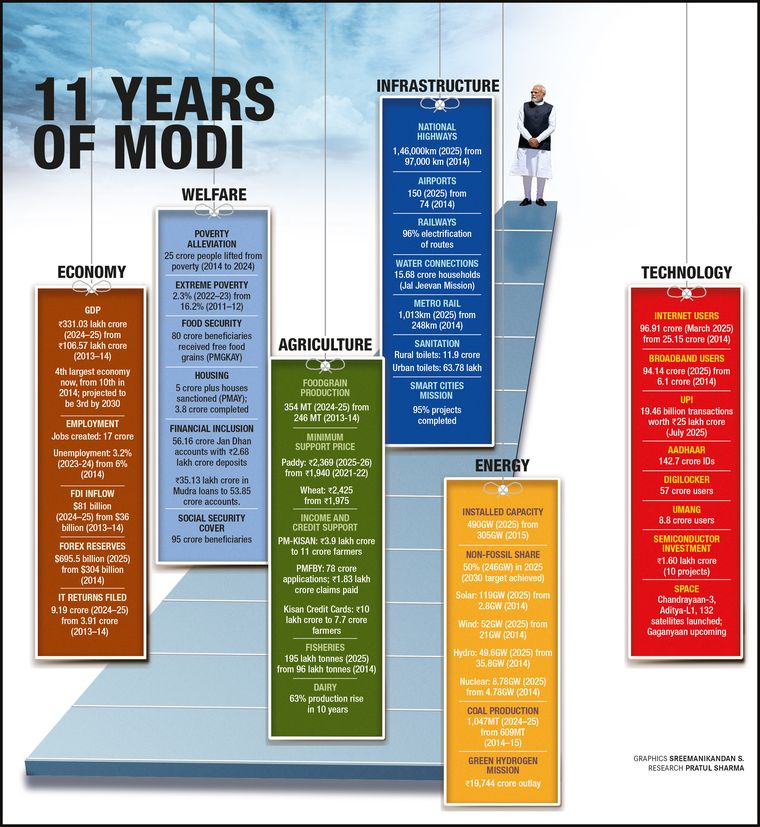
As the BJP and the government embark on the yearly ritual of marking Modi’s birthday as ‘service fortnight’, it gives the ruling dispensation an opportunity to showcase its record. When Modi took over as prime minister in 2014, India was the world’s tenth-largest economy. Today it ranks fourth, with credible projections suggesting it could rise to third by 2030. The government highlights reforms such as the Goods and Services Tax, the Production Linked Incentive scheme and Make in India as drivers of manufacturing. The government claims 17 crore jobs have been created over the past decade, with unemployment reduced to 3.2 per cent. Critics argue that much of this work remains informal or precarious.
 Narendra Modi and Donald Trump | AP
The government also points to progress in social indicators. According to official estimates, more than 25 crore people have moved out of poverty in the past decade, with extreme poverty dropping sharply. The middle class has also seen targeted measures: tax relief, incentives for affordable housing and investment in urban infrastructure such as metro systems. The latest GST reform is presented as part of this drive.
Infrastructure has been a consistent priority. The length of national highways has doubled to 1.46 lakh kilometres, nearly 150 airports are operational and the railway lines are almost fully electrified. The rollout of Vande Bharat trains and freight corridors has been presented as a symbol of modernisation.
Third terms bring their own challenges. Modi cast aside any doubts about pushing his agenda after 2024, when he needed the support of allies like the Janata Dal (United) and the Telugu Desam Party, following assembly poll wins in Maharashtra, Haryana and Delhi.
The past few months have indicated policy shifts. From granting tax rebates that made income up to 12 lakh tax free to offering relief through GST reforms, Modi has signalled it was payback time for the population that supported him. If these reforms carried electoral considerations, there was little pretence otherwise. The income tax rebate came before the Delhi polls, the GST reform ahead of the Bihar polls.
While these measures put more money into consumers’ pockets, the government has also indicated long-term thinking. The decennial census has come with a twist, as Modi agreed to a caste census, a U-turn that caught even his opponents off guard.
At the ideological level, he announced a panel to study demographic change in border areas. “The imminent dangers of demographic imbalance due to infiltration and illegal migration in border areas is high, thereby affecting citizens’ livelihoods,” Modi declared from the Red Fort, the first time a prime minister had flagged the issue from such a platform. Going forward, these issues present an opportunity for more decisive changes when coupled with delimitation and women’s reservations.
At the policy level, the government will set up a task force for “next-generation reforms” to evaluate all current laws, rules and procedures related to economic activities.
BJP leaders indicate that such changes will help build a nationalistic narrative in the run-up to the 2029 polls. The introduction of new bills debarring prime ministers, chief ministers and ministers after arrest on serious charges has been presented as a push towards cleaning up the executive. The opposition says it is aimed at them.
India’s security posture has evolved during Modi’s tenure. He has spoken of a ‘new normal’ of responding decisively to every terror attack. Operation Sindoor, carried out against targets in Pakistan, has been hailed by the government as proof of a tougher doctrine, building on the precedent of the Balakot strikes. The operation drew political scrutiny as opposition leaders, particularly Rahul Gandhi, questioned whether the government’s assertions matched reality. Relations with the western neighbour are at their lowest, but Modi’s strong response has been projected as a deterrent against cross-border terrorism.
“The strategic message of Operation Sindoor is that the strategic autonomy spoken about in the last 11 years has been practised on the ground. No power in the world can think of impacting the national sovereignty of India. We have emerged as a friend of the world, the prime minister calls it vishwa bandhu. It is not just a message to the Global South but also in the comity of nations where India is respected,” said BJP spokesperson Guru Prakash.
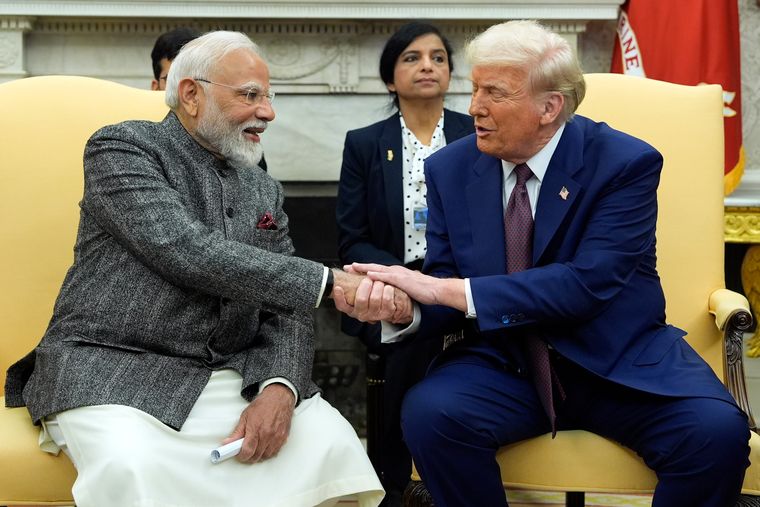
The big security challenge has given way to an economic one. US President Donald Trump’s repeated claims of intervening for a ceasefire with Pakistan, followed by his 50 per cent tariffs, have cooled the relationship with the US. Modi, however, has taken a strong stance to protect Indian agriculture and dairy sector. “The prime minister has clearly said that the interests of our farmers and dairy producers are topmost and non-negotiable. Incorporating national interest, we believe in open markets. We understand that linking our manufacturing sector, particularly MSMEs, to regional and global supply chains is very essential,” said BJP spokesperson Gopal Krishna Agarwal.
Trump may have pushed India closer to China, with whom it also faces trust issues. The recent Shanghai Cooperation Organisation summit provided useful optics, evoking a response from Trump, almost as if from a jealous partner. Trump, meanwhile, has struck a conciliatory note, saying that there will be no difficulty for the two countries to reach a successful conclusion in trade talks. He also hinted at direct talks with Modi to which the prime minister responded warmly. “We value our long-standing friendship with the US. Within these parameters we are pursuing trade and tariff negotiations and are hopeful of positive outcomes,” said Agarwal.
The tariffs underline a paradox: as India champions self-reliance, it remains vulnerable to global currents it cannot control. In both cases, whether dealing with Pakistan or with Trump, Modi’s response has been in sync with his self-crafted image of a strong and unwavering leader.
Opposition parties have embraced the slogan of “vote theft”, alleging electoral manipulation to target the BJP government and the Election Commission. They have made the Special Intensive Revision (SIR) of electoral rolls a talking point, but its effectiveness in polls is yet to be tested. Bihar will be the nearest test. Every Bihar election is billed as a semi-final for the government, with any upset seen as a barometer of whether the BJP can retain dominance in the Hindi heartland. However, when Modi enters the campaign arena, even his detractors admit he can sway undecided voters.
“The SIR cannot be viewed through a political lens. It is an independent constitutional exercise mandated by the Supreme Court,” said Guru Prakash. “The apex court said the Election Commission is pursuing SIR in accordance with Articles 324, 325 and 326 of the Constitution. Less than one per cent of claims have been made in a population of 14 crore with 8 crore voters. It shows that the people of Bihar have accepted the process.”
An even bigger test awaits the BJP in 2026, when states such as Tamil Nadu, Kerala, Assam and West Bengal go to the polls. These will test the BJP’s ability to expand in the south and hold ground in the east. Victories would further entrench Modi’s supremacy; setbacks could embolden an opposition still searching for a coherent strategy against the government.
In the last 11 years as prime minister, Modi has reshaped Indian politics and governance. Whether he will be remembered more for economic transformation, ideological assertion or making the BJP the most dominant political force, one fact is settled: his imprint on India’s present and future may be one of the strongest in the country’s political history.