



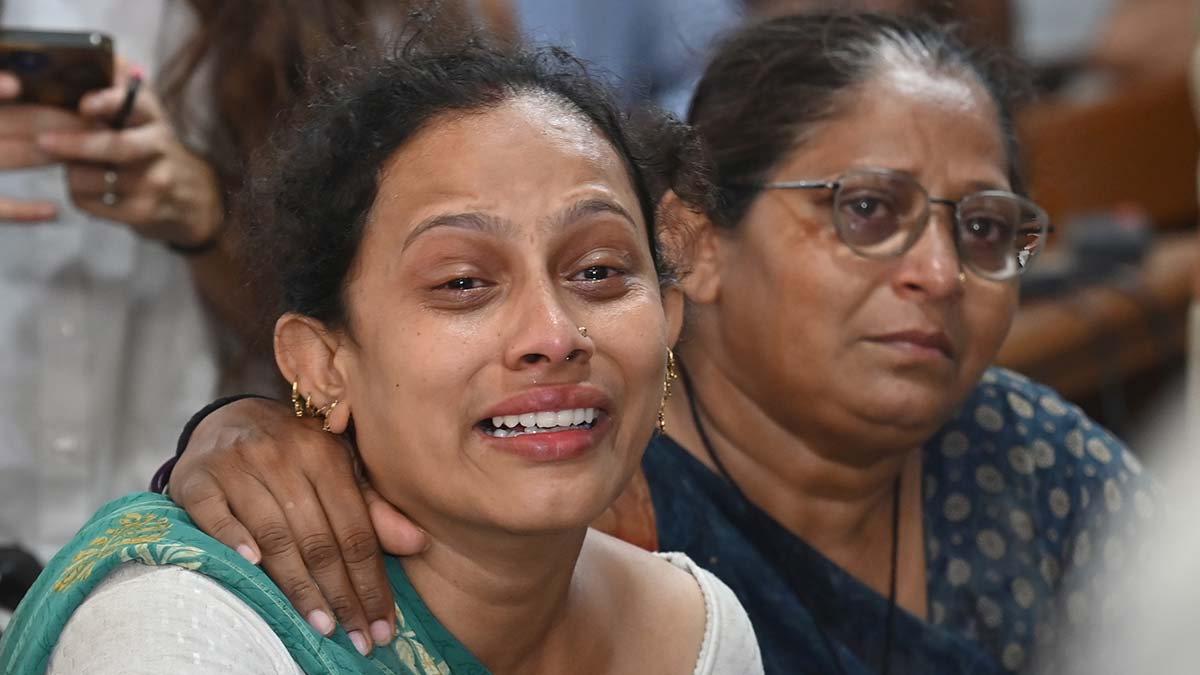
Kinal Mistry from Anand in Gujarat was looking forward to returning to the UK, where she was on a work permit. Last year, the 24-year-old had an accident while on pilgrimage in India. Having completed the long treatment, she had booked a ticket on Air India’s flight AI 171 bound for London’s Gatwick Airport from Ahmedabad on June 12. The family had come to see her off, on what should have been a routine flight. Little did they know this would be the last time they saw her.
On the ground, Akash Patani, 14, was sleeping under a tree close to his family’s tea stall near BJ Medical College Hostel. His mother, Sitaben, was working at the stall. The Air India flight took off with 242 people, but within minutes it crashed into the buildings of the hostel. The fully loaded fuel tank exploded and the entire area was up in flames. Akash had no chance. Sitaben, who tried to save him, got burnt and was taken to hospital.
According to doctors, 270 bodies were brought to the Civil Hospital. “They were charred beyond recognition,” said a resident doctor. “There was nothing we could do to save them.”

The dead included students from the medical college, many of whom were having lunch in the hostel mess. Authorities could not provide an exact number, but the estimate of those who died on the ground is around 30.
The aircraft was a 12-year-old Boeing 787 Dreamliner. These have been in service since 2011 and more than 1,100 are in use worldwide. This was the first time this type of aircraft had crashed.
Reports said that by June 18, through DNA matching, 190 victims were identified and mortal remains of 159 had been handed over. The dead included former Gujarat chief minister Vijay Rupani.
Various theories have been put forth for the crash. Videos showed the flight taking off and climbing. However, having reached about 625 feet, it descended and crashed. Take-off pilots had made a distressed mayday call to air traffic control, but there was no reply when the ATC responded.
Some suggest that both engines might have lost power, which can happen but is extremely rare. Perhaps there was a bird hit that led to the engines failing. In the video, the landing gear was still down, which made some wonder whether the first officer might have accidentally pressed the lever to retract the wing flaps instead of the landing gear. But Captain Sumeet Sabharwal had logged more than 8,200 hours of flying and first officer Clive Kunder had 1,100 hours. Given their experience, such an error is highly unlikely.
Sabharwal’s last rites were performed in Mumbai on June 17. His father, colleagues, friends and relatives were present. “Captain Sabharwal was highly experienced, a thorough professional and one of the most gentle persons you could meet,” said a fellow pilot, adding that the first officer, too, was knowledgeable and friendly.
Aditya Paranjape, an associate professor of aerospace engineering at Monash University in Australia, said that from the videos, it looked like a dual engine failure was evident. “Either both engines had shut down or they were producing very little thrust,” he said. “Now, the question is why did they fail? Did the engines have a problem, did they suffer fuel starvation or something else? That is unknown.”
Paranjape didn’t see any chance of pilot error. “The altitude was barely 400ft above ground, 625ft was the barometric altitude,” he said. “If we assume that things were functioning normally for the first five to six seconds, they barely had 25 seconds before the crash. You had very little time.”
The sole survivor, British national Vishwash Kumar Ramesh, had recalled hearing a loud bang before the crash, which some say suggested there might have been an issue with one or both engines.
The investigators will sift through the black boxes and the debris at the crash site in great detail. The cockpit voice recorder (CVR), which captures pilot conversations, alarms and other sounds; and the flight data recorder (FDR), which logs technical parameters like engine performance, air-speed and altitude, should provide crucial details. A report said that the pilots in their mayday communication had said that thrust was not achieved and they were falling. The CVR would have caught that.
Multiple investigations have been launched, including by a committee headed by Union Home Secretary Govind Mohan. Officials of the Aircraft Accident Investigation Bureau, Boeing, the US National Transportation Safety Board and the US Federal Aviation Administration have inspected the crash site.
In 2021, when the Tatas re-acquired Air India from the government, Ratan Tata had said: “On an emotional note, Air India, under the leadership of J.R.D. Tata had, at one time, gained the reputation of being one of the most prestigious airlines in the world. Tatas will have the opportunity of regaining the image and reputation it enjoyed in earlier years.”
However, the June 12 crash, which Tata Sons chairman Natarajan Chandrasekaran said was “one of the darkest days in Tata Group’s history,” seems to have shattered Air India’s image.
The crash aside, there have also been service-related complaints time and again about broken seats, in-flight entertainment screens not functioning, etc. Earlier this year, Union Minister Shivraj Singh Chouhan had complained about Air India allotting him a broken seat on a Bhopal-Delhi flight.
There have also been reports of technical issues. On June 16, an Air India flight from Hong Kong to Delhi had to return to Hong Kong because of a possible technical snag mid-air. The following day, a San Francisco to Mumbai flight reportedly had a technical snag and passengers had to be de-planed at a scheduled stop at Kolkata. The same day, a flight from Ahmedabad to London was cancelled. Air India blamed this cancellation on the unavailability of aircraft, resulting from airspace restrictions and additional precautionary checks, leading to longer than usual turnaround of aircraft. It was not because of any technical snag, it said.
In July 2024, an Air India flight from Delhi to San Francisco was diverted to Russia’s Krasnoyarsk Airport because of a potential issue in the cargo hold area.
A relief flight was later dispatched to fly people onwards.
In June 2023, another flight on the same route had to be diverted to Magadan airport in Russia because of a technical issue with one of its engines. The passengers were stranded for nearly two days. The airline apologised, refunded the passengers and also offered travel vouchers.
“Everyone had high expectations from Tatas in terms of being fair, promoting honesty, etc. But, it’s the other way round,” said Amit Singh, a commercial pilot and founder of the NGO Safety Matters Foundation. “Quality and safety pay in the long-run. But, you have to invest in them. Everybody looks for short-term gains and short-term profits.”
Industry veterans say there is no doubt that Air India is going through troubled times, but that shouldn’t affect its long-term growth plans. “Many airlines in the world have at some stage had some accident,” said Jitender Bhargava, former executive director of Air India. “But it didn’t affect their long-term interest. The accident is a temporary setback and doesn’t change the airline’s growth trajectory. Air India will continue to expand and grow.”
He also said that issues such as broken seats and in-flight entertainment not working were related to service standards and had no bearing on safety. “Remember, no airline would want to risk its safety record because your insurance premium goes up in a big way,” he said.
A thorough investigation and complete disclosure would help address shortcomings, if any. Other airlines would be watching, too. “All airlines operating these aircraft will want to know what exactly happened,” said Bhargava.
The Directorate General of Civil Aviation (DGCA) held a high-level meeting with senior officials of Air India Ltd. and Air India Express, and raised concerns regarding recent maintenance-related issues. “The airline was advised to strengthen internal coordination across engineering, operations, ground handling units and ensure availability of adequate spares to mitigate passenger delays resulting from such issues and strictly adhere to regulations,” the DGCA said.
Importantly, the regulator didn’t find “any major safety concerns” in the recent surveillance conducted on Air India’s Boeing 787 fleet. The aircraft and associated maintenance systems were also found to be compliant with safety standards.
When the Tatas acquired Air India for Rs18,000 crore in October 2021, the carrier was already in poor health because of years of under-investment. In the financial year 2020-21, it had reported a net loss of Rs7,017 crore. In 2023-24, this shrunk to Rs4,444 crore.
In Air India’s defence, there is already an ongoing exercise to modernise and expand its fleet. In June 2023, the airline had placed an order for 470 aircraft from Airbus and Boeing. Last year, it ordered an additional 100 Airbus aircraft.
While the new aircraft have started flying in, Air India’s entire legacy fleet is undergoing a $400 million retrofit programme. All the old aircraft will be refurbished in a three-class cabin configuration; they will get new carpets, seats, curtains, lavatories and more, along with the new brand livery.
As per the schedule Air India has announced, its fleet of the 787 Dreamliners are expected to get a complete retrofit by middle of 2027, while the Boeing 777s will be heavily refreshed by November this year, with full retrofit to follow.
The airline has also been rapidly expanding its network, adding new destinations and inking several new code-share partnerships (joint operation of aircraft by two or more carriers).
Speaking to nearly 700 Air India employees at the airline’s headquarters in Gurugram on June 16, Chandrasekaran reportedly urged them to show resilience and use the crash as an act of force to build a safer airline.
Separately, in his address on June 14, Air India’s CEO and MD Campbell Wilson said safety was always their “primary responsibility”.
In the aftermath of the 26/11 terror attack on Mumbai’s Taj Mahal Palace hotel, the Tata executives, led by Ratan Tata himself, went the extra mile to support the families of those affected. And while Tata Sons has announced Rs1 crore to the families of each crash victim, and an additional Rs25 lakh by Air India, many would need emotional support, too.
If Air India is to regain customer trust and love and reach the gold standard that it once had under the leadership of J.R.D. Tata, ensuring safety and reliability will be extremely crucial. Passengers will be hoping for just that.
THEORIES BEHIND THE CRASH
Dual engine failure
Some experts point to the deployment of the ram air turbine (RAT), which deploys automatically during total power loss. The lone survivor said there was a “loud bang” and flickering cabin lights
Flap misconfiguration
Some footage suggests they might not have been correctly aligned
Pilot error
Some experts think the co-pilot might have mistakenly raised the flaps instead of retracting the landing gear, causing a loss of lift
Fuel contamination
This could lead to engine failure by clogging fuel systems
Maintenance issues
Air India’s Boeing 787 fleet is reportedly undergoing a safety audit, with a special focus on engine performance and control systems
Other factors
The landing gear remaining extended after take-off is under investigation. While bird strikes were initially considered because of Ahmedabad airport’s history of such incidents, no bird remains were found
