


 Lt Gen Philip Campose (retd)
WHEN THE history of the Indian military is written, the early morning of May 10, 2025, will be remembered in golden letters. On this day, the Indian Air Force launched multiple precision strikes, using cruise missiles, on 11 Pakistan Air Force bases—Nur Khan (Chaklala), Rafiqui, Murid, Rahim Yar Khan, Sukkur, Chunian, Pasrur, Sialkot, Bholari, Mushaf (Sargodha) and Skardu. These strikes severely damaged runways, radars, air defence systems, command hubs, hangars, air traffic control towers, UAVs, ammunition depots and AEW (airborne early warning) aircraft. Such was the scale and precision of the attack that the Pakistan military was forced to sue for peace—directly and through US intermediaries—resulting in a ceasefire by that afternoon. Operation Sindoor, launched on May 7, had thus achieved its objective.
The May 10 airstrikes marked the fourth and final stage of escalation in a conflict that began on April 22, following Pakistan-sponsored terror attacks in Pahalgam, Kashmir, which killed 25 tourists and a pony minder. These attacks were attributable to Pakistan’s “deep state”—the army, intelligence agencies and terror groups—led by General Asim Munir. Surprisingly, despite a clear military defeat, Munir was promoted to field marshal.
India’s initial response to the Pahalgam attack was diplomatic and economic, including suspension of the Indus Water Treaty. Fourteen days later, staying true to its policy of overt, punitive and proportionate retaliation, India launched Operation Sindoor in the early hours of May 7. The operation began with strikes on terror infrastructure across Pakistan, including, for the first time, targets outside Pakistan-occupied Kashmir (PoK)—notably in Sialkot and Bahawalpur in Punjab province.
On May 7, the IAF and the Indian Army conducted stand-off attacks on nine terror facilities using air-launched missiles, glide bombs and kamikaze drones—also known as loitering munitions—alongside extended-range artillery. Among the targets were the headquarters of Lashkar-e-Taiba (LeT) at Muridke and Jaish-e-Mohammed (JeM) at Bahawalpur, both repeatedly hit. French SCALP missiles and HAMMER glide bombs mounted on Rafales, Indo-Russian BrahMos air-launched cruise missiles, Indo-Israeli Sky Striker drones, and Israeli Herop and Harpy loitering munitions and Rampage air to surface missiles were reportedly used. Several terrorist leaders—including Abu Jundal, Yusuf Azhar, Hafiz Jameel, Abu Akasha and Hassan Khan—were killed. India provided immediate video evidence of the destruction. Pakistan claimed to have downed five to six Indian aircraft, but India declined to confirm the number, while affirming that all pilots were safe. The strike was successful in hitting all intended targets, though some terrorists likely survived.
In response, Pakistan launched Operation Bunyan al Marsoos, beginning with heavy artillery and rocket barrages across the Line of Control, causing significant civilian casualties. Over the next three nights—May 7, 8, and 9—Pakistan deployed a thousand drones across India’s western border, from Srinagar to Bhuj. Most were low-altitude Turkish-origin Songar surveillance drones with limited offensive capability and were largely shot down. On May 8 and 9, Pakistan escalated by deploying armed Yiha drones—also of Turkish origin, manufactured under licence in Pakistan—in attempts to strike Indian forward airbases. These loitering munitions were mostly intercepted with Israeli Barak and indigenous Akash missiles. In retaliation, the IAF struck Pakistani airbases, including Lahore, in the early hours of May 9.
Pakistan’s drone attacks of May 8 and 9 made India escalate on May 10, with devastating impact. A desperate Pakistan launched one or two Fateh-2 short-range ballistic missiles, both of which were intercepted mid-flight.
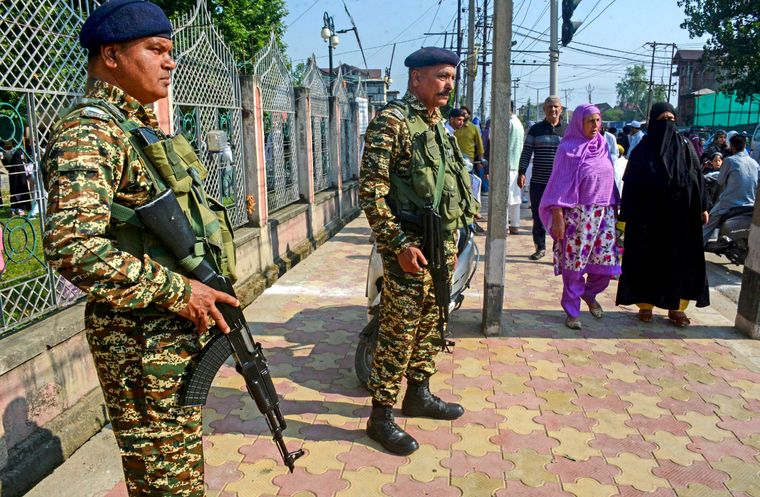 Keeping vigil: Security personnel stand guard outside Eidgah ground in Srinagar | PTI
With the May 10 airstrikes, India had clearly achieved “escalation dominance,” signalling that further conflict would result in greater military loss to Pakistan. This operation also laid to rest lingering doubts from the 2019 Balakot strike, which lacked publicly released visual evidence and saw retaliatory Pakistani air attacks resulting in the loss of an Indian MiG-21 and a helicopter, the latter to friendly fire.
The Indian Army had also struck terrorist infrastructure using kamikaze drones and long-range artillery on May 7. Over the next three days, it countered cross-LoC fire by targeting military posts, deliberately avoiding civilian areas. Army air defence units played a key role in intercepting Pakistani drones and missiles. The Indian Navy deployed a fleet—including an aircraft carrier group—into the Arabian Sea, ready to strike, if necessary.
Following the ceasefire, India declared that any future terror attack from Pakistan would be treated as an act of war, with a swift and decisive response. And that sponsors of terrorism—including the Pakistani military—would be dealt with as harshly as the terrorists themselves, and that Pakistan’s nuclear rhetoric would not constrain India’s actions.
While efforts to apprehend the four Pahalgam terrorists continue, and it remains uncertain whether the Pakistani deep state will refrain from future attacks, India must reflect on key lessons from the conflict.
First, security in J&K must be made foolproof. Intelligence and security agencies must be more alert, efficient and capable of rapidly detecting and responding to terror strikes. Connections with local communities must be strengthened to ensure smooth information flow.
Second, the conflict highlighted the critical role of drones, especially AI-powered drone swarms, and anti-drone systems in modern warfare. Drones are increasingly taking over roles of combat aircraft, helicopters, air defence systems, tanks, artillery, military engineers and even the infantry. We need to further develop and incorporate drone technologies to maintain superiority in future conflicts.
Third, for offensive air attack as well as air defence systems, seamless network-centric capability incorporating airborne early warning, are critical for operations across all military domains. It is no longer a choice but an absolute necessity.
Fourth, India has declared that any cross-border terror attack will be treated as an act of war. This means that the next confrontation could begin at a higher level of escalation. India’s armed forces must be prepared to act swiftly across land, air, sea, space and cyber domains, necessitating comprehensive capacity building and readiness—even for protracted conflicts. Preparedness in terms of modern armament, technology infusion and adequacy of reserves will determine success.
Fifth, India fell short in the information and propaganda war—a decisive factor in modern conflicts. Delays or lack of transparency in communication can hand advantage to the adversary in the war of narratives. Media strategy must be improved and guided professionally.
Sixth, while China, Turkey and Egypt provided material and other support to Pakistan, India found itself relatively isolated diplomatically. While defence procurements from France, Russia and Israel played a role in our success, broader global political backing was limited. This calls for a recalibration of our diplomatic efforts to secure stronger international alliances and support.
While India’s military actions on May 7 and 10 were successful, it is vital to assess strategic and tactical lessons including shortcomings. As some analysts, including Lt Gen H.S. Panag, have pointed out, India “won just by the skin of its teeth”. A comprehensive review of Operation Sindoor is essential. The next round may be even more serious—and may occur sooner than later.
The writer was Vice Chief of the Indian Army.