


Ukraine President Volodymyr Zelensky and a few top security officials must have been a tense lot on June 1. The following day, an important bilateral meeting was to take place in Istanbul with the Russians to end the more than three-year-old conflict. But more importantly for them, and unknown to anyone else, ‘Spider’s Web’ was to be launched deep inside Russia.
Planned in absolute secrecy for about 18 months and personally overseen by Zelensky, Spider’s Web—a Ukrainian guerrilla style operation—was aimed to deliver a crippling blow to Russia’s long range and nuclear-capable air fleet that had been instrumental in intelligence gathering and bombing Ukraine. The only departure from the classic guerrilla tactic of “creating mayhem behind enemy lines” was the use of first-person view drones instead of armed combatants.
Worldwide, among the major militaries, there is an ongoing race to create the perfect drone or one where AI and machine learning are perfectly integrated. This would make the drone an unstoppable killing machine.
While AI will enable advanced autonomous decision-making, machine learning will enhance perfection in specific battlefield tasks in the blink of an eye. At the moment, there is no conceivable answer to such a drone, not to speak of its swarms.
Russia’s long-range air fleet—consisting of Tupolev-95 and Tupolev-22M3 strategic bombers besides A-50 radar detection aircraft—were parked in four major airbases thousands of kilometres from Kyiv. So swift, silent and deadly was the drone attack that the Russian warplanes did not even get the time to take off. With daybreak, the damage was clear. Zelensky called it an “absolutely unique operation”.
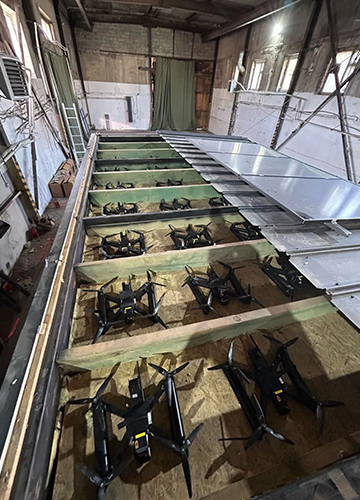 Major hit: A handout photograph shows Ukrainian military drones | AFP
To explain in sheer numbers, 117 first-person view drones—some as cheap as $600—were packed in wooden casings in trucks with retractable roofs and smuggled to locations near Russian airbases over a period of time. These drones apparently took out 41 cutting-edge warplanes or 34 per cent of Russia’s strategic cruise missile carriers. The total damage is reported to be around $7 billion.
While it would deliver a crippling psychological blow to the Russian war juggernaut, it would also lift the sagging morale of the Ukrainian fighters.
Much closer home, during the intense India-Pakistan conflict launched on May 7, both used drone power to the hilt.
While Pakistani drones and their swarms—mainly the Turkish-made Yiha and Songar drones in the hundreds—were countered effectively by Indian air defence systems including lasers, India’s Nagastra 1 and Israel-made Harpy caused substantial damage to terror bases and Pakistani military installations. The verdict was on the wall—drones were the new tools of war.
Before the Ukrainian drones, it was Russia that had extensively used the Iranian origin Shahed and Mohajer drones to target Ukrainian infrastructure. Russia is now collaborating with Iran to produce these drones in large numbers.
The 44-day Armenia-Azerbaijan war in 2020—over the disputed territory of Nagorno-Karabakh—was among the first military operations to strongly underline the lethality of military drones in conventional warfare. Videos of the Turkish-made Bayraktar TB2 drone destroying Armenian T-72 tanks is an enduring image from that war. Many war strategists declared the end of the tanks era.
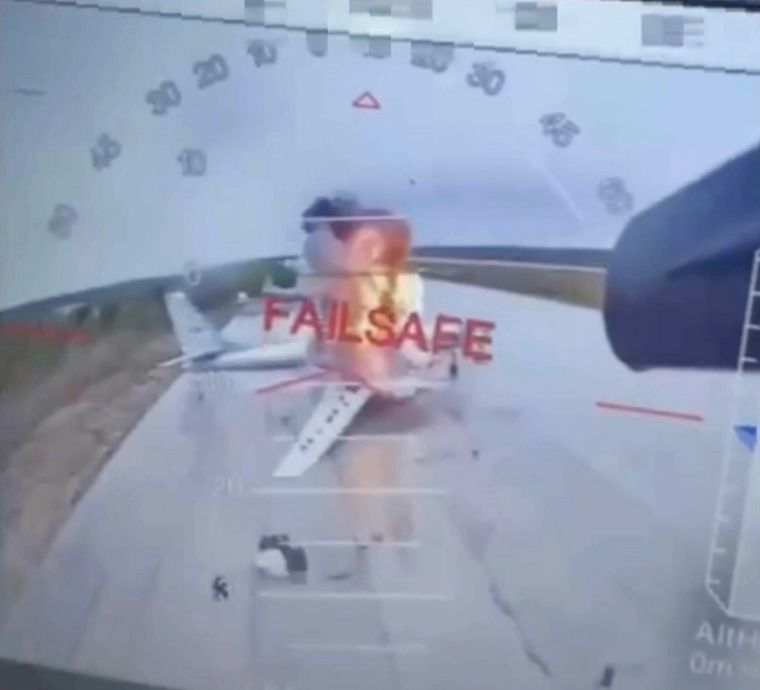 A video grab of a Ukrainian drone striking Russian planes | AP
But even before that, it was the US that used drones to devastating effect to take out the Taliban and Al Qaeda leadership in targeted killings in Afghanistan and Pakistan.
According to the Bureau of Investigative Journalism, between 2015 and 2020, the US carried out more than 13,072 drone strikes in Afghanistan, killing about 10,000 people, including a significant number of non-combatants. In Pakistan, between 2005 and 2018, there were at least 430 confirmed drone strikes that killed 4,000 people, including civilians.
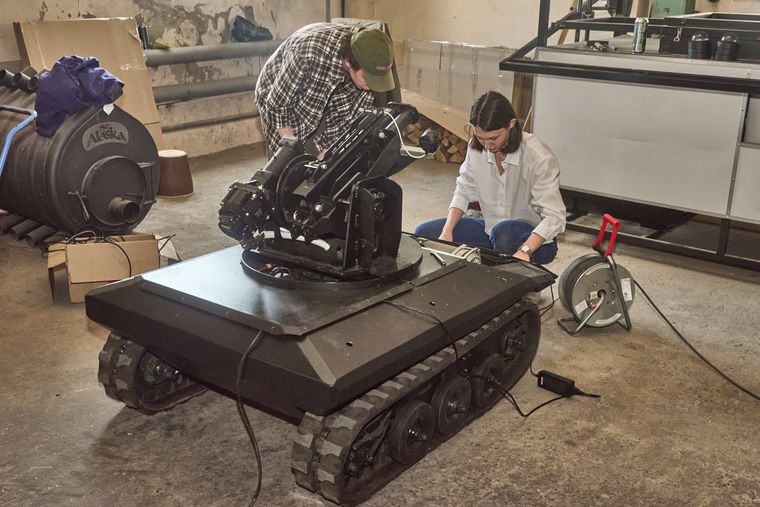 Engineers at a drone manufacturing facility in Odessa | Getty Images
It put to question a key fundamental war concept. The ground-based military had largely operated under a protective umbrella set up by the air force. But with the proliferation of drones, its swarms and loitering ammunition that operate at much lower altitudes, what is the tactic to be adopted?
Most drones operate at the intermediate layer between the earmarked zones for the air force and ground forces. At its fighting best, the drone or the unmanned aerial vehicle (UAV), or unmanned aerial system (UAS), is basically a flying robot that can not only travel long distances to ‘watch’ but also return to base. It can also patiently wait and loiter before diving in for the ‘kill’.

They cost less, have the potential for high-impact disruptions, are increasingly difficult to detect and can go to places man cannot. They navigate complex terrain and provide unprecedented situational awareness—all with minimal collateral damage and risk.
The drone has a psychological impact on both combatants and non-combatants, creating at the same time a sense of omnipresence and vulnerability.

They are also versatile; all types of drones—indoor, outdoor, short- and long-range—can be smartly positioned and weaponised for combat. With every modern-day battle, they are emerging as the frontline war-fighting tools that are capable of changing the course of a battle with their precision, autonomy and scalability.
As a top Indian Air Force officer told THE WEEK at the Aero India 2025 show in Bengaluru: “When a war breaks out nowadays, the military sends not fighter aircraft but drones.”

Drones and counter-drone measures have become a vital part of India’s military preparedness. Said Lieutenant General Sumer Ivan D’Cunha, director-general of India’s Army Air Defence (AAD): “It is a cause for concern. Earlier, we could quantify the numbers and type (quality) of weapons the aerial platforms (like fighter aircraft) can carry, but now defining the quantity and quality is a challenge.”
The AAD is mandated to take out air threats before they manifest. “Counter UAS remains a very important responsibility of AAD,” he said. “These counter-UAS systems have improved from pure jamming to ‘hard kill’, and to hybrid systems that include both passive and active detection with jammers and directed energy weapons including lasers and high-power microwave.”

The AAD has recently deployed the Integrated Drone Detection & Interdiction System (IDD&IS), developed by Bharat Electronics Limited and Defence Research and Development Organisation. It is a hybrid system with multispectral detection capability and directed energy weapons like lasers.
Lieutenant Colonel Narendra Tripathi (retd), who has 21 years of Army service and is a veteran in developing drone, robotics and AI solutions, told THE WEEK: “The challenge of countering drones remains far from fully addressed, as militaries worldwide, including India, continue to grapple with the rapidly evolving drone threat.”

Pointing to emerging challenges like swarm drone attacks and AI-powered autonomous drones, he said: “Although India is working on counter-drone solutions, including jamming, laser-based, and high-power microwave systems, these technologies are still in their early stages. Additionally, the concept of autonomous drone-carrying mothership (both naval and airborne) is being considered, providing persistent surveillance and rapid drone deployment capabilities for multi-domain operations.”
The challenge from swarms comes from the fact that AI-enabled autonomous drones operate in coordinated formations to overwhelm enemy defences. “These drone swarms will dominate future battlefields, making traditional anti-air systems increasingly vulnerable,” said Tripathi.

The Indian military has in its fleet a combination of indigenous and imported UAVs. In the MALE (medium altitude, long endurance) and HALE (high altitude, long endurance) categories for intelligence, surveillance and reconnaissance (ISR), key assets include the Israeli-origin Heron and Searcher-II, along with the indigenous Nishant and Rustom 1/2 UAVs developed by DRDO.
India has also inked a deal with the US for 31 MQ-9B Predators, while DRDO is advancing the development of Rustom 2 (TAPAS BH-201) as an armed UAV.
In the tactical segment, SWITCH by IdeaForge and Netra by DRDO are actively deployed in counter-insurgency and counter-terrorism operations. The Army has also opted for Nagastra 1 as a loitering munition with the Israeli Aerospace Industries-made Harpy forming a key component of kamikaze drones. DRDO is also developing Archer for the Navy for maritime operations.
Active collaboration between the Indian government, the industry and the academia have led to the shaping of an ecosystem that is developing a plethora of solutions.
Said Sameer Joshi, CEO and director of NewSpace Research & Technologies: “Drones enable precision strikes, rapid and real-time ISR, versatility of payloads and newer doctrinal philosophies like swarming and human-machine teaming. All this, along with a lower cost of ownership than manned platforms, results in an asymmetric impact towards battlefield exploitation for kinetic and non-kinetic missions.”
NewSpace recently unveiled its Sheshnaag 150—a swarming attack system designed for “coordinated swarm drone attacks to overwhelm and saturate enemy defences and execute precision strikes”.
Named after the hydra-headed snake from Indian mythology, it claims an operational range of more than 1,000km and an endurance of over five hours, with capability to loiter over target areas providing real-time surveillance and strategic attack options. Details are still under wraps as it may be of interest to the Indian security establishment with which NewSpace closely collaborates.
Then there is Paras Defence, a leading private player. Its director Amit Mahajan said: “We are looking at drone detection and drone jamming solutions, which would be portable and targeting a large variety of drones. These will be low-cost, high-tech systems that would have application requirements in [several areas].”
Making a strong pitch for drones, maverick US billionaire Elon Musk recently wrote on X: “Some idiots are still building manned fighter jets like the F-35.” Alongside, he posted a video showing a swarm of drones making geometrical patterns in the sky. This at a time when President Donald Trump is trying to hard-sell the top-of-the-line F-35 fifth-generation fighter to India.
Interestingly, when Trump made the first open offer of F-35s to India on February 13, one of the counter arguments in India was that manned fighter aircraft are the present, drones are the future.
But drones are also the present. And they come in all shapes and sizes. The smallest drone perhaps would be the one made by Flir, a leading camera maker. “It’s just the size of your index finger,” says Pankaj Akula, sticking out his finger. “And the biggest would possibly be the ones made by Baykar, a Turkish private company that makes the deadly Bayraktar drone.”
Founder MD of AKSI Aerospace, a company he set up in March 2024, Akula, 39, began with military drones but has now forayed into civilian ones including those meant for agriculture and industrial use.
Akula, an IIT Kanpur product, has worked on drones ever since his days at the state-owned National Aerospace Laboratories. “Drones can be a force multiplier,” he said. “With the present-day technology, drones could be a valuable replacement tool for guns and prevent loss of valuable lives of policemen and soldiers.”
At the Aero India show, AKSI Aerospace inked a Rs850 million strategic agreement with FIXAR Global for licensed drone manufacturing in India.
Another key challenge for militaries is how cheap drones have drained out expensive air defence systems and missiles. According to the US Center for Strategic and International Studies (CSIS), an Iranian Shahed drone costs less than $35,000, has a 2,000km range and can carry a 40kg explosive payload. Of rudimentary technology and with a 10 per cent hit rate, the Shahed has found a fan in Russia, which has been firing it in salvos to overwhelm Ukrainian infrastructure installations.
Said a CSIS analysis: “The Shaheds are used as much to saturate air defences as they are to attack targets, cluttering radar screens and forcing command centres to make decisions about where to fire their more capable surface-to-air missiles like the Patriot.”
Incidentally, a Patriot interceptor costs over $3 million. No wonder Russia is focusing more on quantity than quality in its projectile attacks in Ukraine.
Then there is already talk of plans to develop AI-fortified supersonic and even hypersonic drones, including in India. But in the near future, drones will see much enhanced autonomy, making them deadlier, smarter and more difficult to counter when used as part of a swarm, like wolf packs.
At the same time, the easy availability of knowhow and of materials to make a cheap and easy-to-use drone has resulted in a new threat. It is not very difficult for even a small ragtag outfit to lay their hands on drones, load them with explosives and fly them to bomb adversaries. This implies the ‘democratisation’ of air power where non-state actors and smaller military forces pose serious threats through asymmetric tactics.
Says Joshi: “Drones level the playing field for smaller or less technologically advanced forces, allowing them to challenge more powerful adversaries. This has been evident in conflicts where non-state actors have effectively used drones against conventional military forces. The focus has to be on active kinetic or directed energy platforms, especially since passive strategies like jamming will soon be redundant to counter hardened drones.”
Globally, the big combat drone makers are China, the US, Turkey and Iran. The Chinese drone market size is bigger than $15 billion while the Indian one is valued at less than $1 billion, not factoring in the $4 billion deal India has inked with General Atomics for 31 Predators.
While the drone ecosystem has rapidly grown in India, no cutting-edge drones are being made in the country. One problem is obviously the money. In such a scenario, only government-funded risk capital to private enterprises can help.
Pointing out the need for indigenisation of drone production, Sai Pattabiram, MD, Zuppa Geo Navigations Technologies, said: “[With] both Russia and Israel, India’s two largest suppliers of defence equipment, at war.... India really doesn’t have an option but to build its own future-ready defence startup ecosystem for drones.”
But what stops India from making high-end military drones? “The Indian drone ecosystem has evolved into being assemblers of imported components with very little domestic value addition,” said Pattabiram. “The competencies required to build large platforms in the MALE and HALE class do not exist in India.”
A strong commitment and policy support by the government are essential to build an atmanirbhar drone ecosystem. “Without this, India cannot achieve its true potential of evolving into a global drone hub by 2030,” he added.
Joshi said India was capable of producing a high-standard MALE UAV like the Predator and the Bayraktar. “The issue is more of the lack of clinical focus and accountability to develop such a platform,” he said.
There are other constraints, too. “Export restrictions and strategic constraints, such as the US’s ITAR (International Traffic in Arms Regulations), further limit access to cutting-edge drone technology, restricting India’s ability to develop next-generation UAVs,” said Tripathi.
However, the landscape is gradually shifting. Said Mahajan of Paras Defence: “India is in the process of developing hi-tech birds and soon you will see advanced drones either developed fully in the country or drones manufactured in India in collaboration with foreign OEMs.”
The ongoing atmanirbharta project has helped the effort towards technological sovereignty. “It will enable India to retain control over AI, swarm technology and stealth UAV capabilities, which are critical for future warfare,” said Tripathi. “The Drone Rules 2021, the establishment of defence corridors in Tamil Nadu and Uttar Pradesh, both of which aim to accelerate domestic drone production and innovation, are important steps in this effort.”
While drones are a clear and present danger to conventional military tactics, they have also ushered in a state of a ‘forever war’—a state where being on alert everywhere is the only way out. Till effective counter-UAS measures are devised, low-cost air defence systems might provide a temporary breather. But only till then.