


Five months after Bharatiya Janata Party president J.P. Nadda announced a panel to oversee organisational elections and select his successor, the process has entered its final phase. While there is an abundance of candidates, no favourite has yet emerged to be the party’s 12th president.
In the recent past, the selection of the BJP president has been relatively swift. But, the delay this time is an indication of the key responsibilities awaiting the new appointee. Beyond leading the world’s largest political party, in power in 21 states with offices in 650 districts, the incoming president could even oversee the selection of the next prime ministerial candidate.
Several factors are being considered with regard to the profile of the new president. Should the candidate be from the south―the region where the BJP is eyeing growth―or a dalit―now the only missing piece in representation in top posts? Or should it be a woman as a nod to the constituency? Or an OBC, as the opposition parties are playing the caste census card to counter the BJP’s hindutva push? Or would the party continue to give representation to the upper castes?
Party spokesperson Gopal Krishna Agarwal said the party always looks for workers who have good grooming in organisation work, are well connected to all the workers and have ideological commitment.
Interestingly, except the 1998-2004 period―Atal Bihari Vajpayee’s tenure as prime minister―when the party had four presidents, all presidents were in their 50s when they first took charge. During that Vajpayee regime, three of the four party presidents were from the south―Bangaru Laxman (61), K. Jana Krishnamurthi (73) and M. Venkaiah Naidu (63). This was a time when the BJP organisation suffered because of Vajpayee’s focus on governance. Moreover, Laxman, who was also the party’s first dalit president, had to step down in 2001, after a sting operation by a news magazine showed him accepting a bribe.
Now, almost 25 years later, the BJP is well-positioned to pick a new chief from the south if it wants to. In that case, Union Minister G. Kishan Reddy, 64, and Vanathi Srinivasan, 54, the women’s wing president, are contenders. Srinivasan, a member of the central election committee, had beaten Kamal Haasan from the Coimbatore South assembly seat in 2021. Reddy, the Telangana unit president, is close to Union Home Minister Amit Shah.

Party sources say experience in the organisation is crucial for selection as the chief.
According to the BJP constitution, candidates must have 15 years of experience in the party. Therefore, when more recent joinees are ruled out, the pool from the south is limited.
The last two presidents, Nadda and Shah, had both served as general secretaries. If the same criteria is used, the candidate pool would narrow down to current party general secretaries, with Sunil Bansal, Vinod Tawde and Dushyant Gautam being prominent considerations. Bansal, 55, has proved his mettle as an able organiser and astute election manager as he steered the party to victory in Uttar Pradesh in 2017. He became a national office bearer in 2022 and has been given the responsibility for three tough states―Odisha, Telangana and West Bengal. Odisha has been a resounding success and Telangana has seen remarkable improvement (with Reddy serving as state chief).
Tawde, 61, a Maratha, is in-charge of Bihar, where the BJP is eyeing a repeat of its Maharashtra success of having its own chief minister. And, Gautam, 67, a dalit face of the party, would have been in contention to be Delhi chief minister if he had not lost in the recent assembly polls. Another dalit face in the government is Union Law Minister Arjun Ram Meghwal, 71.
The pool gets wider when the names of other party leaders who have proven their mettle in managing several elections and playing crisis managers are added. Here, the names of Union ministers Dharmendra Pradhan and Bhupender Yadav come into play. The two are prominent OBC faces in the Modi cabinet with formidable election experience. Pradhan was with the Akhil Bharatiya Vidyarthi Parishad―a popular route to key assignments in the BJP―and has in the past served as party general secretary and election-in-charge for Uttar Pradesh, Bihar and most recently Haryana. Yadav has wide experience in managing elections, right from assembly polls to the presidential election.
As the opposition steps up its caste-based narrative, having an OBC president would help the BJP. Till now, the party has not needed an OBC face in a prominent role in the party because Modi has been its OBC face. Indeed, except Laxman, all BJP chiefs have been from the upper caste―the party’s core vote bank. The choice of party president would also give a hint about the likely prime minister candidate in 2029 as both can’t be from the same grouping of caste or community.
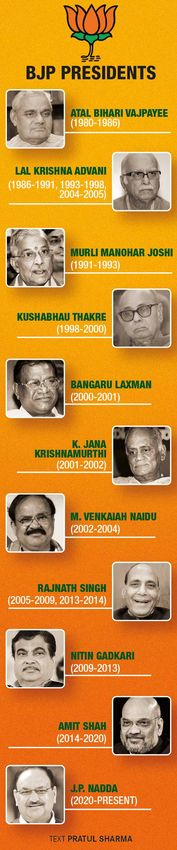
The most crucial factors in deciding the next party president would be the trust of the Modi-Shah duo and a stamp of approval by the party’s ideological mentor, the Rashtriya Swayamsevak Sangh. The RSS may prefer a leader who would be able to take everyone along and is a binding force for all the divergent voices and personalities. The importance of the RSS became evident in the aftermath of the discord between the BJP and the RSS during the Lok Sabha polls. Subsequent assembly polls, be it Haryana, Maharashtra or Delhi further proved that the combined organisational strength of BJP and RSS cadre could turn around even tough contests.
In its centenary year, the RSS will plan its future at its annual meeting on March 21-23 in Bengaluru. RSS chief Mohan Bhagwat insists on maintaining cordiality. The growing clamour to regain disputed structures may need a BJP leader with strong presence to guide the sentiment, as Bhagwat recently said. There is also a feeling in the RSS that a generational change should be brought in the party to address any gap after Modi. “The gap was visible after Vajpayee and L.K. Advani; the next generation of leaders was not groomed to helm the party,” said an RSS insider.
That generational change is already visible as the BJP is picking chief ministers in their 50s who come with an RSS association. This trend may also rule out those who are not from the sangh parivar for the president’s post.
Two senior leaders tick most of the boxes―Shivraj Singh Chouhan, 65, and Manohar Lal Khattar, 71. But, age is against them. Chouhan, considered a favourite, was also an alternative to Modi before 2013―a ‘limiting’ factor in his rise.
The BJP has carried out extensive organisational overhaul starting with the booth-level committees―only when 50 per cent of such panels are formed are polls to mandals held. And when 50 per cent of mandals are completed, the district chiefs are elected or nominated. When half the district chiefs are elected, a state chief is eligible to be picked. Now, the BJP is inching towards completing the selection of at least 18-20 of the 36 state units, after which the national president can be elected.
“Mandal-level elections are over, most of the district president elections have also been completed,” said Agarwal. “Now 13 states have new presidents. The [50 per cent] requirement will be completed soon. Then the national president election will take place.” There are indications that the new chief will be picked ahead of the RSS meeting.
However, organisational elections were delayed in some states like Karnataka and Madhya Pradesh because of warring factions. Ideally, the party would prefer new chiefs of bigger states like Karnataka, Uttar Pradesh, Madhya Pradesh and Gujarat being picked before the national president is decided.
The delay has unsurprisingly led to much speculation. But everyone in the party is also aware that the Modi-Shah duo is capable of springing a surprise, as they have done over the years while picking candidates for the roles of president, vice president and chief ministers.
“There is an unwritten rule in the BJP: whomsoever’s name is discussed in public is often rejected,” said a senior party leader. “The wiser ones stay quiet.” As a result, dark horses emerge often. Union Sports Minister Mansukh Mandaviya and former cabinet minister Anurag Thakur are among the dark horses in this race.