


Shivraj Singh Chouhan looked suitably sombre during the swearing-in of his cabinet ministers on April 21. His day had started with the news of a police inspector in Ujjain succumbing to Covid-19, the second such death in Madhya Pradesh within 48 hours. Naturally, the shadow of the pandemic hung heavy as Govind Singh Rajput, Kamal Patel, Meena Singh, Narottam Mishra and Tulsiram Silawat were sworn in.
The cabinet formation came almost a month after Chouhan became chief minister in dramatic fashion; the Kamal Nath government was toppled by defecting Congress MLAs and the BJP returned to power.
Chouhan attributed the delay in appointing ministers to the pandemic and said more would be appointed after lifting the lockdown. Political analysts, however, felt that Chouhan kept the cabinet small because of other compulsions. Basically, it was the BJP central leadership that had pushed through the decision, under pressure from the Congress, and Chouhan did not have much say in the matter, including in the choice of ministers.
There are too many strong contenders for cabinet posts, including BJP heavyweights and 22 former Congress MLAs who recently joined the party along with former Union minister Jyotiraditya Scindia. At least 10 of them were promised ministerial berths.
The BJP does not want political dissension to boil over, said analysts, when the pandemic is worsening and Madhya Pradesh has the third-highest death toll in the country.
The first Covid-19 cases in Madhya Pradesh were reported in Jabalpur hours after Kamal Nath resigned as the chief minister on March 20. The situation worsened over the next few weeks, especially in commercial capital Indore. As on April 26, the state had recorded 2,090 cases and 103 deaths, and the mortality rate in the state (around 5 per cent) is well above the national average of 3.2 per cent.
Health activists and the Congress have been pointing to the poor health infrastructure, lack of health care access to non-Covid-19 patients, scarcity of testing kits and other hurdles. The state government has tried to take multiple preventive steps, including lockdown in hotspot districts, increasing screening and community sampling, adding to the number of labs, sending out samples to laboratories in other states, and making attempts to start plasma therapy. The situation, however, remains critical.
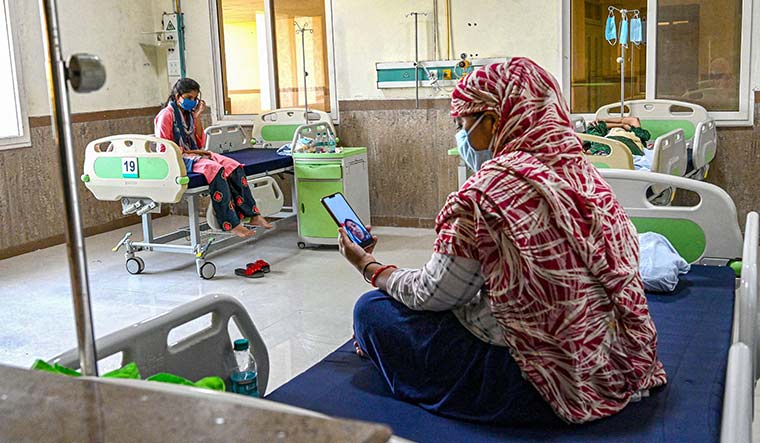 Bridging the gap: A woman suspected of having Covid-19 speaks to a relative from the isolation ward of a hospital in Jabalpur | PTI
It is in this situation that the BJP has to prepare for the upcoming byelections to 24 Assembly seats, necessitated by the defections and two deaths. The Congress currently has 92 MLAs, the BJP 107. There are four independents, two Bahujan Samaj Party MLAs and one from the Samajwadi Party. All seven had supported the Congress government and could turn with the tide again.
The biggest test would be for Chouhan, who overcame strong opposition from within the party to become chief minister for the fourth time. That the current cabinet has none of his confidants would also impede him.
“It is actually a disastrous and suicidal move by the BJP to constitute this truncated cabinet at this point of time,” said political analyst Girija Shanker. “They could have continued without a council of ministers or should have constituted the complete cabinet.”
Not having a council of ministers would have kept all the aspirants hoping and prevented the current resentment, he said. “One thing has become clear,” he said. “As two of Scindia’s supporters have been included in the cabinet, there would be 60:40 share for the original BJP cadre and the new entrants. This means the space for the original BJP cadre will shrink considerably.”
Political writer Manish Dixit said that the exclusion of strong contenders such as former leader of opposition Gopal Bhargava sent out a bad message to the party cadre. “This is probably for the first time in the history of Indian politics that a leader of opposition in a state did not become even a minister when his party assumed power,” he said.
Though Bhargava told THE WEEK that he was not disappointed by the development, there was a hint of pain in his tone. “I have been working for the party for 40 years and have been an MLA for most of the time,” he said. “In those days, I never dreamt that my party would ever assume power, but I continued working. I have been a cabinet minister for 15 years and then as leader of opposition, too, I had the rank of cabinet minister. So, I do not aspire for anything more. Politics has changed over time and now there are two clear breeds of politicians—the ones who want something from the party and politics and the ones who believe in work. There are a lot in the first category these days; I belong to the second.”
Those in the Scindia camp might also be worried. Though most of them come from the Gwalior-Chambal belt, where Scindia is influential, none from the region were included in the cabinet. “Also, the fact that Scindia himself has not yet been given a ministerial berth at the Centre might be playing on their minds,” said Dixit.
Apparently, the BJP had told Scindia that he would be made a Union minister after he was elected to the Rajya Sabha, and all his MLAs would either be made ministers or be given top posts in state boards and corporations.
But given the uncertainty, leaders such as Bisahulal Singh and Aidal Singh Kansana, who switched to the Scindia camp after Kamal Nath denied them ministerial berths, might be feeling let down, said Dixit.
“The BJP will face big trouble when it tries to field to all the defectors in the byelections,” he said. “Some prominent BJP leaders had lost to these defectors in the Assembly elections." If they feel diminished in their own regions, he said, then the BJP may also suffer defections.
Political writer Rasheed Kidwai said, “Three of the five ministers—Narottam Mishra, Kamal Patel and Tulsiram Silawat—have held health and medical education portfolios in the past 16 years. It was during their terms that the state’s health infrastructure worsened. They will surely be held accountable by the people.” He said Scindia's position had weakened; the two ministers from his camp got relatively lightweight portfolios, and popular leaders such as Imarti Devi were left out.
BJP state president Vishnu Dutt Sharma, however, played down the possibility of strife in the party. “No one is angry,” he told THE WEEK. “Everything is fine. Our priority is handling the Covid-19 situation with all our might. There was a feeling that the chief minister was handling multiple responsibilities for a long period and he needed a support system. Therefore, a small cabinet was formed. The expansion will be considered when the situation is normal.”
Said Pankaj Chaturvedi, who jumped ship with Scindia: “We are all in the BJP now and it does not matter who has been made minister or not. It is the prerogative of the chief minister. There should not be any politics on the issue of cabinet constitution when we are faced with this pandemic.”
Congress leader and former minister P.C. Sharma said the negativity around the pandemic would surely affect the BJP and the state government. “The party is responsible for the worsening of the pandemic not just in Madhya Pradesh, but also in the entire country,” he said. “It delayed the lockdown and other preventive measures simply to grab power in the state. Now, in government, too, it is failing to handle the situation. Common people are suffering because of a huge loss of livelihood and jobs, and measures such as the holding back of DA (dearness allowance) hike. All this will fuel public anger. Then there is the tussle within the party due to the defectors' entry. Scindia himself will not be comfortable as there are multiple centres of power in the form of central leaders and the RSS (Rashtriya Swayamsevak Sangh). Internal surveys are already showing negative tidings for the BJP. The Congress will certainly make its mark in the byelections.”
Kidwai argued that, during his three consecutive terms as chief minister, Chouhan had an absolute majority and his leadership qualities were never put to the test. “Riding on statistical jugglery, he managed to get several awards from the erstwhile UPA (United Progressive Alliance) government and consolidated his position as a people's leader on the basis of populist measures like Kanyadan and Ladli Laxmi schemes for girls, teerthyatra (pilgrimage) scheme for senior citizens. Also, a large section of the media was favourable to him. But, the current situation is totally different.”
Usually, Chouhan would be in yatra mode, connecting with the people. “But now he cannot make that connect in the lockdown, and he is not comfortable handling technology,” said Kidwai. “So, it is the bureaucracy that is basically running the show. His own touch is missing and this is going to hurt him badly.”
As Shanker said, “The Covid-19 situation has taken away the chief minister's [advantage] of direct contact with people. There is a lot of suffering due to the lockdown and it is only growing. This will surely harm the prospects of the ruling party because people usually hold the government responsible for any suffering. There is a growing feeling that the Shivraj government is as good or bad as the previous Congress government and this does not augur well for the BJP. Shivraj is losing out on the goodwill that he created over the years. They (the BJP) might consider the coronavirus as a political shield, but it will actually lead to heavy losses for them politically. That is the irony of the situation.”