



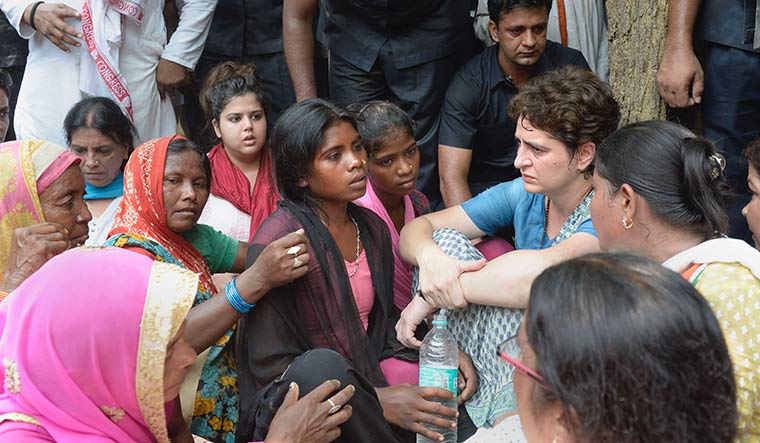
As Priyanka Gandhi dug in her heels at Mirzapur, insisting on meeting the families of the ten adivasis killed over a land dispute in Sonbhadra district in Uttar Pradesh and declaring that she was ready to go to jail for their cause, the Congress, desperate for a turnaround in its fortunes, was stirred into activity.
Comparisons were immediately drawn between Priyanka’s detention and Indira Gandhi’s Belchi moment of July 1977. Indira had arrived in Belchi village of Bihar’s Patna district to meet the families of 11 dalits who had been killed by an upper caste gang. The powerful image of Indira arriving in the flooded village atop an elephant marked her political comeback after her post-Emergency electoral decimation.
Priyanka was kept in detention at the Chunar Fort in Mirzapur, and party leaders shared visuals of the place not being provided with electricity or water, eager to convey the hardship being endured by their leader. When the local administration urged Priyanka to furnish a bond of Rs50,000 for bail, she refused. “Ek paisa nahin bharungi (I will not pay a single paisa),” she said, amidst loud applause from party workers.
Enthused by Priyanka’s combative stance, the Congress got ready with plans to hold agitations across the country to protest the Sonbhadra killings and also the high-handedness of the Yogi Adityanath regime in dealing with Priyanka’s visit. Priyanka’s Sonbhadra sojourn contrasted sharply with her brother Rahul Gandhi’s recent visit to Amethi, which evoked a completely different mood. Rahul did not heed the calls from Congress workers to take back his resignation as Congress president, although he promised them that he would carry on the fight against Prime Minister Narendra Modi, Chief Minister Yogi Adityanath and local MP Smriti Irani.
Nearly two months after Rahul made it clear that he was quitting, there is little clarity on how and when the Congress will zero in on his successor. And, the leadership vacuum is not helping matters as the Congress struggles to control infighting and the exodus of leaders in several states, especially those that will see assembly elections later this year.
Some voices have emerged of late, calling upon Priyanka to take on the mantle despite Rahul having made it clear that the new party chief has to be a non-Gandhi. Priyanka’s detention in Mirzapur has only added to the buzz, reinforcing the sentiment that only a Gandhi can keep the Congress together.
“No one will be more acceptable to all Congress members than Priyanka Gandhi to lead the Congress, since Rahul Gandhi has offered his resignation. She has the capability of taking all the Congress leaders and workers together,” said Congress leader Anil Shastri.
A party leader close to Priyanka, however, rubbished the speculation. “Jaise Arjun ki nazar sirf machli ki aankh par thi, Priyankaji ko sirf Uttar Pradesh nazar aa raha hai (Just as Arjun focused on the eye of the fish, Priyanka can see only Uttar Pradesh),” said the leader. He clarified that Priyanka’s mission was to prepare the Congress for the assembly elections in Uttar Pradesh in 2022, and her agitation over the Sonbhadra killings was just a teaser of what she was planning to do.
“The issue is not of leadership. It is of wiping the tears of the oppressed. We are all ready to stand behind Priyankaji in her fight to provide justice to the victims of Sonbhadra,” said Randeep Singh Surjewala, head of the Congress communications department.
The calls for Priyanka to take charge have come amidst growing restlessness within the party over the leadership issue. In the letter announcing his resignation, Rahul had suggested that the party should constitute a group of leaders to decide on his successor. Also, he said that he would not be associated with the process. Subsequently, a group of senior Congress leaders including Ghulam Nabi Azad, Ahmed Patel, Anand Sharma, P. Chidambaram, Motilal Vora, K.C. Venugopal, Jyotiraditya Scindia and Surjewala have held meetings. A party leader associated with the process said suggestions were sought from other senior leaders, including Congress chief ministers. A shortlist will be prepared, which will be forwarded to the Congress Working Committee (CWC). The final selection is likely to be made only with the nod of the Gandhis.
A meeting of the CWC to accept Rahul’s resignation and to decide on his successor can take place only after a consensus is evolved on the issue. Several names have done the rounds as probables for the post, which include veteran dalit leaders Mallikarjun Kharge and Sushilkumar Shinde, the ever-dependable Mukul Wasnik and Rahul’s contemporaries Sachin Pilot and Scindia.
The choice of the new Congress chief is not proving to be easy as it has to be someone who can take everyone along and can command the authority to bring about a definitive revival of the party. Political expert Ram Bahadur Verma said the task was made difficult as Rahul remained the most popular Congress leader. “Rahul Gandhi is making a big mistake by stepping down as Congress president,” he said. “He will only end up weakening the party with this decision. He should not decide on the basis of emotions.”
Also, it is being debated whether the reins of the party should be given to a young leader rather than a veteran. Punjab Chief Minister Amarinder Singh has called for a young party chief, and his comment is being interpreted as a preference for someone who can bring about a difference in the party instead of just keeping the chair warm for a Gandhi.
“Rahulji has always spoken about the need to encourage young talent at all levels in the party. It will be good if the younger generation gets a greater say in the decision-making process,” said Rajesh Lilothia, who is one of the three working presidents of the Delhi Congress. A formula being talked about in the midst of the old versus young debate is whether a veteran leader can be the president, assisted by a team of vice presidents or working presidents, who can be from the younger generation.
The delay in finalising the new president has led to aggrieved voices protesting the “chaos” and “disorientation” in the party. One such voice is that of veteran leader Karan Singh, who wrote, “Instead of honouring his [Rahul’s] bold decision, a month was wasted in pleading with him to take back his resignation which, as a man of honour and integrity, he should not have been pressured to do.” He said the CWC should meet under the chairmanship of former prime minister Manmohan Singh to decide on the issue, and that the party should appoint an interim president and four working presidents or vice presidents.
Senior leader Janardan Dwivedi has questioned the ‘business as usual’ attitude of Congress leaders following Rahul’s resignation, the indication being that the rush of resignations by other functionaries that was expected has not happened. “The party president submits his resignation and the party carries on with work as usual. If you look at the contents of [Rahul’s] letter, it is clearly stated, ‘I take responsibility as party president, and I am doing so since otherwise I cannot hold others accountable.’ I feel, the indication was clear.... But the people who are in responsible positions, they should have followed it. That did not happen,” he said.
Dwivedi is also against the process being adopted for the selection of the new president. Asked Dwivedi, “How will the new Congress president be selected? Has this been discussed in the CWC? No. What kind of a committee is this where A.K. Antony has not participated? If there was a formal composition, it would be more credible.”
As discussions drag on, accentuating the leadership crisis, the Congress is in serious trouble in several states, the problems ranging from bitter infighting to legislators leaving for greener pastures. The Congress-JD(S) government lost the trust vote in Karnataka, while party MLAs quit en masse in Telangana and Goa to join the ruling parties. In Maharashtra, the Congress had to endure the ignominy of its legislative party leader Radhakrishna Vikhe Patil jumping ship and joining the BJP-led government. The Congress government in Madhya Pradesh, which has a wafer-thin majority, is on high alert.
The state units in Punjab and Rajasthan are witnessing personality clashes. If Navjot Singh Sidhu is on the warpath against Amarinder in Punjab, in Rajasthan, Chief Minister Ashok Gehlot and Deputy Chief Minister Sachin Pilot have an extremely uneasy working relationship. In Haryana, the state unit is literally torn apart by intense factionalism even as the knives are out for state president Ashok Tanwar. And, Delhi stares at a leadership crisis following the death of state president Sheila Dikshit.
The central leaders are finding themselves torn between dealing with the leadership crisis at the Centre and the problems in the states. Also, there is lack of clarity about who is in charge. “The authority of the Congress general secretaries is also under question. This does not help matters when the state units are in turmoil,” said a Congress leader.
As the leadership issue drags on, the Congress is clearly struggling to come out of the tailspin.
