



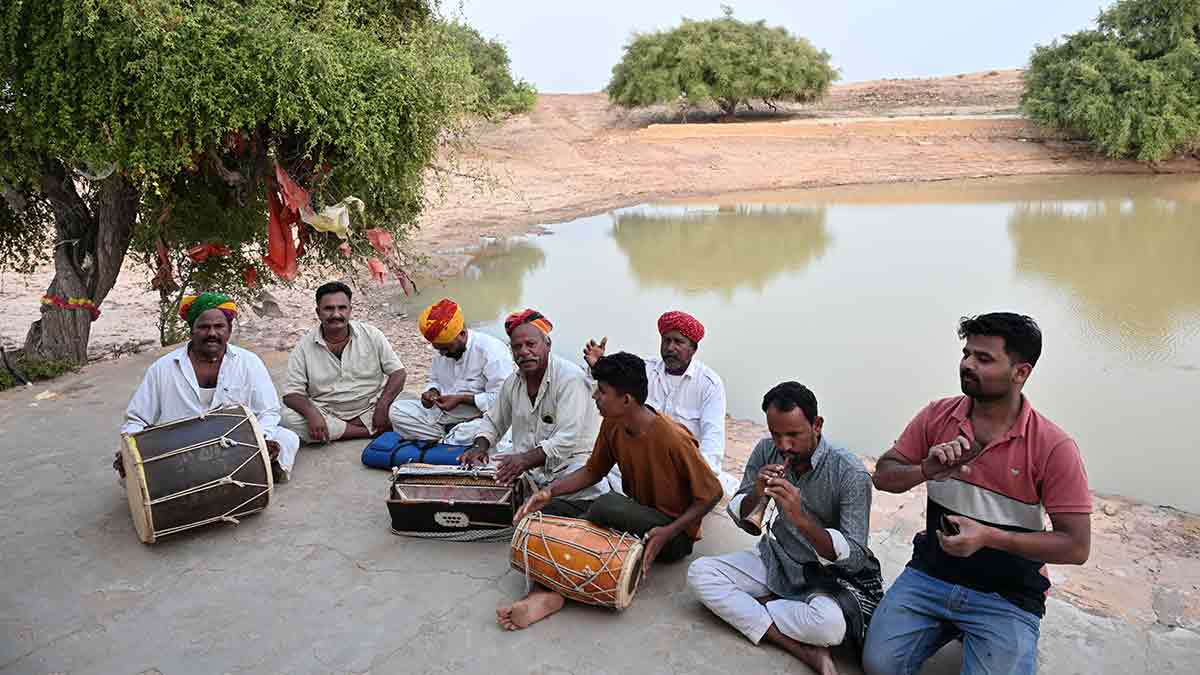
At Mokla village, about 30km northwest of Jaisalmer city, it is a sight like none other—a bowl-shaped scrubby landscape dotted with khejri, ber (jujube), ker (wild berry) and other flora, with a nadi, an artificial pond to collect rainwater, at the centre. A temple, white in colour and covered with striking frescos, instantly catches the eye. Here, Manganiars, the Thar’s renowned Muslim folk singers, perform tales of Dungar Pir Ji—a cultural and spiritual figure revered locally as a medieval war hero—often invoking Radha, Krishna and Ram.
This is an oran, a sacred grove, dedicated to Dungar Pir Ji. And it is 800 years old, as old as the Jaisalmer Fort, which means “this land has not been tilled, with the villagers not having plucked even a leaf from here for 800 years”, says Parth Jagani, a Jaisalmer native who works on ecology in the region, particularly on the Great Indian Bustard, Rajasthan’s state bird.
Revered as sacred spaces, there are many orans in the region, dedicated to deities, war heroes or women who committed sati, weaving history, culture, spirituality and also livelihoods. Though the land remains untended, it plays a vital role in pastoralism, supporting the cattle that graze there. The orans are also a crucial source of water for both people and wildlife, highlighting how communities in these remote, fragile ecosystems have developed resilient, centuries-old systems to make the most of scarce water resources.
“With minimal human intervention, we have rich biodiversity here,” says Jagani. “In the mornings, you can spot over 70 bird species. Three years ago, we even sighted the critically endangered Great Indian Bustard. The area is also home to foxes, jackals, chinkara (Indian gazelle), as well as khejri, ker, desi babool and rohida trees.”
However, these sacred groves and the flora and fauna they have protected for centuries are now under threat. With a major push for solar energy, a crucial part of India’s environmental commitments, the land which currently comprise these orans is being allotted to solar companies all across the region, says activist Sumer Singh, who led a protest against the action.
“Orans are important not just for our beliefs, but for our very survival,” he says. “We are herders, and our cattle graze here. It is the backbone of the poor in this region. Where would we go otherwise? Wherever solar energy is being installed, trees are being wiped out overnight.”
Having been deemed as wastelands since independence, a Supreme Court committee in 2005 recommended that orans be classified as forests except for “small fragmented areas, which are difficult to manage”. In December 2024, the Supreme Court directed the state to recognise orans as forests.
Last year, widespread protests also broke out against Adani Green Energy Limited at Jaisalmer’s Baiya. And at the centre of the protest was a 600MW solar power plant the company had proposed, which, the locals said, would threaten their orans.
“The sacred groves are being allotted to these companies because when the land allotment first happened, we couldn’t get them in the temple’s name, because of which it became government land,” says Singh.
Rajasthan has set an aim to increase its solar energy capacity from 29,546.70MW, currently installed, to 90,000MW by 2029-2030. It already is the biggest producer of solar energy in India. According to reports, in the last 14 years, about 2.5 million trees have been cut for 21,000MW of solar energy in the state, causing significant damage to native vegetation and wildlife.
It is an ambitious target for India’s climate-change commitments—one that, paradoxically, comes at the cost of centuries-old ecosystems and traditional systems.
Meanwhile, it is past sunset at Dungar Pir Ji’s oran. After praying at the temple, villagers sit together to share prasad (offering) before returning home—a quiet testament to their shared reverence towards the oran.
