



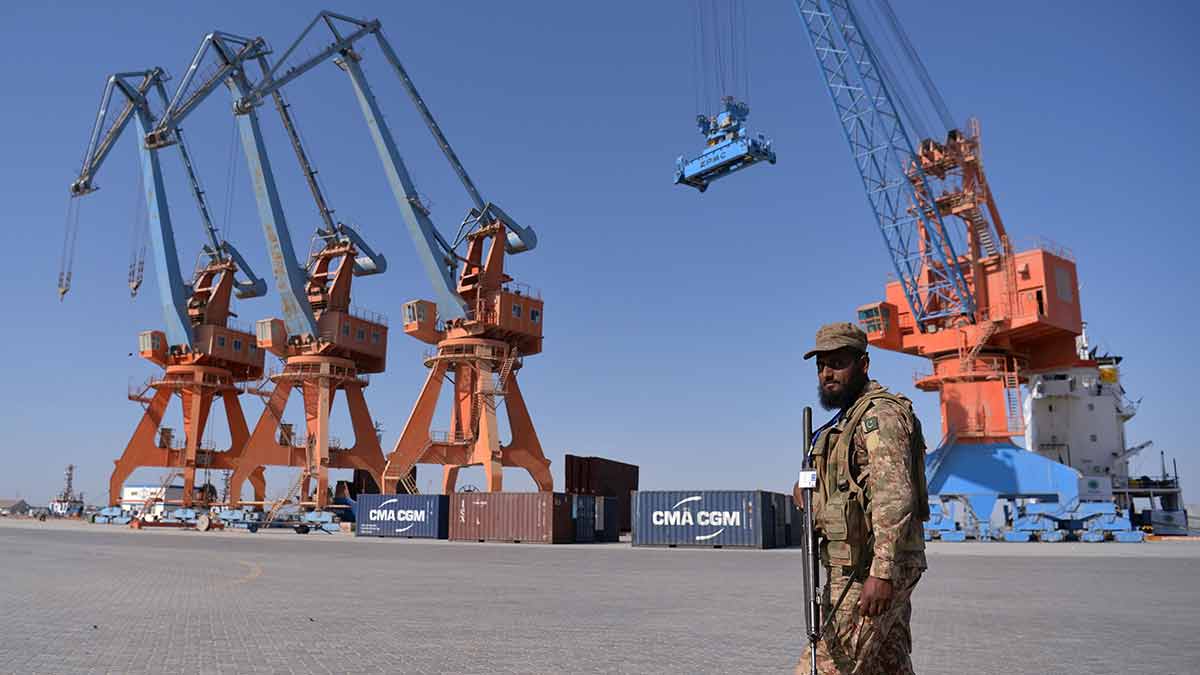
India’s neighbourhood is abuzz with major Chinese initiatives such as the Teesta River project in Bangladesh, the Gwadar port in Pakistan and the upcoming Sinopec oil refinery in Sri Lanka. What is completely under the radar is the extensive proliferation of small businesses owned by the Chinese around these major projects, along with a growing presence in universities, research centres and, more covertly, in cyberspace through criminal networks. All of these have wide-ranging implications, not just for the host nations but also, directly or indirectly, for India.
In Pakistan, the commencement of the delayed second phase of the China–Pakistan Economic Corridor (CPEC) marks a shift from government-to-government deals to business-oriented initiatives in sectors such as industry and agriculture. One example is the proposed establishment of a massive textile factory in Karachi’s Special Economic Zone, with an investment of around 17 million Pakistan rupees. While this is above board, there are reportedly 414 Chinese businesses already operating in Karachi, 988 in Islamabad and over 500 in Lahore. In Muzaffarabad, data suggests the presence of over 3,000 Chinese workers engaged in projects such as the Karakoram realignment and three hydropower plants. These locations likely host Chinese security personnel, with three major firms linked to former PLA (People’s Liberation Army) officers operating in Pakistan.
The story continues in Bangladesh, where figures indicate the presence of around 98,000 Chinese nationals, primarily in Dhaka and Chittagong in a variety of small businesses. The Chinese Exim Bank has recently announced plans to relocate manufacturing plants to Bangladesh to benefit from its favourable export tariffs and strategic location. Sri Lanka, too, has witnessed a similar wave of Chinese immigrants, who have set up supermarkets, salons and retail stores to serve the growing Chinese workforce.
No figures exist for the Maldives, but research reveals that, in addition to gated communities housing Chinese workers involved in infrastructure projects, Chinese firms have discreetly partnered with local companies. A case in point is Horizon Fisheries, part of the Villa Group, owned by a politically influential Maldivian figure often referred to as a ‘kingmaker’. A significant portion of the profits from Horizon reportedly goes to Zhoushanshi Putuo Dongnani Import and Export Limited (ZPD), a small Chinese investment firm with no registered office. This shows a certain modus operandi involving land acquisition via local fronts amid widespread corruption.
Chinese involvement in educational and research institutions is increasing. Notable examples from Pakistan include the University of Gwadar’s CPEC Study Centre and Chinese language centre, the China Technical and Vocational Institute and a recent agreement to establish centres of excellence in agriculture, including a biotech centre in Sargodha. In Sri Lanka, several Chinese language centres have been established alongside Confucius Institutes at the Universities of Peradeniya, Kelaniya, Jayewardenepura and Colombo. The demand for Chinese teachers and textbooks is growing steadily in Bangladesh, too.
Where there is a high concentration of people and economic activity, corruption and criminal networks inevitably follow, now spilling over into cyberspace. Cyber platforms are increasingly being used for illicit trade and money exchange. In Pakistan, criminal cases involving Chinese nationals range from human trafficking—such as the notorious “Pakistani brides” scandal—to recent arrests in Faisalabad, where 71 Chinese were detained at the home of a former head of the local power grid. In both India and Bangladesh, online scams often originate from Chinese entities offering fake employment opportunities.
Sri Lanka faces additional problems. The Colombo High Court recently seized over 201 million Lankan rupees from the account of a Chinese businessman involved in a decade-long smuggling and money laundering operation.
The drug trade is even more ominous, with Chinese and Pakistani gangs operating jointly in the Maldives and Sri Lanka, while Chinese Triads control narcotics trafficking from Myanmar into Bangladesh and India’s northeast. Pakistani drug lords cover the Afghan axis, pushing massive consignments into India and Europe.
The scope of Chinese activity across South Asia goes far beyond grand projects like hydropower, energy and connectivity. Large-scale undertakings often come with an influx of Chinese nationals, businesses and soft power projection. In Bangladesh, a major hospital project along the Teesta River involving Chinese cooperation is progressing, despite prior Indian agreements with Dhaka. As this hospital rises, more Chinese businesses are expected to follow.
It is reasonable to assume that Chinese nationals involved in business abroad undergo thorough vetting before deployment. Many may knowingly or unknowingly serve as components of China’s broader intelligence and information gathering apparatus. This level of integration is not incidental but rather part of official policy, often linked to initiatives like the Belt and Road Initiative (BRI).
The close, often obscured connections between Chinese criminal syndicates and state-linked institutions remain insufficiently explored. All signs point to an intricate, interlinked network—much like a giant spider web—whose many seemingly independent strands work in coordination to expand and entrench Chinese influence across the region.
The author was director, National Security Council Secretariat.
