



SRINAGAR
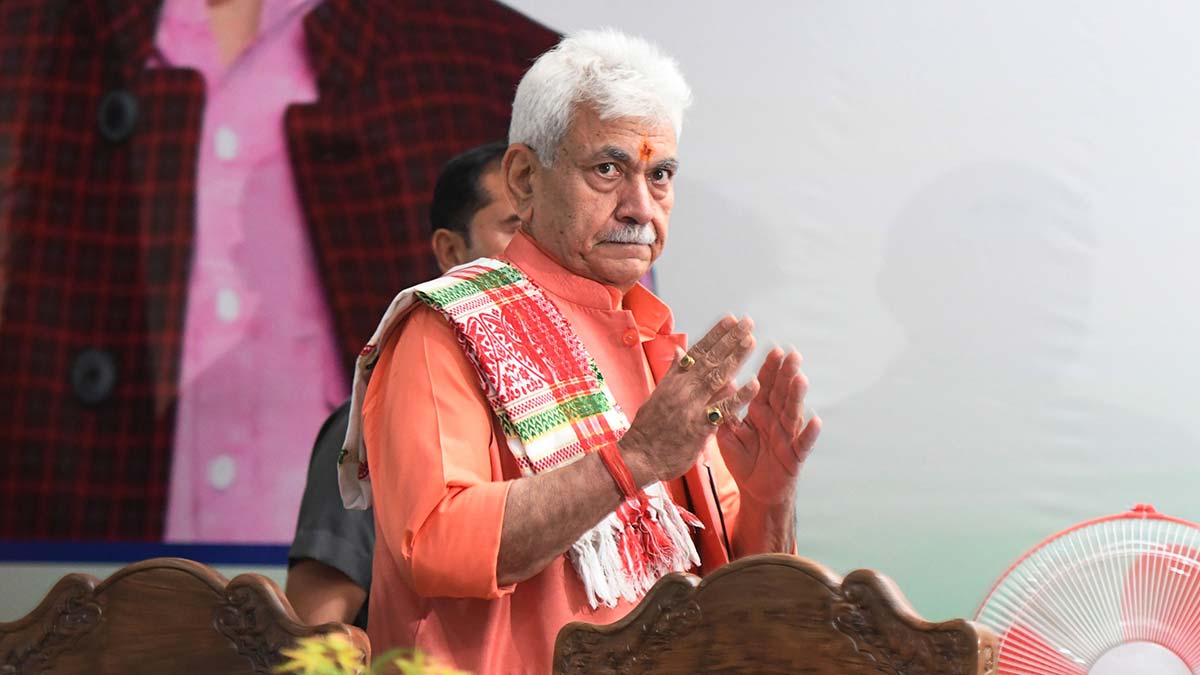
Interview/ Manoj Sinha, lieutenant governor Jammu and Kashmir
he skies are clear after the drone raids of May, but counter-terrorism operations continue quietly on the ground in Jammu and Kashmir. While there is no huge presence of soldiers in uniform, security forces are active behind the scenes, carrying out operations in Pulwama, Tral, Shopian and Baramulla. “Operation Sindoor continues,” said Jammu and Kashmir Lieutenant Governor Manoj Sinha, referring to the active counter-terror measures that follow the military confrontation with Pakistan. Launched after the brutal terror attack in Pahalgam on April 22, the cross-border operation targeted Pakistan-based terror camps. Sinha, who also holds key responsibilities for law and order in the Union territory, told THE WEEK in an exclusive interview that any act of terrorism would be treated as an act of war.
Beyond the immediate security response, another battle is unfolding quietly within Kashmiri homes that have suffered the impact of decades of terrorism. Sinha said the fight against terrorism must also address justice and relief for victims, adding that bringing support to those affected over the past three decades remains a critical challenge. Edited excerpts from the interview:
Q/ The number of terror incidents had declined in Jammu and Kashmir before the Pahalgam attack on April 22. What are the key security challenges now?
A/ Local recruitment into terror ranks has drastically fallen. Earlier, 100–150 youth used to join militant groups each year. This year, there has been only one recruitment. Last year, there were just six or seven. This shows that people have started trusting peace and development. The number of stakeholders in peace has grown and prosperity has changed lives. I believe this is a historic shift in the last five to six years. The number of terror incidents shows that our neighbour continues to send infiltrators. Security forces are alert. Many operations are successful, some are ongoing. The coordination among the Army, police and Central Armed Police Forces remains strong.
Q/ The government has said that Operation Sindoor continues. What has changed in the way security forces are operating in Jammu and Kashmir?
A/ Operation Sindoor continues. The prime minister said clearly that terror and tourism would not go together, terror and trade would not go together and water and terrorism would not flow together. Any act of terror will be treated as an act of war. The armed forces are fully alert. In just three days, terrorist hideouts were destroyed (during Operation Sindoor). When Pakistan targeted our military installations, we responded directly. The message was clear: everything in Pakistan is within our reach. The country and the world witnessed it. Pakistan’s claims were proven false and our indigenous defence systems showed their capability.
Pakistan is using terror as a state policy. It does not bother whether its citizens are provided basic living conditions and survives on loans from other countries. India, on the other hand, is the fourth largest economy in the world and is striving to become a developed country. So, there is no comparison between the two countries, and we cannot foresee a stable Pakistan in the coming years.

Q/ You have spoken about ‘Naya Kashmir’, but there is still no timeline for the restoration of statehood.
A/ This is New Kashmir—no Pakistan calendar, only academic calendars. Cinema halls are running again. After 33 years, Muharram processions have been held for three consecutive years. Hindus, Muslims, Sikhs and Christians all celebrate their festivals proudly. Amarnath Yatra is successful. Youth are getting jobs. The economy has doubled. The youth of Jammu and Kashmir now share the aspirations of a developed India. As far as statehood is concerned, when the Article 370 abrogation bill was passed, the government said three steps would follow: first delimitation, then elections and then statehood at an appropriate time. Delimitation happened. Elections were held peacefully and a government was formed. Now the final step—statehood—will also happen. It was said in Parliament and it will be honoured. But the word used was “appropriate time”. The prime minister reiterated that last year in Srinagar. We must wait for the right time.
Q/ Omar Abdullah says his position has been downgraded from chief minister of a state to chief minister of a Union territory. There is a feeling that the state government has been disempowered.
A/ When Omar Abdullah was fighting the assembly elections, it was clear that it was the Union territory which was holding its elections. The Election Commission had specified that, and every citizen in this country knew that. He willingly participated in the elections and won. So, it is obvious that when he becomes chief minister, he will be the chief minister of a Union territory. It is true that the Central government has assured that the statehood of Jammu and Kashmir will be restored at an appropriate time, so he can make this demand.
Q/ Concerns persist about the balance of power between the chief minister and lieutenant governor. How is your relationship with Omar Abdullah?
A/ I have cordial relations with the chief minister. We meet often at conferences and other occasions. As for powers, they are clearly defined in the State Reorganisation Act. The roles of the lieutenant governor, chief minister and the elected government are well laid out. I know my constitutional limits and will never act beyond them.
Q/ Former chief minister Mehbooba Mufti says there is selective targeting of government employees who are being removed based on allegations of terror links under Article 311.
A/ The framers of our Constitution included Article 311 to protect the state from internal threats. Every dismissal is being done after detailed scrutiny. The action that is being taken under Article 311 against government employees is not community or religion-based. It may seem as if a certain community is being targeted, but many people from that community have also been excluded from action. There is no religious angle. Most of those dismissed have a past or active terror record. Many are in jail. We will never act against an innocent person. The duty of the government is to ensure the law is used only against those who endanger the state.
Q/ There is concern that dissenting voices are being silenced in Jammu and Kashmir.
A/ I don’t think that anyone’s voice is being curtailed. The political parties are freely doing their work and participated freely in the assembly elections last year. There was political canvassing and campaigning that went on late into the night, and today, the elected MLAs are going about their work as usual. I do not think there is any truth in these allegations. Democracy is very much alive in Jammu and Kashmir and there are no curbs on anyone. The only effort we are making is to ensure there is no threat to national security. Those are well thought-out decisions of the government. But it does not mean that political activities or people’s democratic rights are being curtailed.
Q/ Should policing and law and order remain with the lieutenant governor rather than the elected government, given Jammu and Kashmir’s national security context?
A/ On the security front, there has been a clear policy shift under the Union home minister: we will not buy peace; we will establish it. The Jammu and Kashmir Police, Army and Central Armed Police Forces have together created a situation where there are no lockdowns and no hartals. Life has returned to normal. People now enjoy nightlife. Stone-pelting has stopped. But we must remember that Jammu and Kashmir is a border region. From a national security perspective, the Centre will evaluate and decide the right time for further transitions.
Q/ What measures are being taken to secure tourist sites following the Pahalgam attack?
A/ After the incident, the home minister chaired a review. It was decided that all major tourist sites such as Gulmarg, Pahalgam and Sonamarg would have mandatory security deployments. Some sites were temporarily closed. After review, 15–16 sites were reopened. Others will be opened gradually, with full security arrangements.
Q/ As you complete five years as lieutenant governor, what are the biggest changes and the unfinished tasks?
A/ Under the leadership of Prime Minister Narendra Modi, there has been a huge transformation in Jammu and Kashmir over the last five to six years. In every sector, Jammu and Kashmir has seen unprecedented growth. First, in terms of transparency and accountability. Second, the economy has doubled in the last five to six years. J&K Bank, which was running at a loss of Rs1,139 crore, now reports a profit of Rs1,700 crore.
When I first came, it used to take 8 to 8.5 hours to travel from Jammu to Srinagar. Today, it takes just 4.5 hours. Approximately Rs1.5 lakh crore worth of highway and tunnel projects are underway. In rural areas, as per the 2001 census, 99 per cent of villages with populations above 250 were included in the Pradhan Mantri Gram Sadak Yojana. Now, under the 2011 census, Rs4,000 crore is being added for the remaining villages.
Premier institutions like IIT, IIM, NIFT, two AIIMS and seven new medical colleges have been established. Earlier, power generation was around 3,450 MW. We are in the process of adding an additional 3,100 MW. Transmission and distribution capacity has also expanded. Tourism has surged. Last year, 2.36 crore tourists visited.
Earlier, private investment was around Rs14,000 crore. Now, because of the New Industrial Policy and support from the Centre, investment of Rs10,000–Rs12,000 crore has already materialised. Another Rs28,000–Rs30,000 crore is in the pipeline. Today, 1,146 government services are being delivered online. Land records have been digitised. In 2022, we launched the Holistic Agriculture Development Plan, with a goal to double agriculture’s share in GDP in five years.
Across all sectors, our approach has been peace, prosperity, progress and people-first. Most importantly, the authority of the Indian state is now fully established. Jammu and Kashmir is completely integrated with India. That is a big achievement.
Q/ Many families have lost their loved ones in terror incidents over the decades. What is the government doing to help them rebuild their lives?
A/ Recently, I was in Baramulla where I met families of terror victims. It was a deeply emotional experience. Some had never received financial aid. Others were still waiting for dependent certificates, without which they could not get jobs. Some didn’t have FIRs registered, and some had lost homes or land. We took decisions immediately. Those eligible for financial assistance or government jobs will get them. More than 40 people have already been given jobs within 15 days of launching this initiative. Financial aid for others who had not received it is now being processed.
For those who didn’t have FIRs, police are investigating through the helpline, and FIRs will be registered. In some cases, their lands were grabbed by terrorists, and we are helping recover their properties. We are also encouraging self-employment. Financial assistance and handholding will be provided under the Pradhan Mantri MUDRA Yojana so that victims can become entrepreneurs. This is being handled with a whole-of-government approach. Our goal is justice, jobs and dignity for those whose voices were never heard.
To read the full interview
Visit www.theweek.in
