


Interview/ Max Deeg, professor of Buddhist Studies at Cardiff University, Wales
Prof Max Deeg specialises in the history of Buddhism, especially the spread of the religion from India to Central and East Asia. He was part of the Xuanzang Trail project, started in 2020 as an international collaboration between Cardiff University and the Bihar Heritage Development Society. Deeg is currently working on a new English translation of Xuanzang’s Record of the Western Regions of the Great Tang Dynasty, which the Chinese monk presented to the Tang emperor Taizong after his journey to India in the seventh century. The “Record” is now considered the most detailed written account of India from that era.
Nevertheless, according to Deeg, Xuanzang’s account requires careful interpretation and contextualisation before conclusions can be drawn about India’s social, religious and political situation in the early medieval period. “An honest interpretation of the text,” he says, “has to take into account how it is situated in the Chinese context.”
Edited excerpts from an interview:
Q/ How significant are Xuanzang’s accounts for our understanding of medieval India? What aspects of India’s history, society or culture might have remained obscure without his writings?
A/ Xuanzang’s account has played a major role in the reconstruction of Indian Buddhism and its history since the second half of the 19th century, starting with Stanislas Julien’s translation of the Record into French. It has been crucial in the discovery of major Buddhist sites in India, particularly in the northwest and the Gangetic plain. Without Xuanzang’s account, early archaeologists like Alexander Cunningham would not have been able to find major Buddhist sites like Bodh Gaya and Sarnath…. Without Xuanzang’s account, particularly his general description of India—where he talks about education, law, military and society in general—we would not be able to compare and, sometimes, match the information with the data we can extract for much earlier periods from the Dharmashastras, the Arthashastra, and so on.
Q/ What do we know about Xuanzang’s motivations for undertaking such a long and perilous journey? Were his reasons purely religious, or were there political or intellectual designs?
A/ In principle, Xuanzang was interested in two things: in visiting the Buddhist sacred places—that’s the “pilgrimage” part of his story—and retrieving authentic Buddhist doctrinal and philosophical texts like the Prajñaparamita, Abhidharmakosa and the Yogacara for translation into Chinese.
There are indeed what I call different layers of intentionality in Xuanzang’s account, where he addresses issues like good governance… or highlights the vibrant intellectual environment in great Buddhist monastic institutions like Nalanda.
Q/ Based on his observations, what can we infer about the social and political landscape of seventh-century India?
A/ This question is difficult to answer. Since what is presented in Xuanzang’s account is not a pure documentation of Indian society, deducing historical realities from it [is tough]. An honest interpretation of the text has to take into account how it is situated in the Chinese context: the record was written on the request of the second Tang emperor Taizong after Xuanzang’s return from India in 645…. Since the account is written from a Buddhist—one could say “propagandistic”—perspective, other religions are only mentioned in passing. So, although the account gives a wealth of information about India in the seventh century, it clearly has a certain bias that calls for careful interpretation and contextualisation before drawing conclusions about the societal, religious and political situation of India in the early medieval period.
Q/ To what extent can Xuanzang’s account be considered reliable?
A/ This has to be decided case by case. But generally speaking, it is quite surprising how ‘exact’ his record is. One has to be careful to not read his “description” as a kind of documentation of the situation in seventh-century India. When comparing Xuanzang’s records with Indian sources, the matches often point to his knowledge of normative texts—either Buddhist or brahminical—than to a pure “eyewitness” report. One may assume that he reports what is to be expected, and not necessarily what was done, practised or lived in a normal societal environment. After all, his interest in, and access to, commoners’ life beyond the walls of the monasteries he lived in was restricted.
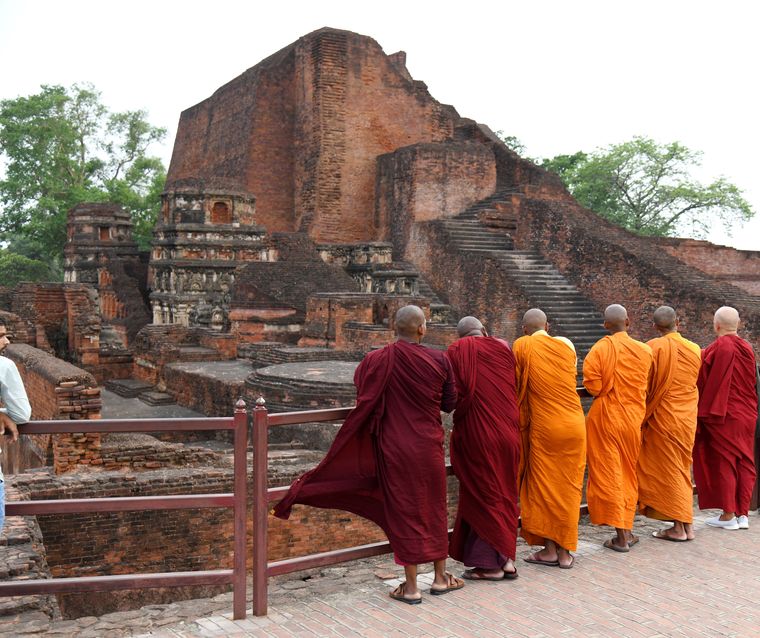 Remnants of the past: Monks near the site of the Nalanda Mahavihara ruins.
Q/ Are there elements in Xuanzang’s writings that seem exaggerated or possibly shaped by political agenda—either his own or of his patrons?
A/ Xuanzang did not write in a vacuum. It is interesting to see how he tried to use the Record to further the agenda of promoting Buddhism in the political climate of the early Tang dynasty, in which the political establishment was not necessarily supportive. In that sense, some of the information contained in the Record may be called exaggerated, but for me as a scholar, these parts are sometimes more interesting than the plain descriptions of places.
To give an example: in order to promote nonviolence, Xuanzang states that in India the death penalty does not exist—which is not true. But the crucial point here is that he wants to project an idealised Buddhist society to the ruling Tang elite—which he may have hoped could inspire the emperor. My personal feeling is that Xuanzang tried to foster diplomatic ties between the Tang empire and the kingdom of Harsha, attempts which may have had some success for a short period of time: according to Chinese sources, envoys between the two polities were exchanged on a quite regular basis until the momentum was brought to a halt by the assassination of the Indian king and the turmoil that followed.
Q/ How do Xuanzang’s descriptions compare with what archaeological and Indian textual sources tell us about the same period?
A/ Xuanzang does not give us descriptions as such, and it is therefore not surprising that quite often we find differences between the archaeological situation and his account. A good example is the Nalanda Mahavihara, the monastery in which Xuanzang spent most of his time in India. The layout of the excavated remains of the monastery differs considerably from what can be reconstructed from Xuanzang’s “description”: while most of the monastic courtyards at Nalanda are oriented south-north, Xuanzang describes their arrangement almost as a circular cluster. Now, we have to be careful because the excavated site is only a fraction of what the monastery was in the past, with quite some remains lying underground and still awaiting excavation.
We encounter similar problems in other cases. Example: the large monastic site of Telhara close to Nalanda, and partly excavated recently by my Xuanzang Trail project colleague Dr Bijoy Chaudhury. It is extremely difficult to reconcile the neat layout of the Telhara monastery given by Xuanzang with the reality on the ground—even if we, once more, take into account that only a small part of the monastery has been excavated so far.
Q/ In what ways did Xuanzang’s method of engaging with Buddhist texts and sites differ from other pilgrim-scholars like Faxian or Yijing?
A/ First of all, although these three are usually treated as the triad of Chinese “pilgrims”, their accounts are quite different. Yijing, about half a century after Xuanzang, wrote two works about his journey and stay in India. One is a collection of biographies of Chinese monks who had gone to India between Xuanzang’s time and his own visit. Without this collection, we would not know that quite a lot of Chinese monks went to India—some of them staying there and not returning to China. The other work, Record of the Inner Dharma Sent Back from the Southern Sea (southeast Asia) is a “description” of the customs and life in Buddhist monasteries. I am using quotation marks here because this again, like in the case of Xuanzang’s account, is not a documentation of the lifestyle in Indian Buddhist monasteries, but quite often a paraphrase—a translation into practice of the normative monastic code…. Thus, Yijing’s two records are not travelogues like the two texts of Faxian and Xuanzang.
Faxian, writing more than 200 years before Xuanzang, produced a much shorter text but often refers to the same places and sites in Xuanzang’s much more detailed record. Xuanzang talks about far more places and sites than Faxian. Taken together and compared, these two records sometimes allow us to see changes of Buddhism over a 200-year period.
What unifies the three Chinese monks is the fact that they had, of course, knowledge of Buddhist texts, particularly of Buddha biographies that had been translated into Chinese. They carried [this knowledge], so to speak, in their “mental baggage”, and it certainly had an influence on how they “described” India and the Buddhist places. In some cases, it was not so much what they saw but what they expected to see which made it into their records.
Q/ How do you think Xuanzang should be acknowledged or celebrated in India today? What would you recommend to Indian archaeologists, historians or cultural scholars interested in following in his footsteps?
A/ My experience is that Xuanzang is better known in India than in western countries, and therefore also held in high esteem. I am always surprised by the public interest in India when I give a lecture about Xuanzang or a related topic. I would hope that he again attains the status of someone who links South Asia and East Asia. If you would force me to be more specific: he can contribute to a beneficial mutual understanding between India and China.
I would recommend scholars and researchers who want to use Xuanzang’s account to collaborate with people who know the Record, instead of relying on old translations and sometimes drawing quite wild conclusions. I also would like to be cautious not to uncritically mingle the Record with information from Xuanzang’s biography: both texts were written for completely different purposes and audiences, and also they may, taken together, enrich the narrative of the Chinese traveller, such a narrative should not be mistaken for objective history.
My own experience with a year-long project in Bihar, called the Xuanzang Trail project, has shown that such collaboration—in my case with archaeologist Chaudhury and his team in Patna—is extremely rewarding for both sides. It leads to results and discoveries which enable us to throw new light on the history and material culture of the past.