


It is not easy to give up the prestigious Indian Administrative Service to go and work in the hinterlands for the uplift of the marginalised. But Magsaysay Award-winning social activist Aruna Roy did it in 1975, after just seven years as a civil servant. After working with the rural poor in Rajasthan’s Barefoot College, she moved to Devdungri to co-found a participatory people’s struggle-based organisation―the Mazdoor Kisan Shakti Sangathan (MKSS)―in 1990, whose fight for rights has led to the passage of several legislations in the country, including the Right to Information Act.
Instead of joyless and bleak, she found rural India to be a place of “colour, beauty, joy, laughter and tremendous grit to struggle every day”. The journey, she says, was never solitary. “There has been the joy of living, working and learning with people,” she writes in her memoir, The Personal is Political. In an interview with THE WEEK, she spoke about how the situation has changed for women since she came into activism, her wish-list for Indian women and how the women in her life shaped her into the person she has become.
You once said that the women in your family served as your role models. Can you describe how?
I treasure the empowerment of the feminine consciousness in the 20th and now, the 21st century. My grandmother Lalita Krishnaswami, pushed the boundaries of social freedom using privilege to break the stranglehold of custom, like many others of her generation in India in the early 1900s. For her generation, choosing to marry out of even sub-caste was not easy. It was a struggle each step of the way. My grandmother was the first social worker in my maternal family. She worked with leprosy patients and with women and children in slums from the 1920s to the 1950s. She was even an honorary magistrate. Her concern for the poor and her disregard for caste and religious divides shaped and changed values permanently in the family.
When I was around 11, amma advised me to never succumb to the pressure to marry and be caught in the cycle of the home and its chores. She urged her daughters to look for opportunities for self-expression, mainly outside the home. Yet, amma taught me to cook when I was 13, not because I was a girl, but because she felt it was a life skill. She, as the intelligent, academically-inclined daughter of a middle-class family, excelled in mathematics, studied and learnt the veena, was skilled in sports, and won the all-rounder prize in college, but found herself uneducated on the simple skills of living.
How has the country changed for women in the 40 years since you took up activism?
The country has changed in many ways. There are some simple indicators: visibility, empowerment, and the fundamental struggle for equality on critical issues.
Women have become more visible, socially, politically and economically. We have fought for and secured some reservation rights in elections at the panchayat level in Rajasthan. Women are now entering schools, colleges and universities, and becoming doctors, engineers, and pilots. Even in rural India, women are more visible as they step out of their homes and participate in large numbers in the MGNREGA (Mahatma Gandhi National Rural Employment Guarantee Act). They have always worked, but now their contribution to the economy is getting recognition.
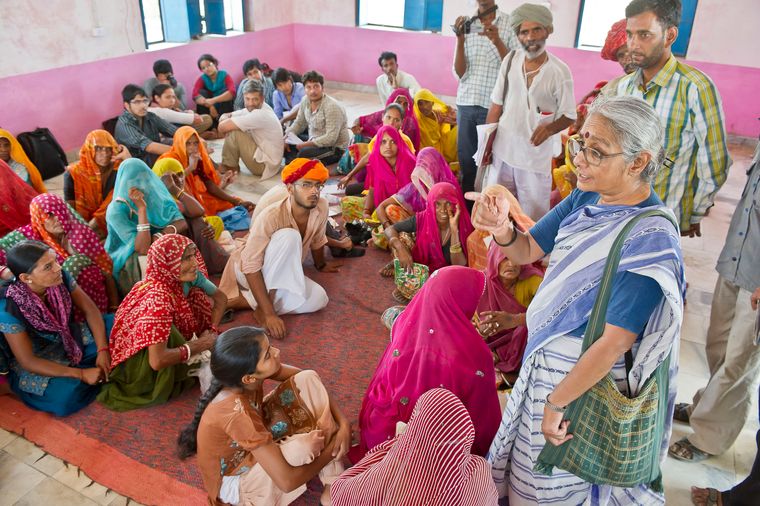 Rural rockstar: Aruna Roy interacts with villagers in Rajasthan | Sanjay Ahlawat
Empowerment, however, is another matter. True empowerment happens when the mind changes―when we accept challenges and reject traditional morality in favour of Constitutional morality. It requires breaking free from deeply ingrained social norms. Women have not broken entirely free from tradition. Women in general, despite more formal education and access to upward mobility, do not question traditional constraints, preferring compromise to conflict in social custom.
Equality on critical issues remains an ongoing struggle, because we often make selective choices. When it comes to marriages and fundamental social relationships, the most privileged set the wrong example. For instance, the preoccupation with the unquestioned extravaganza of destination weddings and the social media frenzy over those who flaunt their wealth and jewellery can only reinforce outdated norms.
Three things in your wish-list for women activists.
Women activists should have the freedom of expression, the freedom to protest, dissent, question, and to fight against any violation of equality by the state or any system in the country.
We, especially the less privileged among us, should have the freedom to articulate our right to equality, without the fear of facing sedition charges or false cases, simply for challenging status quo. Women must have the ability to form strong collectives. Our personal is political. It will be very difficult to suppress us if we raise these issues publicly, and place them in the context of ethical and Constitutional values.
Women have been granted reservations at the panchayat level, but not in Parliament. Furthermore, within political party structures, there is no reservation or meaningful inclusion of women in public decision-making. The National Federation of Indian Women (NFIW) has struggled consistently for 33 per cent reservation for women in parliament. Promises are made but patriarchal priorities have pushed the issue to the back burner. Ensuring women’s representation in governance should be on the wish-list for creating a safer and more equal society. The first challenge we must overcome among ourselves is division― arising from caste, communal, regional, linguistic and social stratification.
Stereotyping has been an issue of struggle for women. Take the stereotyping of ideas of feminine beauty. Notorious marriage advertisements and the media dictate acceptable norms of beauty that dictate and dominate social choices. Women must be “fair and lovely”, slim and tall, with narrow hips and a thin frame, but why? The Indian body is not naturally slim, narrow, or tall. It is hourglass-shaped and curvy. Why can’t we assert the beauty of our bodies as they are?
Also Read
- Women's Day: How clued in are men to what women want?
- 'There is nothing like the thrill of going out on the field, notepad in hand': Sagarika Ghose
- 'We need to bring the female gaze into our films': Rima Das
- 'For women, it takes repeated demonstration of success to build credibility': Daisy Chittilapilly
- 'Was criticised for wearing shorts, sleeveless T-shirts': Anju Bobby George
- 'We write because silence is impossible': Meena Kandasamy
In your book, you describe two rural women who became your first teachers. What are some of the things these women taught you?
They, and later hundreds of other poor, dalit and unlettered women, taught me my politics and recognising the strength of “femininity”. For instance, that compassion is not weakness. They taught me that the sharp divide between the public and domestic spheres is unnecessary, that there is no shame in talking about your children while at a protest or taking them along with you when you work. They also taught me that kindness matters, that affection and love create bonds that are often stronger than political ideology. They taught me how to laugh, to fight my inhibitions, to dance with them. They taught me how to listen. I was made to acknowledge my body. Listening to them talk about sexuality, we realised that their frank and casual attitude did not need the kind of liberation that was our concern in the 1960s. In many ways, they were free women. They exposed the inequalities and prejudices among us, whether of class, caste, or of religion, and that freedom can indeed mean different things to different people.