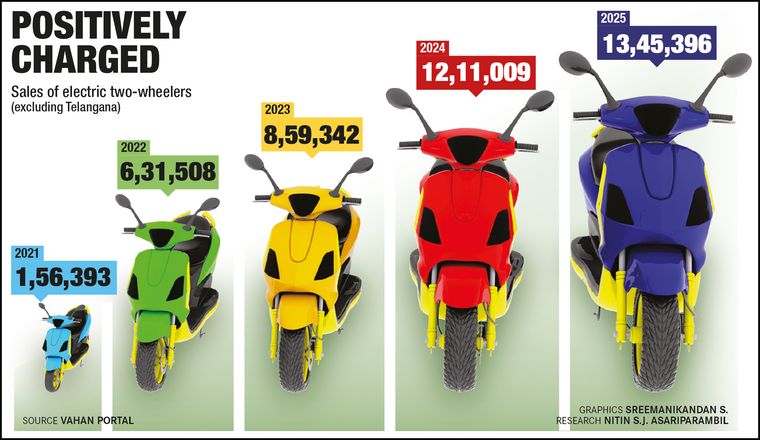
In March 2026, Ola Electric became the first Indian electric vehicle maker to cross 10 lakh units in sales—a milestone for a sector that, not too long ago, was seen as experimental.
The transformation is visible on the streets, with electric scooters zipping past in every direction. Yet the industry’s mood is anything but triumphant. Even as Ola Electric celebrated its landmark, it was also reckoning with a bruising period of brand damage and declining market share. A question hangs over the sector: has India’s EV two-wheeler market truly matured, or is it merely catching its breath before the next sprint?
 Aravind Mani | Bhanu Prakash Chandra
Praveen A., researcher and assistant professor in mechanical engineering at an institute under Kerala’s APJ Abdul Kalam Technological University, describes the current moment as a “conversion stage”. Electric scooters are no longer a novelty, and the Indian middle class is shifting from early adoption into a period of technical refinement and consumer hesitation. Bhavish Aggarwal, Ola Electric’s founder, managing director and chairman, agrees that the market is entering a “tougher, more mature phase”.
The numbers bear this out. Data from the government’s VAHAN portal show EV two-wheeler sales plateauing at between 1.1 lakh and 1.2 lakh vehicles a month throughout 2025, even as cumulative adoption continued to climb. Overall EV scooter registrations for 2025 crossed 13 lakh vehicles. It was 12 lakh in 2024.
Praveen attributes the muted growth partly to customers awaiting a paradigm shift in battery technology. The EV industry moved swiftly from lead-acid to NCM (Nickel-Cobalt-Manganese) cells and lithium-ion batteries. China’s BYD has unveiled a more efficient architecture using flatter lithium ferrophosphate cells, called blade battery. But bringing that technology to two-wheelers is not as straightforward as it sounds.
“What works for four-wheelers need not for two-wheelers, and what works for two-wheelers need not for four-wheelers,” said Vijayanand Samudrala, CEO of Amara Raja Advanced Cell Technologies (ARACT). The blade battery’s form factor is too large for a scooter’s frame. Samudrala, formerly head of Amara Raja Batteries (makers of Amaron batteries), does not see blade battery chemistry as directly relevant to two-wheelers. But the design thinking behind it, he believes, can inform future two-wheeler battery architecture.
For now, the real shift is from NMC to LFP (lithium ferrophosphate) cells. LFP chemistry offers greater safety, but at the cost of energy density—NMC cells deliver around 30 to 32 per cent more energy output for the same space. “NMC is like a cruiser 350cc bike, while LFP is like a trusty 150cc daily motorcycle—one gives you range, the other is safer,” said Samudrala.
Greaves Electric Mobility has already standardised on 100 per cent LFP across its Ampere portfolio. Others are moving in the same direction, though NMC has not been entirely phased out.
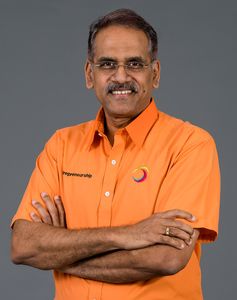 Vijayanand Samudrala | ARACT
Amara Raja signed a memorandum of understanding with Ather Energy in August 2024 to collaborate on NMC, LFP and advanced chemistry cells to be produced locally at its upcoming Gigafactory in Divitipally, Telangana.
Ola Electric, meanwhile, is betting on its in-house 4680 ‘Bharat’ cells. And the company believes the battery story extends far beyond scooters. “The energy storage business globally and even in India is going to be a much bigger business than automotive,” Aggarwal told analysts on the company’s third-quarter earnings call in February. With demand surging from solar-plus-storage projects, grid batteries, and data centres powering AI infrastructure, Ola sees better, cheaper cells eventually powering not just vehicles but homes, factories and the national grid.
Understanding why India adopted electric two-wheelers so rapidly requires setting aside the western fixation on range anxiety. “A typical Indian uses the scooter for 20-30km a day,” said River Mobility CEO Aravind Mani. Most of these scooters offer a range of around 100km.
The economics are equally compelling as well. Ola Electric puts its operating cost advantage at 90 per cent lower than petrol two-wheelers. But it is not just about cost. “An automobile’s primary job is to take you from point A to point B with minimal loss of energy. And for a smooth and swift journey, the vehicle should provide maximum torque at start,” said Suresh Lal, an EV technology expert, explaining the physics of why electric scooters simply ride better. Internal combustion engines require complex transmission systems to generate torque, while electric motors deliver it effortlessly from the moment you twist the throttle.
There is also the factor of chassis dynamics. Battery packs account for 15 to 30 per cent of an EV scooter’s total kerb weight, and most are mounted low in the chassis, which shifts the centre of gravity downward and improve stability. Electric scooters also typically feature larger 13- or 14-inch wheels, which widen road contact, improve stability and reduce braking distances. Larger wheels, however, reduces acceleration, but the initial torque the electric motor provides closes the gap.
Vikas Singh, Managing Director and CFO of Greaves Electric Mobility, identifies a broader shift in how consumers now evaluate EVs. “There is a shift in customer perception, from headline specifications to everyday performance, durability and total cost of ownership,” he said.
 Bhavish Aggarwal | PTI
The battle at the top
The race for EV scooter market leadership has become ferociously competitive, and volatile. In January 2025, Ola Electric and TVS Motor Company were neck and neck, separated by barely 100 units. By January 2026, TVS pulled decisively ahead with 34,428 electric two-wheelers registered, Bajaj Auto was second on 25,505, and Ather Energy was third with 21,915 units. Ola Electric, which had led the market for many months, had slipped from the top slots.
The story of Ola’s fall is instructive. Its problem was never its vehicles. Lal, who has owned three ICE two-wheelers, says Ola’s scooters are superior to all of them. But when his scooter, an Ola S1 Pro, abruptly stopped on a highway in May 2024, what followed was a bureaucratic nightmare: it took Ola Electric until December—seven months—to replace the battery and vehicle control unit under warranty.
Even Aggarwal admitted that Ola had a “service challenge” that had “impacted brand trust”. Ola’s new CFO Deepak Rastogi added that despite “significant brand damage” in 2025, the company was “structurally better placed than rivals to lead the next leg of growth”.
The competitors wasted no time to capitalise on Ola’s stumble. TVS, Bajaj and Hero leveraged their vast national dealer networks—built over decades of selling petrol vehicles—to rapidly expand EV reach. Ather, which had around 350 stores in May 2025, has around 650 now. River Mobility, which sold just 675 scooters in January 2025, had surged to 2,573 a month by January 2026, propelling it to seventh place nationally.
The map is still being drawn
Ather Energy’s chief business officer Ravneet Phokela is adamant that it is too early to declare a national champion. “The industry is going through further consolidation and evolution,” he said. “Any EV company that can aggressively pull off a monthly campaign to sell more than 10,000 units can upset the current rankings.”
His point is well illustrated by comparison with the mature petrol two-wheeler market, where Hero MotoCorp and Honda each sold around 5.2 lakh units in January 2026. The gap between third-placed TVS and the top two giants is 1.4 lakh vehicles—more than the country’s entire monthly EV two-wheeler output.
Ather’s own growth blueprint is telling. Having built dominance across the south, the brand is now aggressively targeting what Phokela calls “middle India”— Gujarat, Maharashtra, Chhattisgarh and Odisha. In 2025, Ather’s market share jumped from 5 to 25 per cent in Gujarat, 8 to 18 per cent in Maharashtra, and 7 to 18 per cent in Odisha. “The south will consolidate,” he said. “There is still more juice in middle India to grow and we’ll keep doing that.”
Regional fragmentation remains a defining feature of the market. South India continues to account for a disproportionate share of EV adoption. “India is not one uniform EV market,” said Mani. “Adoption varies sharply by state, city infrastructure, local incentives and dealer readiness.”
Many companies are also eyeing battery-as-a-service models, which is already gaining traction in the four-wheeler market. It is a way to lower the upfront cost barrier for buyers who baulk at the price premium over petrol alternatives.
Singh of Greaves perhaps best captures where the industry stands today. “A strong local manufacturing base, technology integration, and disciplined distribution expansion will determine which players convert industry growth into sustainable leadership over the next few years,” he said.
Electric scooters have ceased to be tokens in a range race. They are utility vehicles embedded in daily Indian life. As River Mobility’s CTO Vipin George puts it: “Utility doesn’t have to be boring.”
For an industry that has just seen its first ten-lakh milestone, the contest for India’s roads is far from settled. It is, by most accounts, just getting started.