


Imagine a vault so vast that it stretches across underwater mountains, built by nature over thousands—sometimes millions—of years. A vault packed with gold, silver, copper, cobalt and rare earth elements that power everything from smartphones to satellites. Now, imagine India being handed the keys to explore some of the richest parts of this vault.
That moment has already materialised.
In September, India took a decisive leap into the global race for deep-ocean minerals by signing a landmark 15-year agreement with the International Seabed Authority (ISA). The signing, held at Prithvi Bhawan, the ministry of earth sciences headquarters in Delhi, during the visit of ISA Secretary-General Leticia Carvalho, gives India exclusive rights to explore 10,000sqkm in the Carlsberg Ridge—a 3,000-km-long underwater mountain chain in the Indian Ocean. It is believed that the area holds polymetallic sulphides (PMS), which are deposits rich in precious and industrially vital metals.
The Carlsberg Ridge lies closer to India than other ridge systems, a fact that will help reduce operational costs. “The Carlsberg Ridge exploration rights give India access to a scientifically promising area known for active hydrothermal vents and PMS deposits,” said Manasa Ranjan Behera, professor of ocean engineering at the Indian Institute of Technology Bombay. “This region may contain high-value metals needed for India’s future manufacturing and clean-energy sectors. In addition, the exploration allows Indian scientists and engineers to advance research on seafloor geology, hydrothermal circulation, and unique deep-sea ecosystems, strengthening India’s position as a leading ocean science nation.”
The Carlsberg Ridge agreement places India in a unique position. It already holds a 75,000sqkm polymetallic nodule (PMN) exploration contract in the Central Indian Ocean Basin. It is expected that by utilising 10 per cent of the PMN reserve, the country can meet its energy requirements for the next 100 years. India also has a 10,000sqkm PMS contract on the Central and Southwest Indian Ridges. With the new agreement, India becomes the first country with two PMS exploration contracts and the holder of the largest PMS exploration area globally.

“Ocean water naturally contains tiny amounts of metals,” said defence and space analyst Girish Linganna. “Over millions of years, these metals slowly settle and stick to rocky surfaces on seamounts, forming hard, black crusts that look like thick paint layers. These crusts are incredibly rich in cobalt, nickel, copper and rare earth elements—metals that are absolutely crucial for modern technology.”
Understanding how these underwater riches form is like watching nature’s own incredible manufacturing process. Deep beneath the ocean floor, the earth’s interior is extremely hot. When seawater seeps down through cracks in the seafloor, it gets heated to temperatures over 400 degrees Celsius—hot enough to melt lead. This super-heated water dissolves metals from rocks deep inside the earth, creating a mineral-rich soup. When this metal-loaded hot water shoots up through underwater vents (like geysers), it meets the freezing cold ocean water above. Just like how steam becomes water droplets when it hits cold air, these dissolved metals instantly solidify and fall around the vents, creating chimney-like structures over thousands of years. These chimneys are packed with valuable metals—it is like nature building its own treasure towers.

India’s deep-ocean programme spans advanced technology development. As per a representative of the MoES under the Deep Ocean Mission, India is working on developing advanced technologies. Apart from the human submersible MATSYA-6000 and the deep-sea mining machine VARAHA, this includes seabed mapping tools and marine biotechnology platforms. Together, these efforts enable India not only to identify resources but also to develop the capability required to access them sustainably.
The 15-year work plan under the ISA covers seafloor mapping, water-column surveys and initial geological sampling. Over the middle period, more detailed surveys and high-resolution mapping and environmental baseline studies will be undertaken to understand the mineral deposits and the biological communities around hydrothermal vents. The final phase may focus on development of prototype deep-sea technologies, assessing environmental impact and evaluating future mining feasibility.
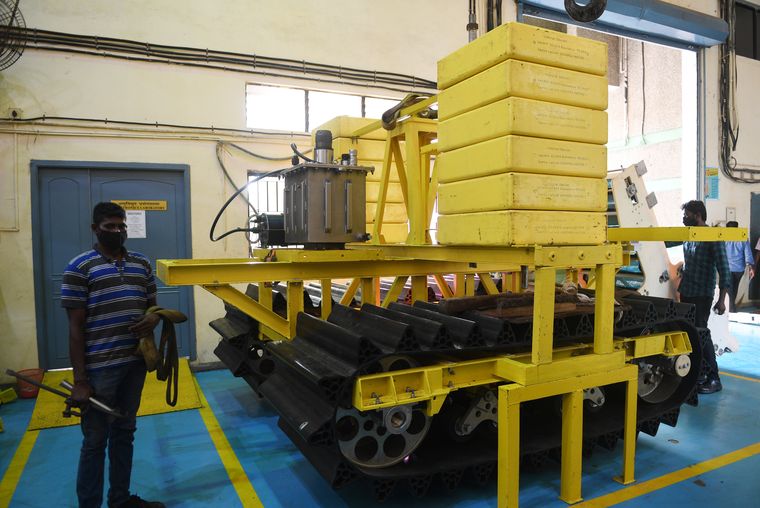 Deep-sea mining machine VARAHA, developed by the National Institute of Ocean Technology | Bhanu Prakash Chandra
“The plan involves the development and testing of autonomous, remotely operated vehicles, specialised sampling tools and prototype extraction systems to eventually support future commercial mining decisions,” said Behera. “The data generated over this period will be critical for assessing the technical feasibility, economic viability, and environmental sustainability of any potential exploitation activities.”
However, it is not an easy task. Major challenges include extreme depths (over 2,000m), rugged terrain and high temperature near hydrothermal vents. Operations would also be made technologically demanding for high-quality environmental data because vent ecosystems contain rare and sensitive species—so, exploration must be cautious and responsible. Additionally, high capital investment requirements and volatile global mineral markets present major economic uncertainties.
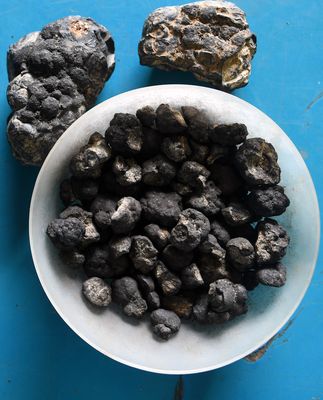 Buried treasure: Polymetallic nodules | Bhanu Prakash Chandra
Detailing the nature of the task ahead, Prof Sunil Kumar Singh, director, CSIR-National Institute of Oceanography told THE WEEK: “It requires high-resolution bathymetric, geophysical and geochemical mapping of the ridge system, using ocean research vessels, remotely operated and autonomous underwater vehicles and a large number of in situ mineralogical, chemical and biological measurements.”
He added that it took the CSIR-NIO almost four decades to conclusively explore 1.5 lakh sqkm in the Central Indian Ocean; the total area of the Indian Ocean is about 71 million sqkm.
But, despite the challenges, the long-term strategic value of the effort makes it a high-priority national endeavour.
“Ocean mining holds tremendous future potential for the world,” said Lt Gen C.A. Krishnan, former deputy chief of the Army staff and an expert on rare earth minerals. “However, we need to wait till appropriate technologies are available for extracting mineral resources from such depths economically. Also, we need to remember that even on land, the lead time required—from the time of discovery of a mineral deposit to mining it—is about 12 to 15 years. Considering the need for elaborate exploration and its low success rate, the lead time required for exploration from the ocean will only be significantly higher. The success rate would be much lower and the investment required for exploration much much higher.”
Krishnan added that high-grade gold deposits on land occur at about 8-19 grams per tonne, whereas ocean concentrations are extremely low, making extraction a massive challenge. “Imagine the huge quantity of ocean bed soggy sand that needs to be scooped out for extraction,” he said. “The ocean waters are estimated to contain about 20 million tonnes of gold dissolved in it. But the extremely dilute concentration makes it a totally uneconomical source. So what is more important at the moment is to be part of formulation of appropriate international legal frameworks for ocean mining rights and also to invest in R&D and forge alliances and partnerships with friendly countries.”
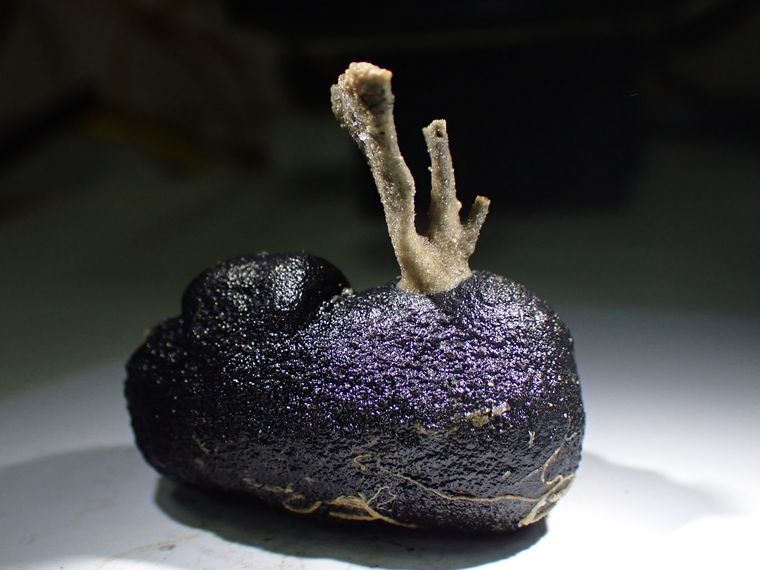 An underwater organism associated with PMN | National Institute of Oceanography Goa.
Many institutions support India’s programme. The MoES leads policy direction and coordination with ISA. The National Centre for Polar and Ocean Research spearheads scientific operations on the Carlsberg Ridge. The National Institute of Ocean Technology develops deep-sea vehicles and submersibles, while the CSIR-NIO and Geological Survey of India conduct seabed geological studies and resource estimation. The Indian Space Research Organisation provides remote sensing, navigation and communication support. IITs and universities contribute research in ocean engineering, robotics, ecology and law of the sea.
For India, these efforts are already yielding results. Parliament records show India has demonstrated collection of over 100kg of cobalt-rich polymetallic nodules from 1,173m depth in the Andaman Sea in 2024. Two active hydrothermal vent fields have been identified in the Central Indian Ocean and biodiversity surveys have discovered 23 new deep-sea species. These achievements, along with the development of MATSYA-6000—capable of reaching 6,000m depth—and the VARAHA, place India among the global leaders in deep-ocean exploration.
Experts note that the global race for deep-sea minerals is growing. China, Japan, France and several Pacific states are exploring resources, but no country has begun commercial extraction in international waters. “This shows that while the global potential is significant, the world is still in the exploration and technology-development stage,” said Behera. “The future of this industry will depend on balancing mineral demand with environmental protection and international regulations. With rising global demand for strategic minerals and increasing pressure to diversify supply chains beyond limited land-based reserves, the global potential of deep-sea resource development is substantial, positioning it as an emerging frontier in the blue economy and resource security landscape.”
Sustained engagement in deep-ocean exploration offers India enhanced resource security, reduced import dependence, domestic high-tech industry growth, specialised workforce development and leadership in international ocean governance. “The initiative is also likely to promote scientific innovation, strengthen marine research infrastructure, generate specialised workforce development and bolster India’s leadership role in international ocean governance,” said Behera. “If pursued responsibly with strong environmental safeguards and evidence-based decision-making, deep-ocean exploration could become a transformative pillar of India’s blue economy and long-term sustainable development strategy.”