


THE GREAT PROMISE of free market economics, especially when liberalisation took root in India in the 1990s, was that competition will lead to better service, competitive costs and protection of customer interests. That may not be the case, according to the Herfindahl-Hirschman Index, or HHI, an international standard used by American and European competition regulators to assess the robustness of free markets.
HHI is calculated by squaring the market share of each firm and summing the resulting numbers. It approaches zero when a market is occupied by a large number of firms of relatively equal size and reaches its maximum of 10,000 points when a market is controlled by a single firm. This comes especially handy in developed countries when competition regulators have to evaluate big ticket mergers and decide whether a new, bigger entity means too much market domination.
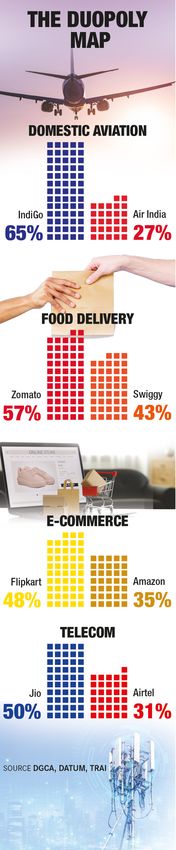
The HHI in Indian aviation is double the threshold internationally accepted for being ‘highly concentrated’, and after the IndiGo fiasco, we all know how terrible that can be for the customer.
But the worrisome factor is that the market concentration has increased over the past decade not just in aviation, but in many other sectors in the country.
In the telecom sector, there are consistent worries over market dominance, after Reliance Jio came out of nowhere and took pole position in the late 2010s. The financial troubles of Vi (the Vodafone-Idea joint entity that provides nationwide service), which went from bad to worse after the Supreme Court verdict to make telecom operators pay up aggregated dues, continues, even though the government stepped in to save the company from shutting shop. Despite that, telecom services in India have virtually become a two-horse race between Jio and Airtel.
The scenario is similar in sectors like cement, iron, steel and automobiles, where the HHI is abnormal. In passenger cars, Maruti Suzuki has a market share of around 40 per cent. Maruti’s marketshare used to be well above 50 per cent till recently, but the advent of electric cars changed that.
Similarly, in two-wheelers, Hero currently holds a market share of around 30 per cent. Again, it used to be 38 per cent just a few years ago.
The situation is worse in the digital economy, where one or two dominant players straddle the ecosystem. In e-commerce, Flipkart and Amazon hold a major chunk of the market. In food delivery, Zomato holds about 58 per cent of the market, and Swiggy, virtually the only other player in the scene, controls most of the rest.
The story of mobility is a classic example of what competition can do to the market. When Rapido came in as a dark horse and stole the thunder from Ola and Uber, which had dominated the market for long, it led to fares coming down and improved income for drivers.