


NEARLY THREE MONTHS ago, a couple in Maharashtra’s Dharashiv district poisoned their two-year-old child before ending their lives. The father, a tractor operator, had piled up huge debt betting on online games and saw no way out.
It’s a chilling story, but not a one-off.
In the past few years, lakhs of Indians have embraced gaming apps, betting real money in the hope of winning big, sometimes even borrowing to do so. Since 2023, there have been 32 online gambling-related suicides in Karnataka alone, with many of the suicide notes asking the government to ban such apps.
On August 20, the Lok Sabha passed the Promotion and Regulation of Online Gaming Bill, 2025. The bill sought to ban games where “financial stakes are involved”, whether based on chance or skill. Rajya Sabha passed it the following day and President Droupadi Murmu assented to it on August 22.
The press note read: “The legislation is designed to curb addiction, financial ruin and social distress caused by predatory gaming platforms that thrive on misleading promises of quick wealth. It reflects the government’s resolve to safeguard families while guiding the digital economy towards safe and constructive growth.”
Union IT Minister Ashwini Vaishnaw said that about 45 crore people were affected by online money games and had lost more than Rs20,000 crore.
Within 24 hours, platforms such as Dream11, My11Circle, Zupee and WinZO stopped gaming services that involved real money. And with that, thousands of families were left staring at an uncertain future.

“News that such a bill was going to be introduced came on August 19. But it didn’t look like it would get cleared so soon,” said Varsha Mahajan, who worked for one of the online gaming companies. “The bill was passed on August 21 and the founder announced that we will have to close all operations. It was suddenly our last day and everyone was shattered.”
Mahajan had started at the company a year ago; Siddiq Dudekula, on the other hand, was a decade deep in a company that ran an online rummy and poker platform. “[The ban put] our long-built industry and livelihoods at risk,” he said. “Hundreds of jobs, many years of dedication and a community we called home are suddenly uncertain.”
The online gaming industry had seen rapid growth because of cheap data and smartphones. Moreover, when the pandemic kept people indoors, millions took to online gaming to escape boredom. That engagement only grew after the pandemic—more startups entered the fray and there was a surge in advertising.
A PwC report said that gaming revenue in India touched Rs33,000 crore in 2023 and was expected to clock a 14.5 per cent CAGR to reach Rs66,000 crore by 2028. Of this, the real-money gaming (RMG) segment accounted for Rs16,500 crore in 2023 and was estimated to reachRs26,500 crore by 2028.
Another report, by EY, said that in 2024, more than 155 million people played fantasy sports, rummy, poker and other transaction-based games, a 10 per cent year-on-year growth.
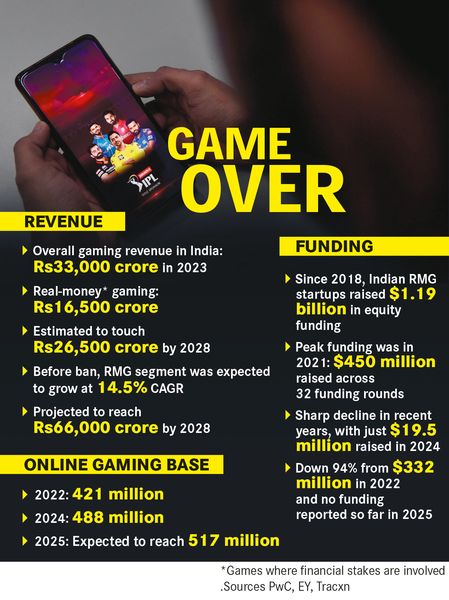
A major reason for this spike is the packed cricketing calendar featuring World Cups and the IPL. Also, several companies launched games in regional languages, which brought in more users.
All that stopped within days. The founders of the companies were miffed, but considering the harsh punishments baked into the legislation, they toed the line. For instance, offering online money games can lead to three years in jail and a fine of up to Rs1 crore. Repeat offenders face harsher punishments, including up to five years in jail and a fine up to Rs2 crore. Also, offences under key provisions will be cognisable and non-bailable.
“For companies relying heavily on real-money games, it is an existential crisis,” said Kunal Gala, partner, deal value creation, BDO India, a major accounting firm.
Dream11, for instance, had to end its association with the Board of Control for Cricket in India as its revenue stream was going to be hit. BCCI secretary Devajit Saikia said the board would “ensure not to indulge with any such organisations in future”.
What has shocked the industry is that there was no consultation with stakeholders before tabling the bill. “There was obviously a lot of addiction to online gaming, specifically in the young generation, and there were mental health issues and suicides. Several platforms were also being used for illegal activities like money laundering,” said Gala. “However, companies could have been given adequate time to reconsider or pivot their operational models, which would have been a more feasible way to implement this.”
The impact of the ban will be multifold. “This industry contributes about Rs25,000 crore annually in direct and indirect taxes to the government, which is a huge amount,” said Gala. “It also attracted FDI exceeding Rs25,000 crore in the past two to three years, and it has supported [close to] two lakh jobs across more than 400 companies in India.”
Payment platforms would also be affected. UPI was the most popular way to pay in such games, and industry sources say there could be a loss of around Rs20,000 crore in monthly transaction volumes.
“The changes carry wider implications for associated sectors such as payments, compliance, advertising, content creation and sponsorships,” said Neha Singh, CEO of Tracxn, a market research platform. “The overall market is in a phase of adjustment, with investors and companies reassessing strategies.”
Anuraag Saxena, CEO of E-Gaming Federation, a non-profit NGO, said global experience showed that calibrated regulation was better than blanket restrictions, which could nudge users towards unregulated offshore platforms.
“A balanced approach that clearly distinguishes between skill-based formats and games of chance can help foster a transparent ecosystem that both protects players and strengthens public trust,” he said.
Legal experts THE WEEK spoke to agreed. “That is one of the arguments the industry could put forward,” said Vikram Jeet Singh, partner at law firm BTG Advaya. “Game providers can offer games cross-border, making it difficult to trace and block. It is not easy for enforcement authorities in India to prosecute cross-border actors.”
There are indications that the companies could challenge the ban in court, arguing that there is a difference between a game of skill and chance. However, legal experts said the courts might not strike down the bill. For instance, in June, the Madras High Court upheld Tamil Nadu’s night-time restrictions on RMG, saying that such games had created public health risks.
Like Tamil Nadu, Andhra Pradesh and Telangana had also banned RMG years before the current bill. Yet, Prahar, an NGO, claimed that Telangana continued to see a rise in online gambling. According to its recent survey, 89 per cent of respondents said they were able to do online sports betting and casino betting with almost no restrictions; the remaining said it was difficult, but still accessible.
Enforcement, indeed, will be key, said Singh. “If it is just notified, and law enforcement authorities are not conducting drives and checks on a regular basis and shutting down websites etc., then this will just remain a law on paper,” he said.
As it stands, several companies have started to focus on expanding in global markets or moving the business overseas. WinZO, which forayed into Brazil in 2023, launched in the US on August 24. This placed the company at the intersection of three of the four largest mobile gaming markets—India, Brazil and the US—with a market size of around $70 billion, it said.
The company has also launched a new short-video content platform called ZO TV. “Our vision has always been to empower Indian game developers to reach global audiences,” said co-founders Saumya Singh Rathore and Paavan Nanda. “Entering the US, the world’s largest and most influential gaming market, is a decisive step towards that mission. The short-video format further diversifies our content offerings and strengthens WinZO’s position as a one-stop destination for interactive entertainment.”
Similarly, Bharti Airtel scion Kavin Bharti Mittal said that his casual gaming platform Rush will exit India completely and go all-in on the US and global markets.
Dream11, meanwhile, has said that it will pivot entirely to free-to-play social games. Its parent company Dream Sports, in any case, operates several platforms including FanCode (live sports streaming), Dream Cricket 25 (a mobile game), DreamSetGo (a sports travel and experiences platform), among others, and through these the company will build a larger sports ecosystem.
The ban might seem to be the end of the road, but it could well open new avenues for the companies, especially in the legal esports space.