


SURAT
As we drive towards the outskirts of Surat in Gujarat, we come across a food stall named Ratnakalakar. The name translates to ‘craftsman of precious stones’. Dipak Ghetiya, who runs the stall, worked in the diamond industry as a polisher for more than two decades. After diamond exports declined, his work hours got reduced significantly, and Ghetiya quit and started his own food business.
“I used to earn around Rs50,000 a month, working 10 to 12 hours a day,” he says. “But recently, work had dropped to just 4–5 hours a day, and my earnings shrank to about Rs15,000. I have a family of eight to support. My nephew is still in the industry but barely makes Rs20,000 a month.”
Ghetiya moved to Surat from a village near Rajkot, like many others from his region, in search of a better livelihood in the diamond trade. Now, he travels 12km every day to sell snacks on his motorcycle.
“There’s a sense of helplessness among diamond workers,” he says. “But people have families to feed, so they carry on. I learned how to run this stall by watching YouTube videos. But not everyone can do that.”
Like Ghetiya, Pankaj Vaishnav also quit the diamond industry this year and began selling snacks in a different part of Surat. Vaishnav came to Surat from Junagadh in 2010 and opened a barber shop. Later, through a friend, he got a more stable job in the diamond industry.
“I was cutting diamonds and easily earned Rs30,000–Rs32,000 a month. But things started going downhill last year, and my salary dropped to just Rs14,000–Rs15,000. I quit and started this food cart. Now I make around Rs30,000,” says Vaishnav.
Surat has long been the diamond cutting capital of the world. Nine of ten diamonds mined globally are processed in Surat. However, the shine has dulled in recent years because of a confluence of factors—from the Russia-Ukraine war to unrest in the Middle East and economic slowdown in two of its largest markets: China and the US.
Adding to the woes, the US government has imposed 50 per cent tariffs on certain Indian imports, a move that threatens to hit the diamond industry even harder.

“The entire industry is in a trauma,” says Kirit Bhansali, chairman of the Gem and Jewellery Export Promotion Council (GJEPC). “Even when the 25 per cent tariffs were announced, it was going to be difficult. Now with 50 per cent tariff, it will be totally dead,” he said.
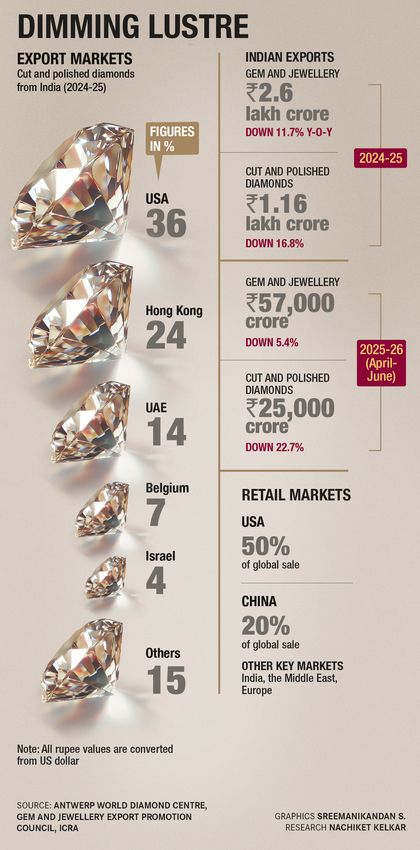
Bhansali says these sweeping tariffs could have far-reaching effects on the economy, supply chains, and employment. “The US is our single largest market, accounting for over $10 billion in exports—nearly 30 per cent of our industry’s total global trade. A blanket tariff of this scale will inflate costs, delay shipments, distort pricing and place immense pressure across the value chain—from small karigars(artisans) to large manufacturers,” he says.
Bhansali pointed that for cut and polished diamonds, half of India’s exports are US bound.
Exports have already been under pressure. Between April 2024 and March 2025, India’s gross gem and jewellery exports declined 11.7 per cent to $28.50 billion from $32.28 billion the year before. Cut and polished diamond exports fell 16.8 per cent to $13.29 billion from $15.97 billion. Rough diamond imports also dropped 24.3 per cent to $10.80 billion.
Things haven’t improved in the current financial year, either. In the April–June quarter of 2025, gem and jewellery exports dipped 5.4 per cent to $6.48 billion. Cut and polished diamond exports slumped 22.7 per cent to $2.84 billion. That was before the new tariffs took effect.
The decline in exports has had a massive impact on Surat’s workforce.

“Surat had an estimated 7.5 to 10 lakh people employed in this industry. About 3.5 to 4 lakh have been affected by the recession. Entire families have returned to their villages. Many have left the industry altogether,” says Bhavesh Tank, vice-president of the Surat Diamond Workers Union.
The industry was battered during the 2008 global financial crisis. Since then, the number of people in the trade in Surat has halved—from around 15 lakh to just about 7 lakh today, says Damji Mavani, former secretary of the Surat Diamond Association.
“The embroidery and textile industries have grown significantly, and many have shifted to those. A lot of migration has taken place,” he says.
Recession is only one part of the problem. Technological advancements are also reshaping the industry. While large companies have embraced automation, many smaller units have been forced to shut down. “With technology, speed has increased, but fewer workers are needed. So while production remains steady, employment is shrinking,” says Mavani.
Large exporters may find workarounds by routing their shipments through countries with lower tariffs. “Big companies with overseas offices will export from those locations. Smaller firms without such options will suffer,” says Mavani.
The newly constructed Surat Diamond Exchange bears testimony to the industry’s struggles. Opened with much fanfare in December 2023, the sprawling complex—with nine towers and capacity for 4,200 offices—remains underutilised. “Surat doesn’t have the capacity to fill this much space. The idea was that traders from Mumbai would shift here, but that hasn’t happened,” says an industry insider.
Meanwhile, the lab-grown diamond market is rising swiftly, owing largely to cost advantages. A one-carat lab-grown diamond costs Rs35,000–Rs55,000, whereas a similar natural diamond can cost Rs3.5–Rs4 lakh.
“Today’s lab-grown diamonds are chemically, physically and optically identical to natural diamonds, thanks to advancements in technology. That perception gap has vanished. Add the fact that they are 60–80 per cent cheaper,” says Rupesh Jain, co-founder of Lucira, a lab-grown diamond jewellery brand. He estimates the global lab-grown diamond market will grow from $26 billion in 2024 to nearly $98 billion by 2034.
Tank of the Surat Diamond Workers Union acknowledges that lab-grown diamonds have contributed to the downturn in the natural diamond market. But Bhansali of GJEPC disagrees, and so does Jagdish Khunt, president of the Surat Diamond Association.
“More people are using lab-grown diamonds now, but both markets will coexist. Every market has its ups and downs,” says Khunt. He expects a short-term dip due to the tariffs, but believes the natural diamond industry will bounce back.
The Gujarat government recently announced a relief package for workers and small units affected by the downturn. Under the scheme, unemployed diamond workers (since March 31, 2024) can get school fees of up to Rs13,500 per child covered for one year. Eligible artisans must be over 21 and have worked in the industry for at least three years.
Also, micro-units can access interest subsidies on term loans up to Rs5 lakh at 9 per cent for three years, along with a one-year exemption on electricity duty from July 2025.
However, there are many gaps in the schemes.
“If your salary was halved but you are not unemployed, you don’t qualify for school fee waivers. That’s a big oversight,” Tank says.
Even so, some one lakh artisans from across Gujarat have reportedly applied for the relief. Applications will now be scrutinised before benefits are disbursed.
Meanwhile, the GJEPC is scouting new markets to reduce dependence on the US and China. “I recently visited Latin America, and we got good feedback. Our former chairman travelled to Vietnam. We’re holding a show in Saudi Arabia this September,” says Bhansali.
He adds that efforts are under way to revive consumer demand in China, though it may take a year or two. Interestingly, Chinese youth remain more inclined towards natural diamonds over lab-grown alternatives. “In the gem and jewellery segment, the Chinese know that there is no diamond without India,” says Bhansali.
The GJEPC has sought various relief measures from the government. In respect of working capital facilities sanctioned, lending institutions may be permitted to allow a deferment of interest of six months, says Bhansali.
As trade dialogues between India and the US continue, the industry is lobbying for zero tariffs on loose diamonds. However, with no breakthrough in sight, the uncertainty over its biggest market lingers, and Surat’s diamond industry continues to lose its sparkle.