



Donald Trump’s tariff war against the world began in March. India’s response had, until now, demonstrated commendable maturity and strategic restraint. Instead of resorting to retaliatory tariffs, Indian policymakers adopted a targeted set of measures: reducing duties selectively on key American imports—most notably whiskey and motorcycles—while facilitating increased US imports in strategically significant sectors such as energy and defence. Reports suggested that a deal was close to being signed. This measured approach underscored India’s commitment to trade stability.
Then Trump hiked tariff for India to 50 per cent (to be effective on August 27), which he justified by citing India’s sizeable trade surplus with the US and its continued purchases of Russian oil. Since other countries with larger surplus and greater Russian purchase are currently facing lower tariffs than India, commentators point to India’s unwillingness to compromise on agriculture and dairy market access, or diplomatic clashes over the India–Pakistan ceasefire, as more probable causes. Whatever the true reason, the announcement threatens to disrupt India’s access to the world’s largest economy and its biggest export destination—worth about $90 billion a year. The economic repercussions are worrying, as labour-intensive sectors such as gems and jewellery, garments and machinery will be hit hard if the tariffs come into force.
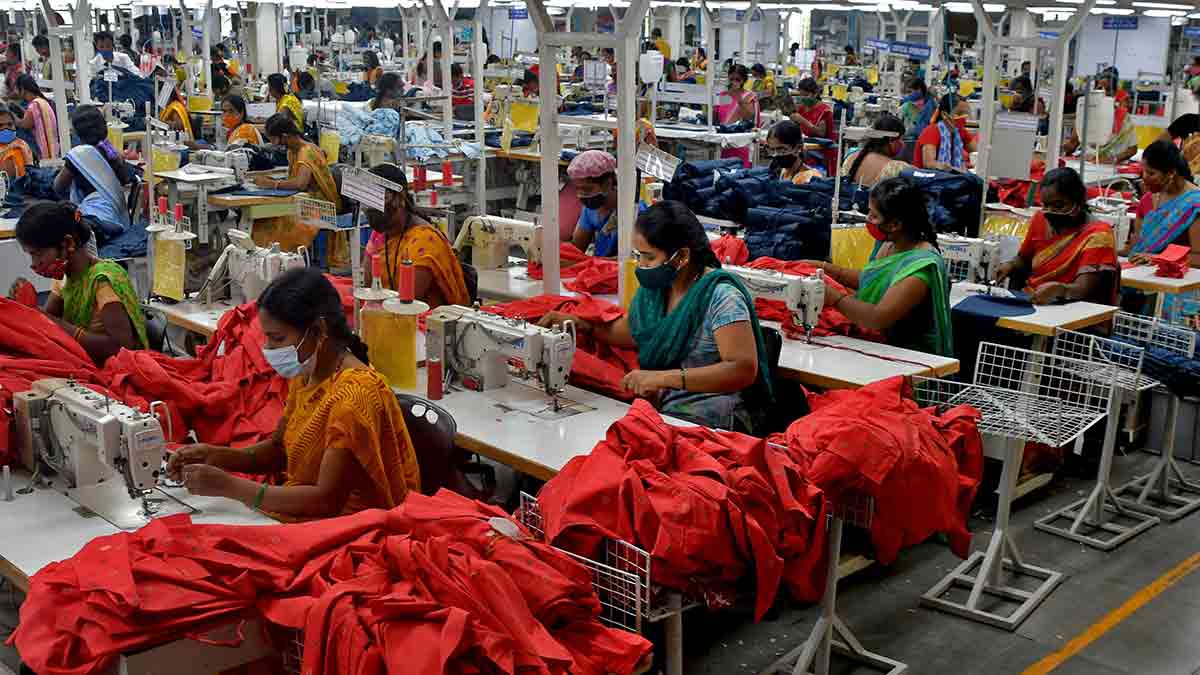
Demand from wealthy countries for labour-intensive products is highly price-sensitive. Consider Bangladesh, which enjoys a 10 per cent tariff advantage over India for access to the European Union market. In 2024, Bangladesh exported about $30 billion worth of apparel to the EU, whereas India exported only $6 billion. Risks from US exposure are already apparent: large apparel maker Pearl Global is exploring moving production to Bangladesh, Indonesia, Guatemala and Vietnam to avoid the high tariff cost. Further disruption should be expected, with top garment exporters such as Gokaldas and Welspun deriving 40 to 70 per cent of their sales from the US. We estimate that if the 50 per cent tariff takes effect, India would retain only $2–4 billion of its garment exports to the US, at best. That would mean a loss of $7–9 billion in production and 700,000–950,000 jobs from that sector alone. Overall, India could lose as much as half of its total exports—around $45 billion. If the tariff hike were extended to currently exempt sectors such as smartphones and pharmaceuticals, the damage could be even greater.
There is also a broader strategic concern. Sustained economic growth is not merely an economic imperative for India—it is fundamental to our national security and strategic autonomy. Without stable and resilient economic foundations, India’s capacity to make critical investments in defence, infrastructure and technology will be severely weakened. Reduced economic vitality inevitably undermines India’s geopolitical bargaining power, posing long-term strategic risks.
India’s response from here on should follow a clear three-part plan. Until the penalty tariffs come into force, we should resist the temptation for further diplomatic one-upmanship and continue pursuing a comprehensive and balanced trade agreement with the US. Diplomatic engagement must be intensified, emphasising negotiation grounded in economic realism. We should avoid the zero-sum language of trade “concessions”. Lowering tariff rates must be seen for what it is—a win for Indian producers and consumers, who gain better inputs and products at lower prices in the short term, and benefit from a more competitive ecosystem with greater efficiency and innovation in the long term.
The second part of the plan should leverage this crisis as an opportunity to diversify export markets and deepen integration with other major trading blocs. Building on the free trade agreement with the UK, we should finalise agreements with the EU, New Zealand and emerging markets in Latin America and East Asia. These markets make up much of the remaining developed world and are also unhappy with Trump’s disruption of global trade. Forming broad trade alliances will help India weather the immediate shock and build resilience for the future. Some rapprochement with China would also be prudent, as technology and know-how transfers from them will be vital in strengthening India’s own manufacturing and innovation ecosystems—much as China has done with the West over the past two decades.
The third part of the plan hinges on getting our own house in order, particularly in a time of global uncertainty. Addressing key bottlenecks in factor markets such as land and labour—alongside overarching issues like contract enforcement and dispute resolution—will lower the cost of doing business and build investor trust in Indian institutions. This is crucial for both domestic and foreign firms, many of which have been hesitant to invest in recent years. Other important policy shifts include replacing market-distorting minimum support prices, electricity subsidies and fertiliser subsidies with direct benefit transfers for farmers. This would also allow India to eliminate its damaging cross-subsidisation in electricity markets, enabling industries to fully exploit the country’s vast solar potential—a route currently blocked by cash-starved and state-owned distribution companies. In addition, ease-of-doing-business reforms—such as reducing the burden of regulatory compliance and simplifying approval processes—are urgently needed to make daily business operations smoother and allow entrepreneurs to focus on improving efficiency through innovation.
The looming US tariff wall is neither the first nor the last external shock India will face, but it underscores the scale of work ahead. First, India should continue diplomatic engagement with the US to achieve a mutually beneficial outcome. Second, it should diversify export markets by fast-tracking ongoing FTA negotiations and initiating new ones. Third, it must intensify reforms to reduce regulatory burdens at both central and state levels. Advancing on all three fronts will help secure the growth, jobs and strategic weight befitting a nation of India’s scale and aspirations.
Formerly with the NITI Aayog, Ahluwalia is the founding director of the Delhi-based policy think-tank Foundation for Economic Development (FED), and Khetan is programme manager.
