



Oppo's Find series is known for the company's flagship devices, taking the camera and performance up a few notches. The new Find X9, priced at Rs 74,999 for the base variant, is aimed at this flagship-like price range that offers many things close to the flagship while keeping the budget around Rs 75,000.
The Find X9 follows a tweaked design of the X8 and X6 to some extent. With a metal frame, curved edges, and flat sides and display, the phone is nearly 8mm in thickness and isn't too huge by today's smartphone standards.
The 6.59-inch display has slim symmetrical bezels around it with Corning Gorilla Glass 7i on top and the front camera sitting at the top middle. The right side houses the volume buttons and power/lock key, and the left side carries the Snap key (more on that later).
The bottom carries the dual SIM card tray slot, USB Type-C port, primary mic, and one outlet for loudspeakers, and the top has the infrared port. This IP66, IP68, and IP69 dust-resistant and water-resistant phone weighs a little over 200 grams and comes in Titanium Grey (the one I tried) and Space Black colour options.
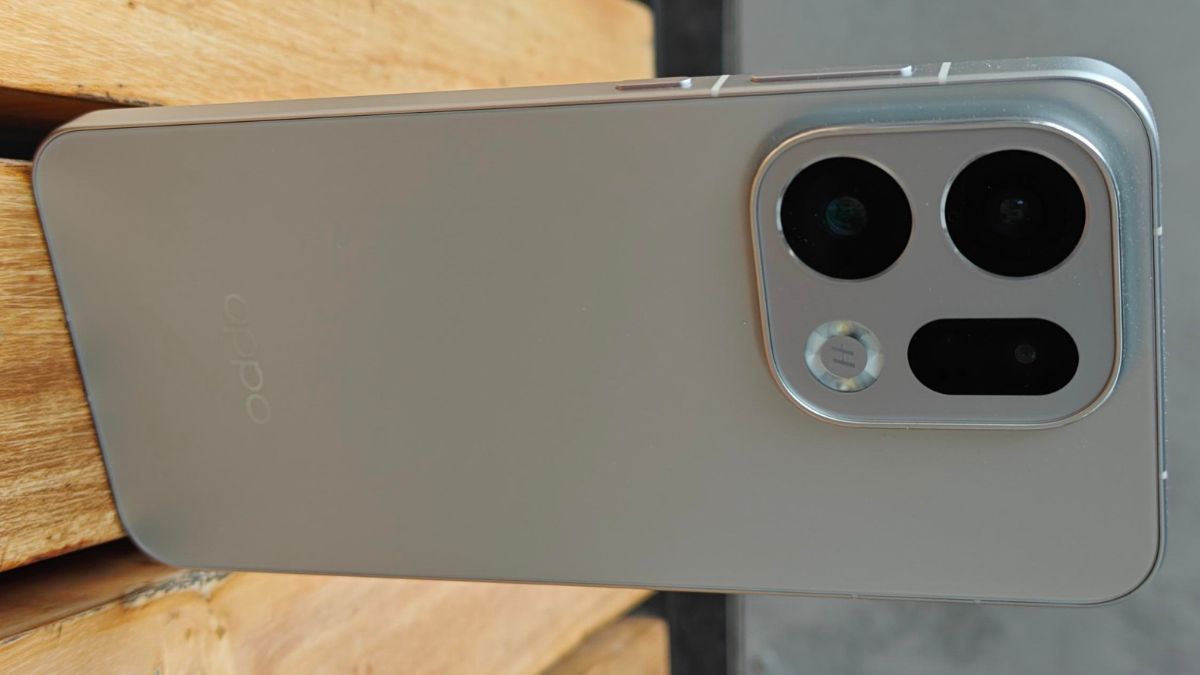
The back houses the triple camera setup on a protruding rectangular cutout on the top left corner with a subtle Hasselblad branding on the LED camera, while the Oppo logo sits near the bottom on the back. The X9 feels nice in the hand; while it is not the most grippy smartphone around, it certainly isn't too slippery either.
The phone's 6.59-inch Full HD+ (2750x1256) AMOLED is sufficiently bright and has excellent viewing angles for reading and viewing something on it. The flat panel has good colour reproduction, which I used in the Standard mode at the highest screen resolution. It's sharp and handles contrast-y HDR content well enough to be a viable option for watching HDR content on the go.
Coming to the camera, it's certainly one of the strengths of the device, as expected—a 50MP (f/1.6) main camera, a 50MP (f/2.0) ultra-wide camera, a 50MP (f/2.6) periscope camera, and a 2MP (f/2.4) monochrome camera. Partnering with Hasselblad for imaging processing, the phone does take well-stitched shots with good colour depth and details in general.
There's very little shutter lag, and the camera app is quite feature-rich and responsive. Motion Photo is now enhanced with a better ability to extract a photo from the moving photo when the Hi-Res mode is enabled. The front-facing 32MP (f/2.4) camera delivers clear shots most of the time, with some details lost in low-light indoors or when taking a photo while moving. You can shoot 4K videos at 60FPS with it, if needed, with the rear camera shooting at 4K 120FPS, which actually gives one of the better video outputs from an Android phone at this price point today.
The Find X9 is equipped with MediaTek's Dimensity 9500 chipset (up to 4.21 GHz octa-core processor, Mali-Drage MC12 GPU) along with 16GB LPDDR5X RAM and 512GB (or 16GB and 256GB in the case of the base model) UFS 4.1 internal storage.
It's running on ColorOS 16 based on Android 16 with the November security patch in place. The OS is now a little translucent in look and has more theme options, including Flix themes that gel well with the overall OS. You can configure the Snap Key to be used for taking input from what's on your screen for AI, or as a mute switch, to take a screenshot, open the camera or voice recorder, and so on. AI features are gradually making inroads into Oppo's offering.
I like the image editing for removing unnecessary shadows the most, but there's a lot more to go in terms of idea generation by simply guiding it to what's on your screen. The OS is fluid and responsive, with some enhanced animations when switching between menus. There's now a full-screen always-on display, along with the ability to change the shape of an app or folder icon. There's a new feature called Motion Cues to help with motion sickness for those who are affected by it from using the phone in a moving vehicle—dots appear on the screen and move up and down in response to the vehicle's movement.
For gaming, you can expect to play something like Hitman Absolution at the highest settings smoothly at 60 frames per second and BGMI at a higher 120FPS, though it looks better in gameplay at 90FPS. The only time I saw some heating was when using 5G on the go with a Wi-Fi hotspot during the day. I wish Oppo had upgraded the USB Type-C port to 3.0 for this price segment; otherwise, performance here is top-notch.
Powered by a 7025 mAh silicon-carbide battery unit, the phone comfortably lasts a day and then some on almost every single full charge. The bundled 80-watt SuperVOOC charger can charge it in slightly over an hour without any major heating issues.
Stereo speakers in the phone are quite loud, clear, and good for indoor usage. 5G network reception is also decent for use on the go. Wi-Fi was a little patchy at first, but the last two updates have made it much more reliable with no issues seen now. Call quality is good on both sides, and so is the GPS on the device.
All in all, the Oppo Find X9 is a solid smartphone in pretty much every department as of now. Its camera is reliable in most scenes, its battery life is excellent, and the whole OS generally performs smoothly with less bloatware than before.
