



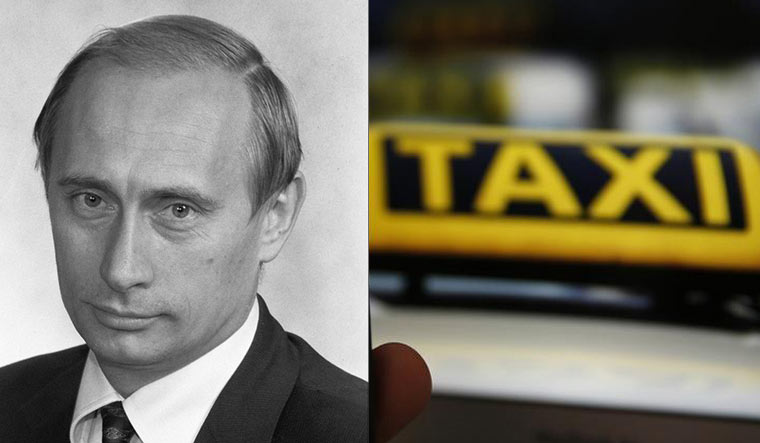
In a new documentary marking 30 years since the fall of the Soviet Union, Russian President Vladimir Putin claims he worked as a private driver to make ends meet after the decline of the bloc.
“We lived like everyone, but sometimes I had to earn extra money…as a private driver. It’s not pleasant to speak about honestly, but unfortunately that is what happened,” he said in the documentary by Channel One titled Russia: Recent History.
This is the first time the former KGB agent has claimed to have moonlighted as a taxi driver.
Putin is believed to have worked with the KGB for 18 years, working in Leningrad and later in the foreign intelligence wing in East Germany. He rose to the rank of lieutenant colonel. He was not a high-ranking KGB official, according to Amy Knight and Blair A. Ruble in ‘The Two Worlds of Vladimir Putin’, and was primarily tasked with identifying foreign nationals worthy of investigation in East Germany. He never broke into KGB power circles.
After the collapse of the Communist East German government, he returned to Leningrad in 1989.
In a 2018 documentary, The Guardian reported, he made a different claim, saying that he “feared” he would have to drive a taxi after his mentor and employer Anatoly Sobchak lost his re-election as mayor of St Petersburg.
Sobchak was a key figure in the formation of the Russian Federation, as co-author of its constitution. After Putin left the KGB in 1991, he worked for Sobchak. As the first democratically-elected mayor of St Petersberg, Sobchak delegated day to day powers to his deputies, Vladimir Yakovlev and Putin.
After Sobchak lost his election, Putin went to Moscow and took up a job in the national government.
Putin’s break came when Boris Yeltsin, following criticism over corruption in his regime and the bungling of the first war in Chechnya of 1994-96, appointed Putin as chief of the Federal Security Service. He was also given the responsibility of heading the president’s Security Council, a position he used to protect Yeltsin from impeachment by threatening the parliament and discrediting the prosecutor-general. His reward was his appointment as prime minister in 1999. Since then, he has helmed Russian politics, becoming the country's longest-serving leader since Josef Stalin.
