



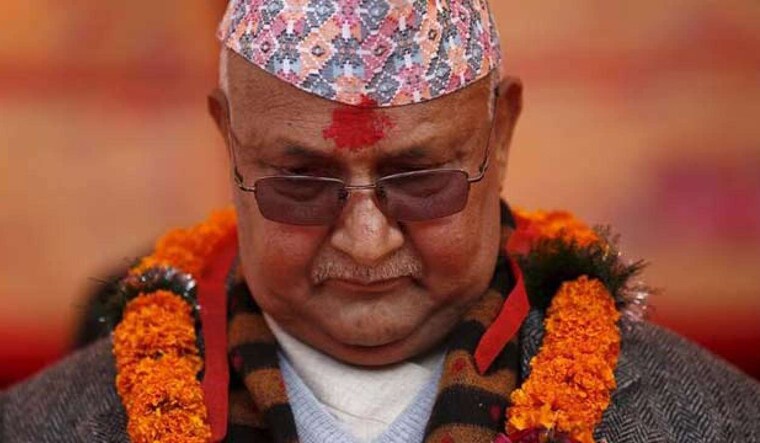
India has not had a comfortable relation with Nepal Prime Minister K.P. Oli. He continues to keep India on tenterhooks even during his second tenure as prime minister. This is a novel experience for India's diplomatic staff who had once taken Nepal for granted as a natural ally and protege.
Oli will be visiting India on a three day tour on April 6. This will be his first visit after taking over as the prime minister for the second time. Oli told the media that the visit is focused on building trust with India.
Traditionally, every new prime minister in Nepal (and also the president, now) make their first foreign visit to New Delhi. Oli is sticking to tradition, as he did the last time. But, last time (in February 2016) his visit came after much delay. There were reasons galore, but the most important cause was Nepal being miffed at India's high handedness over its brand new constitution.
Prime Minister Modi had sent then foreign secretary S. Jaishankar to Kathmandu to convey New Delhi's anger against the draft, which, in India's view, discriminated against some communities—mainly the Madhesis.
Nepal's sovereignty was hit by Jaishankar's trip, and Oli dug his heels into Kathmandu's soil, budging only several months later, once the resultant blockade was over. All the while, he responded happily to overtures from China, much to India's chagrin. At one point it even seemed he would flout convention and make Beijing his first port of call.
This time, too, Oli has toed the invisible line, but he has learnt that it can be circumvented and has already met Pakistani Prime Minister Shahid Abbasi. Cocking a snook at India's professed big brother image in the subcontinent, Abbasi flew up to Kathmandu on Oli's invitation. The two discussed reviving the South Asian Association of Regional Cooperation (Saarc). It may be recalled that Saarc interactions came to a grinding halt in 2016 after India refused to go to Islamabad for the meet, and succeeded in getting all other member nations, too, to isolate Pakistan.
Oli has also told the Nepali parliament, in a much reported statement, that he will not sign any deal with India that will be detrimental to his country's interests.
Oli believes that India was instrumental in the coup that followed shortly after his return to Kathmandu in 2016, and hence nurses a grudge. He also believes that India had a hand in his subsequent ouster.
With India's neighbourhood policy fast unravelling, every country is becoming more and more crucial. Though Oli is the prime minister of a small country, his visit is extremely important.
