



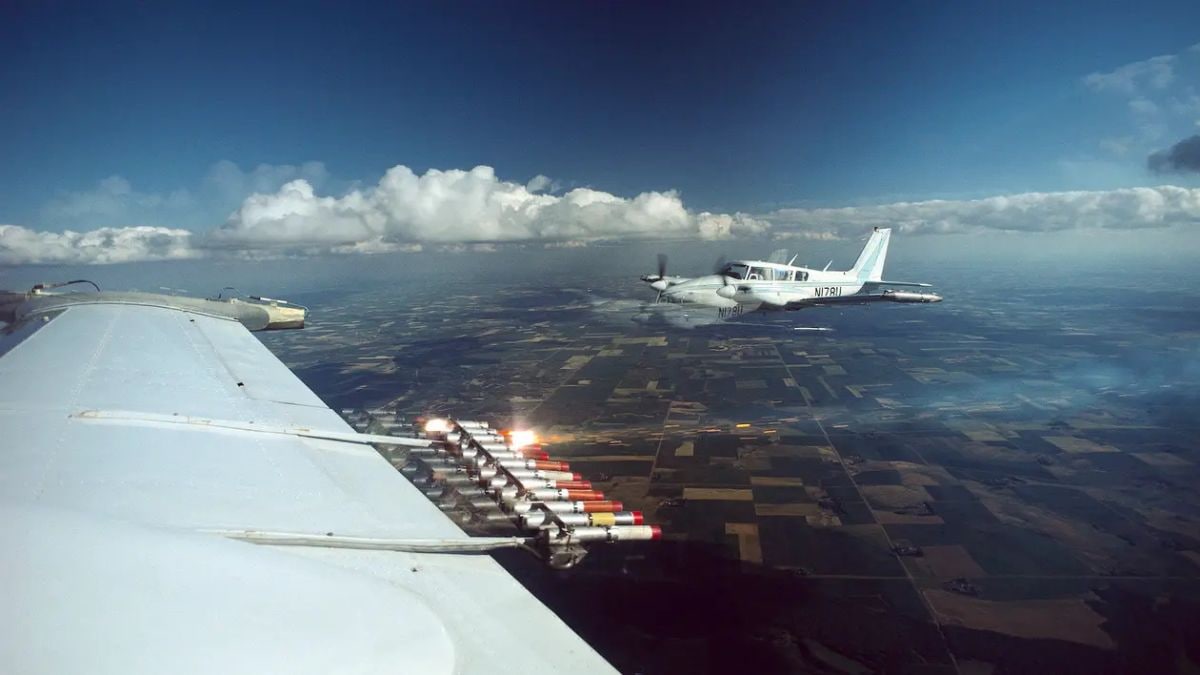
As polluted air continues to choke Delhi, cloud seeding, once considered a marvellous foreign technology for artificially inducing rain, has become the talk of the town.
Delhi CM Rekha Gupta has even called it a "necessity", highlighting the urgency of the situation.
However, behind this rushed experiment—which aims to induce artificial rain on October 29—are a number of health and ethical concerns that ask to be heard.
Cloud seeding: An expensive chance
Cloud seeding involves using aircraft or drones to add silver iodide particles to clouds. Since it has a molecular structure similar to ice, the silver iodide particles modify the structure of the clouds, which increases the chance of precipitation and dissipating fog.
It is for this expensive chance (costing Rs 55 lakhs per attempt) that cloud seeding has been touted as the saviour of Delhi's pollution problem.
The biggest flaw in modern cloud seeding technology is that even if it does create more rain and dissipate some of Delhi's smog, it will only affect a limited area for a limited period of time.
The process is also extremely dependent on various weather systems in play over the national capital and its surrounding areas, especially cloud cover.
Shehzad Gani and Krishna AchutaRao, two professors at Delhi’s Centre for Atmospheric Sciences, have pointed out that the cloud seeding plan was a "gimmick" and "a textbook case of science misapplied and ethics ignored".
They also compared the plan to Delhi's "smog towers" of 2021, which cost almost Rs 23 crore in taxpayer money, and were later found to do nothing to stop Delhi's polluted air, as per a Hindu report.
What the research says
A 2024 US Government Accountability Office (GAO) report takes things a step further, adding that effectively targeting the right cloud was a very important requirement for proper cloud seeding that was often overlooked.
Even then, the report adds that there was a lack of consensus around judging a cloud seeding attempt as a success or failure, and that self-evaluations may point to a "vested interest in positive outcomes".
A 2018 study has suggested that in the case of regular, non-randomised seeding and no corrections to the data, there was also no way to definitively find out whether increased rain that takes place after cloud seeding was due to the process itself, or variability in weather systems.
"Some ideal assumptions are often made according to cloud seeding scheme, statistical test scheme, and the statistical method itself in effect evaluation. When these assumptions are disturbed or invalid, the influence on effect evaluation of precipitation enhancement must be studied," the study said.
The situation is not entirely negative.
A 2023 study has shown that PM10 particles, as well as water-soluble gaseous pollutants, saw a temporary reduction after the rains that followed cloud seeding attempts (in the past). However, the concerntration of PM2.5 particles were more or less the same.
However, the study also warns about the long-term ecological concerns that follow every cloud seeding attempt.
While generally considered low risk in small doses, repeated cloud seeding can lead to chemicals like sodium iodide accumulating in soils and water bodies.
Since research into the long-term effects on agriculture, ecosystems, and human health is also limited, there is no way one can authoritatively say that the common man is wrong in flagging environmental concerns in cloud seeding.
That brings us to the real causes behind Delhi's yearly pollution spike: vehicle emissions, waste burning, construction, and power plants. As long as these issues take a back seat, polluted winter air will continue to hold Delhi by the throat with a vice-like grip.
