



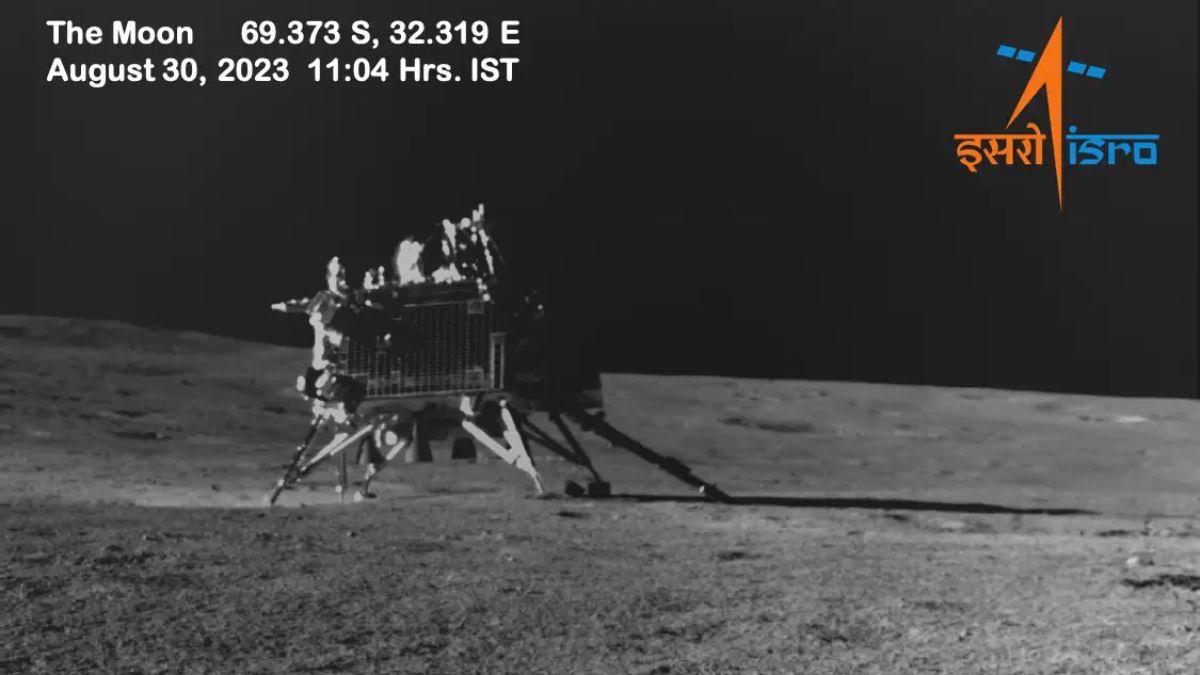
Prime Minister Narendra Modi announced that India and Japan will work together to launch Chandrayaan-5, India's fifth mission to the Moon. He said that ISRO and Japan's space agency JAXA (Japan Aerospace Exploration Agency) will jointly carry out the mission during his speech in Tokyo.
PM Modi said, "For Chandrayaan-5 Mission, we welcome the agreement between ISRO and JAXA (Japan Aerospace Exploration Agency). Our cooperation will go beyond Earth and become a symbol of humanity's progress in space," during his speech at the 15th India-Japan Annual Summit.
He said, "I am glad that India and Japan are joining hands for the next edition of the Chandrayaan series or the LUPEX (Lunar Polar Exploration) mission," in an interview with The Yomiuri Shimbun (Japan's largest newspaper) earlier today.
So why is this collaboration so significant, and why is the Chandrayaan-5 mission so significant?
The Chandrayaan-5 mission will be launched by JAXA (Japan Aerospace Exploration Agency) using its H3-24L launch vehicle. It will carry the ISRO-made lunar lander, which will further deploy a Japan-made rover on the Moon.
The H3-24L launch vehicle is Japan's latest heavy-lift rocket developed by Mitsubishi Heavy Industries and JAXA. It is designed to carry large satellites and deep-space missions, offering higher payload capacity, advanced safety, and reduced costs. The H3 series aims to replace Japan's older H-IIA rockets and strengthen its space exploration capabilities.
Apart from the lander, ISRO will also develop a few scientific instruments for the mission. The spacecraft will carry seven instruments, including a mass spectrometer by ESA (European Space Agency) and neutron spectrometers by NASA (United States space agency).
A mass spectrometer studies the types of gases and particles on the Moon's surface and atmosphere. Neutron spectrometers help detect water, ice, and hidden elements beneath the Moon's soil.
Chandrayaan-5's mission objectives include mapping water on the Moon, drilling lunar soil (regolith) to check water content, quality and composition, and doing scientific studies directly on the Moon using spectrometers and sensors.
“It is planned as a 100-day mission, which may be extended to a year, and will also try to explore the Moon's far side. The far side of the Moon means the side that is always facing away from Earth. We can never see it directly from Earth because the Moon takes the same time to rotate on its axis as it takes to orbit Earth,” explained space analyst Girish Linganna.
This expert further explains that China is pursuing parallel lunar exploration efforts through its ambitious Chang'e program, which directly competes with missions like Chandrayaan-5. Chang'e 7, scheduled to launch in 2026, will target the lunar south pole to search for water ice using an orbiter, lander, and innovative mini-flying probe that can hop into permanently shadowed craters.
“Following this, Chang'e 8 is planned for 2028-2029 and will test critical technologies for lunar base construction, including 3D-printing structures using lunar soil and deploying multiple rovers and robots. The mission has garnered significant international participation, with contributions from Pakistan (35-kilogram rover), Turkey, Italy, Russia, Thailand, and South Africa, among others.
Both missions are designed to lay the groundwork for China's International Lunar Research Station (ILRS), planned for the 2030s, with the ultimate goal of supporting crewed lunar missions by 2030. This parallel timeline puts China's lunar ambitions in direct competition with the India-Japan Chandrayaan-5 collaboration, highlighting the intensifying global race to establish a permanent human presence on the Moon,” added Linganna.
This landmark collaboration comes at a pivotal moment as India's space economy is projected to grow fivefold from $8.4 billion in 2022 to $44 billion by 2033, making it a crucial component of the nation's vision for Viksit Bharat 2047. The government has significantly increased space sector funding, with the Department of Space receiving Rs 13,416.2 crore in the 2025-26 budget, alongside the establishment of a Rs 1,000 crore venture capital fund to boost private sector participation.
India and Japan have a history of strong bilateral ties, including vibrant student exchange programs and joint educational initiatives in science, technology, and innovation. University collaborations, research fellowships, and academic mobility have paved the way for cultural understanding and knowledge transfer.
This space partnership thus extends opportunities for students, researchers, and startups to engage in real-world space science and technology development, reinforcing broader strategic, technological, and educational connections.
“The collaboration matters for multiple reasons. Scientifically, it will open new frontiers in lunar and planetary research, especially in the search for water and understanding lunar evolution. Technologically, both countries will benefit from sharing expertise, from robotics to data analysis, launch and mission operations.
For students, this alliance will stimulate educational exchanges, internships, and research collaborations in STEM fields between Japanese and Indian institutions. For industry, the joint approach promotes a collaborative ecosystem in cutting-edge space applications, potentially driving new startups and commercial ventures,” remarked Srimathy Kesan, the founder and CEO of SpaceKidz India.
The Prime Minister Modi has emphasised that this government-to-government collaboration between ISRO and JAXA is fostering cooperation between industries and startups in both countries, creating an ecosystem where innovation flows both ways—from labs to launch pads, and from research to real-world applications.
The approval for Chandrayaan-5 was given by the Modi government on March 10 as a financial sanction. In May 2025, ISRO and JAXA held their third face-to-face technical meeting at ISRO headquarters in Bengaluru, joined by experts from Mitsubishi Heavy Industries, Japan. The two-day meeting discussed the mission plan, technical details, and possible landing sites.
