



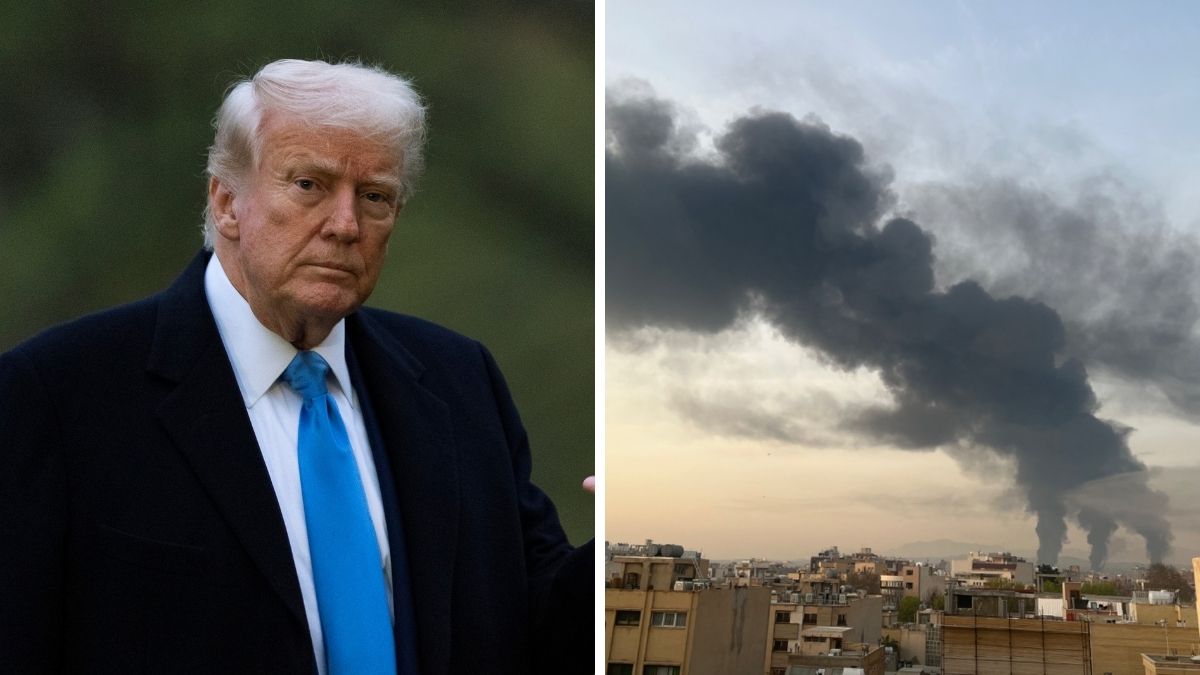
On March 6, US President Donald Trump posted four words on Truth Social that shut the door on diplomacy and opened another one towards prolonged conflict. "There will be no deal with Iran except UNCONDITIONAL SURRENDER!" he wrote, rejecting Iran's simultaneous signals of openness to mediation. His press secretary, Karoline Leavitt, later clarified that the standard would be met when the President himself decided Iran no longer posed a threat to the United States, whether or not Iran agreed it had surrendered. In other words, the end of the war would be defined unilaterally by the party doing the bombing. This is not a peace strategy. It is a doctrine of humiliation. And history, including history that India has been part of, tells us where that leads.
The lesson Europe refused to learn
When the Allied powers gathered at the Palace of Versailles in 1919 to settle the terms of World War I, they had a choice between justice and vengeance. They chose vengeance. The Treaty of Versailles, signed on June 28, 1919, held Germany solely responsible for the war, stripped it of 13 per cent of its territory, imposed reparations eventually fixed at 132 billion gold marks, and placed humiliating restrictions on its military. Germany was not invited to negotiate. It was summoned to sign.
The German public called the treaty a Diktat, a dictated peace. The resentment it generated did not dissipate over time; it fermented. The shame of the War Guilt Clause, combined with the economic devastation wrought by reparations and the subsequent hyperinflation of the 1920s, hollowed out the Weimar Republic. By the early 1930s, radical right-wing parties had found their audience. Adolf Hitler and the National Socialist German Workers' Party campaigned explicitly on reversing the humiliation of Versailles, promising to restore Germany's military strength and reclaim its national pride. In 1933, he became Chancellor. Six years later, the world was at war again.
Economist John Maynard Keynes had warned as early as 1919, in his prescient work ‘The Economic Consequences of the Peace’ that the treaty's terms were not just punitive but counterproductive. He was correct. Versailles did not end the war. It postponed it, loaded it with additional grievances, and handed extremists the very fuel they needed. A peace built on a nation's humiliation is not peace at all. It is a deferred conflict with a longer fuse.
What India chose instead
India has its own instructive chapter in this history. In December 1971, the Indian armed forces achieved one of the most decisive military victories of the post-war era. In 13 days, the Indian Army, Navy, and Air Force acting in concert compelled the surrender of Pakistani forces in what was then East Pakistan. Lieutenant-General A.A.K. Niazi signed the instrument of surrender in Dacca on 16 December 1971, and Bangladesh was born as an independent nation. Nearly 93,000 Pakistani soldiers and officers were in Indian custody, representing close to one-third of Pakistan's entire army. India held extraordinary leverage.
There were voices at the time urging Prime Minister Indira Gandhi to press that advantage to its fullest, to extract maximum territorial and political concessions before releasing the prisoners of war. The temptation to humiliate a defeated adversary is always present after a crushing victory, and understandably so. But Indira Gandhi and her advisors chose a different path. On July 2, 1972, she met with Pakistani President Zulfikar Ali Bhutto in Simla, Himachal Pradesh. The Simla Agreement that emerged from those talks was built on the principle of bilateral resolution, mutual respect for sovereignty, and a commitment to peaceful coexistence.
Under the agreement, India returned all captured Pakistani territory except a few strategically significant areas, formalised the Line of Control in Jammu and Kashmir, and over the following months released all 93,000 prisoners of war. In exchange, Pakistan formally recognised Bangladesh's sovereignty, a concession of enormous diplomatic weight. India also gave back more than 13,000 square kilometres of Pakistani territory it had seized during the conflict, as an explicit gesture of goodwill.
Critics have argued that India did not fully capitalise on its military advantage, that more could have been extracted from a defeated Pakistan. That critique misses the point entirely. The objective of the 1971 war was not to destroy Pakistan but to end a genocide, secure the independence of Bangladesh, and establish a stable regional order. Crushing Pakistan's dignity along with its military would have undermined each of those aims. It would have entrenched the very revanchism it sought to prevent. Indira Gandhi understood what the architects of Versailles did not: that how you end a war shapes everything that follows.
The problem with unconditional surrender
There are circumstances in which unconditional surrender is both necessary and appropriate. The Allied demand for unconditional surrender from Nazi Germany in World War II was justified precisely because the Nazi regime was genocidal and ideologically incompatible with a negotiated peace. The same logic applied to Imperial Japan. But these are exceptional cases that arose from exceptional evils. They are not a universal template for ending wars.
Iran is a nation of nearly 92 million people. Whatever one thinks of the Islamic Republic's government and its regional conduct, the demand for unconditional surrender says nothing about what comes after and everything about the desire to be seen as dominant. Trump himself acknowledged this ambiguity when he told Axios that unconditional surrender could mean Iran announcing it, or it could mean Iran having nothing left to fight with. That is not a peace objective. That is a description of destruction.
The White House simultaneously denied that this was a regime change war while insisting that Iran's new leadership must be acceptable to the United States. Secretary of State Marco Rubio told Arab foreign ministers that the military focus remains on missile launchers and stockpiles. Yet Trump stated that he wanted to be personally involved in selecting Iran's next supreme leader and that the country's governance must treat the United States and Israel well. These are not the stated aims of a power seeking a limited, defined settlement. They are the ambitions of occupation without its name.
What history demands now
Iran's president, Masoud Pezeshkian, stated clearly on March 6 that some nations were already engaged in mediation efforts. The door was open. Trump slammed it shut with a social media post. Every day that diplomatic off-ramps are foreclosed is another day that forces beyond either government's control, regional escalation, oil prices approaching $150 a barrel according to Qatar's energy minister, threats to the Strait of Hormuz through which a significant share of global oil flows, shape the eventual outcome.
The lesson from Versailles is that a peace imposed in humiliation plants the seeds of the next war. The lesson from Simla is that a victor who chooses restraint can achieve more durable outcomes than one who presses every advantage. Neither lesson is obscure. Both are well-documented, widely studied, and consistently forgotten at the moment they are most needed.
There is no shame in seeking a negotiated end to conflict when the alternative is open-ended war in one of the world's most combustible regions. There is no weakness in leaving an adversary a dignified exit. The weakness lies in mistaking maximalism for strength and the silencing of an opponent for the achievement of peace. Unconditional surrender is a headline. It is not a strategy. And in the Middle East, where every war eventually becomes everyone's problem, the difference between the two is not academic. It is measured in years of conflict still to come.
