



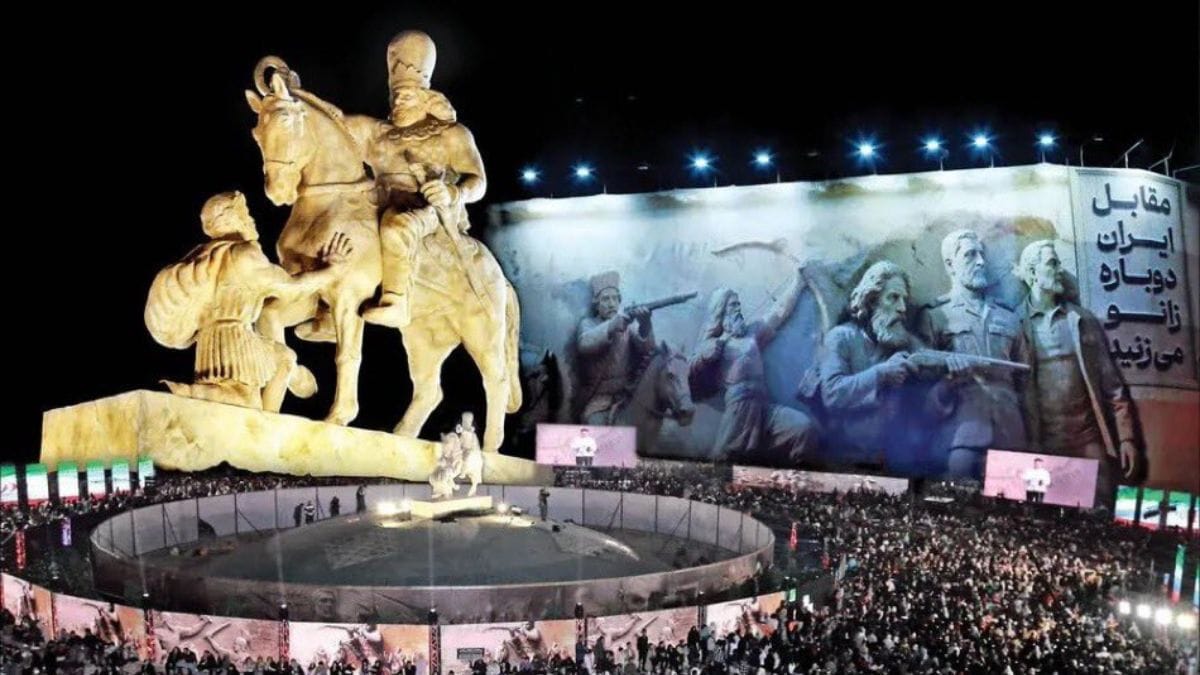
Discussions regarding the nature of Iranian nationalism and its expression by the Islamic Republic of Iran have resurfaced recently. This time it is attributed to the unveiling of a statue of the Sasanian King Shapur I in Tehran's Enqelab (Revolution) Square this month, which depicts the defeated Roman Emperor Valerian kneeling before him. Coming against the backdrop of the Iran-Israel conflict in June this year, the unveiling of this statue was part of the “You will kneel again against Iran” campaign by the Supreme Leader.
Contrary to common interpretations that portray Shi’i Islam as the singular dominant feature of Iranian identity, the Islamic Republic’s selection of a pre-Islamic Sasanian king is reflective of a deeper, long-standing approach that should be viewed in the context of regime consolidation. This move aims to tap into a deep, non-religious source of patriotic sentiments and historical authenticity to forge solidarity that transcends the current ideological rift between the clerical establishment and secular nationalists.
The statue is a direct appeal to Iran’s “ethnic core”, drawing on the enduring notion of Sasanian imperial pride. By invoking the powerful imagery of the Shapur-Valerian, the state is deliberately tapping into a narrative of Iranian civilisational resilience and triumph over a formidable Western adversary.
The Islamic regime has often been called out for ignoring the Persian heritage and emphasising Islamic identity rooted in the 1979 Revolution, which marginalises the long pre-Islamic history. However, surprisingly, the project's (Shapur-Valerian) design and implementation followed instructions issued by Ayatollah Ali Khamenei.
This development can be better understood in the context of several broader trends. In contemporary Iran, national identity has traditionally been rooted in religion, language, and a shared civilizational heritage. But today, invoking Shi‘i Islam as a unifying force, something that worked powerfully during the Iran-Iraq War and in the years that followed, no longer carries the same weight. Iranian society has undergone a noticeable secular shift, limiting the ability of religious identity to mobilise people at the national level.
A confidential study leaked in 2024, conducted by the Ministry’s Research Centre for Culture, Art and Communication, found that nearly 73 per cent of Iranians support separating religion from the state. While this is not a universal shift, it aligns with other indicators like a decline in religious self-identification, growing public resistance to the mandatory hijab, and similar findings from multiple polls and analyses.
Fully aware of these changes, the regime has increasingly turned to cultural history to construct a new nationalist narrative, an approach that has resurfaced repeatedly throughout the country’s political evolution. For example, in the latter half of the 20th century, Iranian intellectuals drew heavily on the collective memory embedded in the Abu’l Qasim Firdausi’s epic Shahnameh, recounting the history of Iranian kingship from the creation of the world to the Arab conquest in the seventh century to shape and promote a modern nationalist ideology.
Following the Iran–Israel conflict in June, the Iranian state began drawing more explicitly on the country’s pre-Islamic, millennia-old history to stir nationalist feeling, something it had rarely done so openly before. In June, a new mural was unveiled at Tehran’s Vanak Square featuring the legendary figure Arash the Archer (Arash-e Kamangir), shown poised to release his arrow with missiles rising in the background, accompanied by a patriotic verse about Iran. Soon after, bronze statues of Arash Kamangir were installed in July and August. Another billboard in Tehran depicted Israeli Prime Minister Benjamin Netanyahu kneeling before the mythical hero Sorash, alongside the caption: “From the beginning of time, real men have always forced the unmanly to kneel.”
The turn to pre-Islamic history rather than to familiar themes of martyrdom, the authority of the Vali-e Amr-e Muslemin (the “leader of all Muslims,” referring to the Supreme Leader), or the Shi‘i principle of Mazloumiat, which urges the oppressed to rise against oppressors, reflects a deliberate, if somewhat desperate, attempt by the regime to consolidate its authority. By invoking ancient Iranian symbols instead of its traditional religious repertoire, the state is recalibrating its nationalist messaging.
This shift fits within a broader pattern in which the regime prioritises Maslahat-e-nezaam (the expediency of the system) over its formal constraints. Under this doctrine, electoral outcomes, constitutional provisions, Shi‘i traditions, and even Islamic law can be set aside if they conflict with the regime’s immediate interests. For instance, the Ministry of Culture and Islamic Guidance reportedly advocated for Homayoun Shajarian’s concert at Tehran’s Azadi Stadium in September, framing it as a “gift to the public during hard times.” The move was widely criticised as another attempt to tap into nationalist sentiment to generate even minimal public support. The concert was ultimately cancelled, officially due to logistical issues.
All of this is unfolding against the backdrop of a prolonged economic crisis driven largely by international sanctions, which has produced deep recession, soaring inflation, a sharply devalued currency, and widespread unemployment. Coupled with rising public discontent and a marked secular drift in society, these pressures have made the task of regime perpetuation more difficult than at any point in its recent history.
Throughout modern Iranian history, ruling elites have sought legitimacy by crafting myths and elevating historical symbols, and the Islamic Republic is no exception. Yet in a rapidly changing, highly globalised world, the effectiveness of these strategies is increasingly limited. Even if such efforts resonate in the short term, they are unlikely to confer the regime with durable legitimacy and stability.
Mohammed Shoaib Raza is a doctoral candidate at the Centre for West Asian Studies, Jawaharlal Nehru University, New Delhi.
