



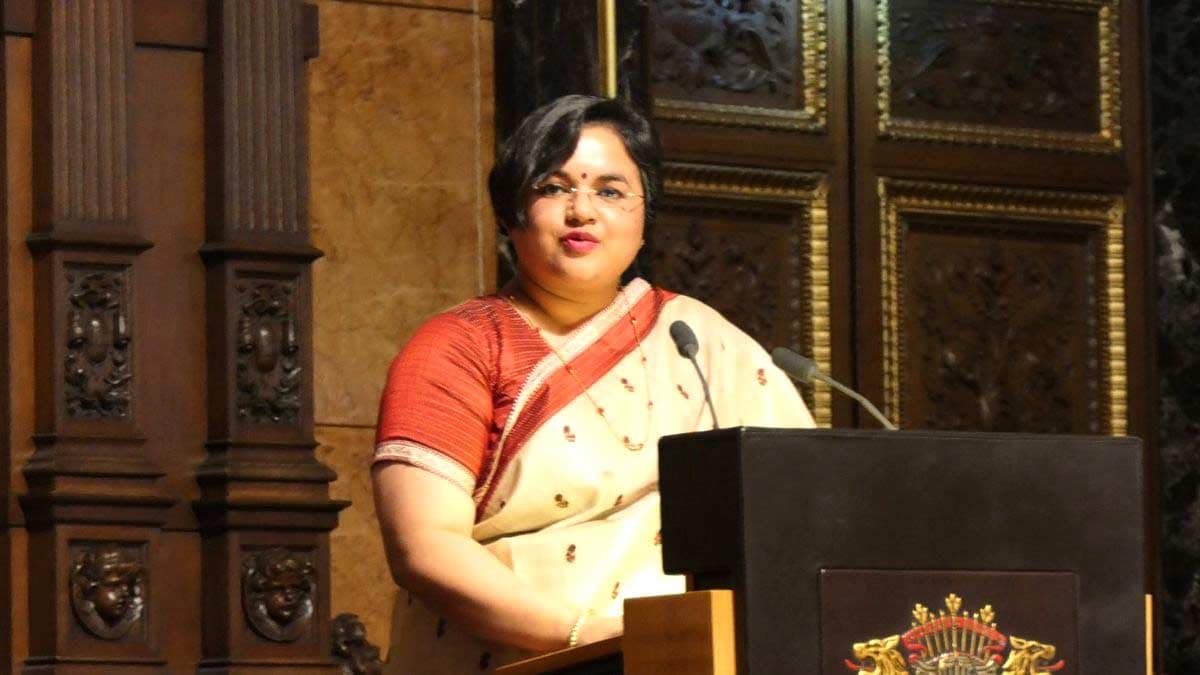
The Ministry of External Affairs recently announced that Paramita Tripathi, from the 2001 batch of the Indian Foreign Service, has been appointed India’s Ambassador to Kuwait and will assume the post shortly. This otherwise routine and innocuous move signals a new shift in India’s approach not only towards the relatively conservative Middle Eastern region but also its commitment to women’s empowerment.
Since the early days of Independence, prominent figures like Vijaya Lakshmi Pandit, Meera Shankar and others have represented India in different parts of the world. However, their footprints in the Middle East have been limited and exceptional. The conservative and largely patriarchal nature of the region has been a major stumbling block. Thus, since Independence, several Middle Eastern countries have not seen women ambassadors from India. But this too has been changing in recent years.
Within the region, North Africa has been luckier than the rest. In recent years, Algeria, Libya and Tunisia have had women ambassadors. Tunisia had its first Indian woman ambassador in Nagma Mohamed Mallick, shortly after that country underwent the Jasmine Revolution which blossomed into the region-wide Arab Spring, whose impacts are still reverberating. Likewise, M. Manimekalai was in Tripoli when Libya descended into turmoil leading to the overthrow and killing of Muammar Gaddafi and the subsequent civil war. These events forced India to move its mission to neighbouring Tunisia in 2011 and eventually to shut down its Libyan mission, a situation that continues to this day. The current Indian ambassador in Algiers, Swati Vijay Kulkarni, is also the first female diplomat to represent India in that country.
Above all, veteran arms control expert Arundhati Ghosh represented India in Cairo during 1992–95. This was a critical phase as New Delhi had normalised relations with Israel in January 1992, and had to allay Egyptian concerns over the decisive shift in India’s Middle East policy. Until now, Morocco remains the only North African country that has not seen an Indian woman ambassador.
Lebanon and Türkiye were relatively better placed and each had two female ambassadors. Despite prolonged internal disturbances and frequent conflict between Hezbollah and Israel, Nengcha Lhouvum (2005–09) and Anita Nayar (2013–16) headed the Indian mission in Beirut. Likewise, Chitra Narayanan (2005–08) and Susmita G. Thomas (2011–14) looked after Indian interests in Türkiye. However, despite the greater social, economic and political accomplishments of women and their empowerment, Israel is yet to see a female diplomat from India. The same is true of Iraq and Syria, which in the past had championed greater power and representation for women. Interestingly, even in the heydays of Ba’athism, India did not send women ambassadors to Baghdad or Damascus.
The situation in the countries along the Persian Gulf is even more striking. Until now, none of the countries—Bahrain, Iran, Iraq, Kuwait, Oman, Qatar, Saudi Arabia, the UAE and Yemen—has had a woman as India’s ambassador. Conservatism, reinforced by tribalism, continues to impede a greater role for women in several Gulf Arab countries; in Iran, the Islamic Revolution has prevented any serious political role for women. Indeed, all the top decision-making bodies of the Islamic Republic are off-limits to them. Since ambassadors are expected to work within the limits and cultural norms of the host countries, there has been little India—or any other country—could do to break the glass ceiling for women.
It is in this context that one should view the Indian decision to name Tripathi as its next ambassador to Kuwait. She will be the first female Indian ambassador in the entire Persian Gulf region. Kuwait itself has additional impediments. While the larger Middle East has been slow in franchising women and granting them voting rights, Kuwait had an erratic journey. After much internal debate and pressure from the ruling Al-Sabah family, Kuwait introduced voting rights for women in 1985. This did not go down well with the clergy, which viewed political rights as an exclusively male domain, and women’s voting rights were revoked. An attempt to restore them in 1999 failed, and they were only reintroduced in 2005. Though Kuwait has been proud of its electoral path since its independence in 1961, its elected parliament today is an all-male forum.
While other Gulf Arab countries like Saudi Arabia and the UAE are moving in the direction of greater female empowerment, Kuwait is treading a turbulent path. Under pressure from the clergy and others, Kuwait has imposed severe restrictions on its women citizens who marry foreigners, especially in terms of conferring Kuwaiti citizenship to their spouses and children. Above all, Kuwaiti citizenship is increasingly being restricted to those with close tribal links to certain groups, thereby threatening the future of foreign women who marry Kuwaiti men.
By sending a woman diplomat as its representative—also accepted by the host—to Kuwait, India has taken a decisive step towards women empowerment. Hopefully, this will be followed in other Middle Eastern countries where women have never been India’s emissaries. Will the Kingdom of Saudi Arabia be the next?
Kumaraswamy teaches contemporary Middle East at the Jawaharlal Nehru University, New Delhi.
