



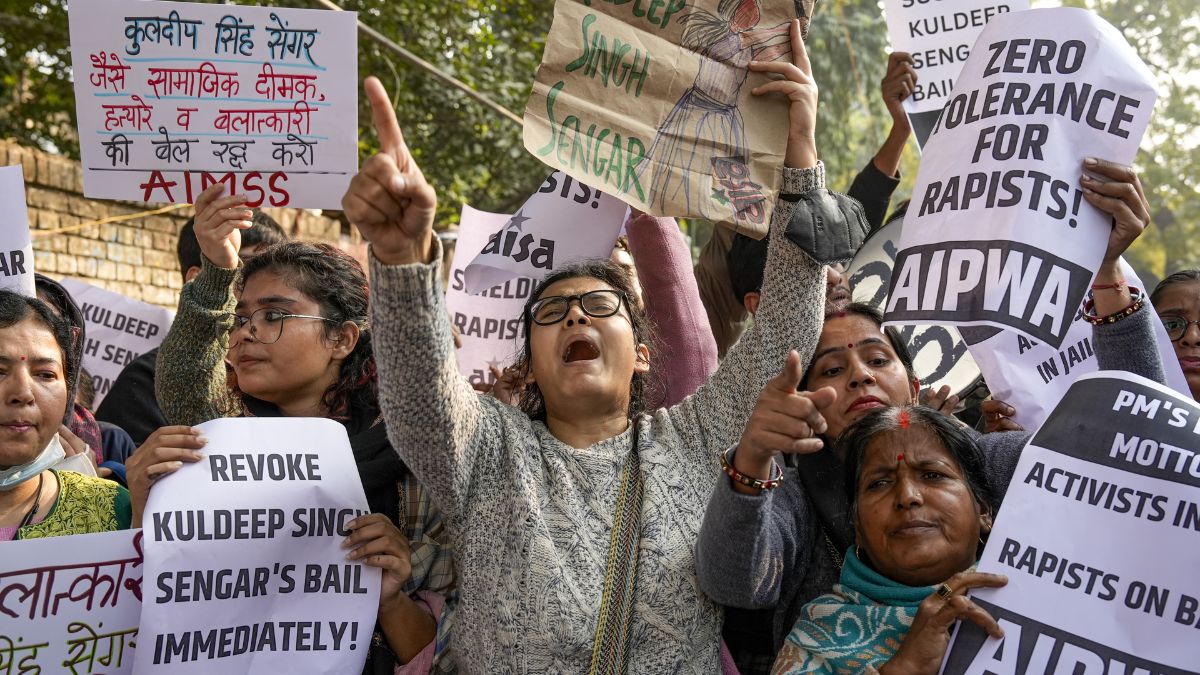
The Supreme Court on Monday stepped in to halt what it described as a legally troubling turn in one of India’s most haunting criminal cases, staying the Delhi High Court’s order granting bail to former BJP MLA Kuldeep Singh Sengar in the Unnao rape case.
The ruling ensured that Sengar, convicted of raping a minor and sentenced to life imprisonment, will not walk out of jail even for a day.
A ‘peculiar case’ and a stayed release
A bench led by Chief Justice of India Surya Kant said the case raised “substantial questions of law” that warranted close scrutiny. While bail or suspension of sentence orders are ordinarily not stayed without hearing the accused, the court said the present matter involved “peculiar facts”.
Sengar, it noted, continues to remain in prison owing to his conviction and sentence in another criminal case linked to the same chain of events.
A case that shook the nation’s conscience
Behind the legal reasoning lies a case that shook the country’s conscience. In 2017, a minor girl from Uttar Pradesh’s Unnao district accused the then-powerful legislator of raping her.
What followed was not swift justice but a harrowing ordeal marked by alleged police inaction, threats to her family, and a sense of abandonment by the system meant to protect her.
Desperation outside the corridors of power
In April 2018, driven to desperation, the survivor attempted self-immolation outside the official residence of the Uttar Pradesh Chief Minister, accusing authorities of shielding the accused.
The image of a young girl standing outside the corridors of power, pleading to be heard, became emblematic of the deep imbalance between influence and vulnerability.
Supreme Court steps in to ensure fairness
Public outrage forced the case out of the state’s hands, with the Supreme Court transferring the investigation to the Central Bureau of Investigation and later moving the trial from Uttar Pradesh to Delhi to ensure fairness.
Conviction, life sentence, and related cases
In 2019, a Delhi court convicted Sengar under Section 376(2)(i) of the Indian Penal Code for rape and sentenced him to life imprisonment.
He was also found guilty in separate cases arising from the custodial death of the survivor’s father and attempts to intimidate witnesses, cases that underscored the extent to which power had allegedly been used to crush resistance.
High Court bail order under the Supreme Court’s lens
It was against this grim backdrop that the Delhi High Court’s recent order suspending Sengar’s sentence and granting him bail sparked disquiet.
On Monday, the Supreme Court made it clear that the High Court’s reasoning could not be allowed to stand unexamined.
POCSO interpretation raises red flags
The Chief Justice expressed serious concern over whether the High Court had even examined Sengar’s conviction under Section 376(2)(i) IPC while granting relief. The Bench also flagged the interpretation adopted under the Protection of Children from Sexual Offences (POCSO) Act, warning that it could lead to absurd consequences.
If accepted, the court observed, even a constable or a patwari could be treated as a “public servant” for the purpose of aggravated offences, while an elected MLA or MP could escape that classification and seek exemption.
‘Even the finest judges are prone to errors’
Such an interpretation, the court suggested, runs counter to both legislative intent and common sense.
The Bench further clarified that amendments to POCSO were meant to enhance punishment for existing offences, not to create new categories of offences through interpretative shortcuts.
At the same time, the court struck a note of institutional humility. “Even the finest judges are prone to errors,” the Chief Justice observed, underlining that judicial scrutiny is an essential part of the legal system.
What it firmly rejected, however, was the tendency to publicly browbeat courts or take legal disagreements “to the streets”, a remark seen as a caution against trial by media and public pressure.
Survivor’s rights and the road ahead
For the survivor, whose counsel sought permission to intervene during the hearing, the Bench clarified that she did not require the court’s leave to challenge the High Court order.
She has a statutory right to file a separate special leave petition, the court said, adding that free legal aid would be provided through the Supreme Court Legal Services Committee if she chose to avail it.
Acting on a plea filed by the CBI, the Supreme Court issued notice to Sengar and stayed the operation of the High Court’s bail order, making it unambiguous that he shall not be released from custody pursuant to that ruling.
