



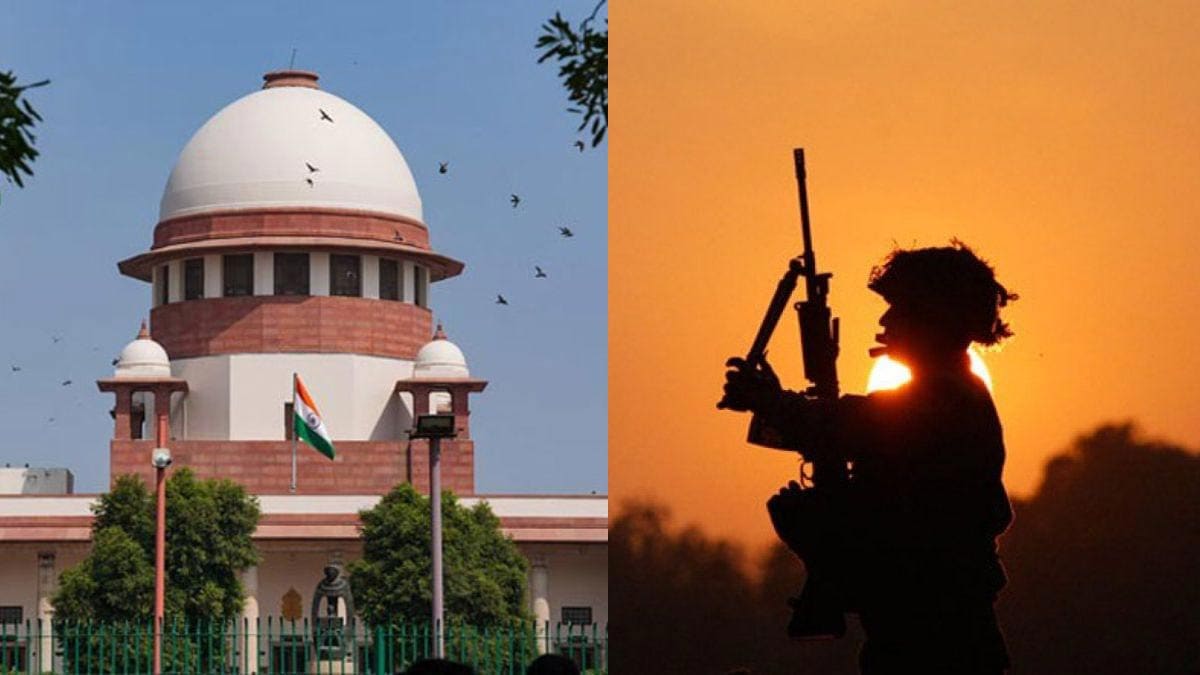
The Supreme Court on Tuesday refused to interfere with the termination of a Christian Army officer who was discharged for declining to enter the sanctum sanctorum of his regiment’s temple and perform pooja.
The bench, led by Chief Justice of India Surya Kant and comprising Justice Joymalya Bagchi, dismissed the petition while underscoring that the Armed Forces stand on discipline, cohesion, and collective morale and those values cannot be compromised in the name of personal faith.
The petition, filed by a Lieutenant Colonel Samuel Kamalesan challenging his termination from the Indian Armed Forces over refusal to participate in certain regimental religious ceremonies at his unit, located in Mamoon, Punjab. Senior Advocate Gopal Sankaranarayanan, appearing for the officer, argued that the case raised a serious constitutional question: is the right to profess and practise faith under Article 25 subordinate to military discipline?
Officers must lead by example, says CJI
Right from the start, CJI Kant appeared unconvinced by the argument that the officer’s faith justified refusing participation in rituals at places of worship other than his own.
"What kind of message he has been sending, he should have been thrown out for this only, grossest kind of indiscipline by an army official." Chief Justice Kant observed.
“If somebody asks you to perform rituals then it is fine but there is no ritual in a Gurudwara,” the CJI remarked, questioning the officer’s refusal even to enter the gurdwara. The CJI noted that the officer did not even listen to the pastor, referring to the counselling given by a church representative urging him to attend the Sarv Dharm Sthal, a multi-faith space.
Justice Bagchi pressed further, telling the counsel that the officer could not claim a personal interpretation of religious obligations beyond what his own clergy endorsed. “You cannot have your private understanding of what your religion permits. That too in uniform,” he said.
At this juncture, Justice Bagchi pointed out that a pastor had opined that entering the sanctum would not violate the tenets of Christianity. Sankaranarayanan replied that the pastor's statement was in the context of a Sarv Dharm Sthal and not a temple.
The Bench repeatedly emphasised the institutional context, “Leaders have to lead by example. You are insulting your troops,” CJI told Sankaranarayanan.
My faith has nothing to do with army duty, says Lieutenant Colonel Kamalesan
In response, Sankaranarayanan argued that the officer had always participated in social celebrations including Diwali, Lohri and Holi and abstained only from religious rituals that violated his conscience.
“My faith has nothing to do with army duty,” he submitted. He added that a Sarv Dharm Sthal wasn’t available in Mamoon due to infrastructure constraints, complicating expectations of neutral participation.
He also contended that the Army had acted harshly and prematurely, without notice or proportional consideration, even though the officer had an unblemished service record of six years. "I cannot be forced to worship a deity. Constitution permits that much freedom," Sankaranarayanan submitted.
Sankaranarayanan warned that the termination order sent the wrong message.
To which the CJI replied, “This will send a strong message.”
Respect the collective faith of the majority you command, says the CJI
Justice Bagchi drew a distinction between personal sentiment and essential religious practice under Article 25.
“Breach of Article 25 needs to be seen from the angle of essential practices, not every sentiment of religion,” she observed, adding that as a commanding officer, he was also constitutionally expected to respect the collective faith of the majority.
The bench was particularly concerned about cohesion within the regiment, noting that Sikh soldiers regarded the gurdwara as the most secular space available, and the officer’s refusal risked alienating his own men.
“For the Army, we are not going to open this kind of issue,” the CJI said, adding that existing regulatory provisions were not under challenge.
The court held that the petitioner had shown unwillingness to respect the sentiments of soldiers under his command and that this affected discipline.
The plea was subsequently dismissed.
