



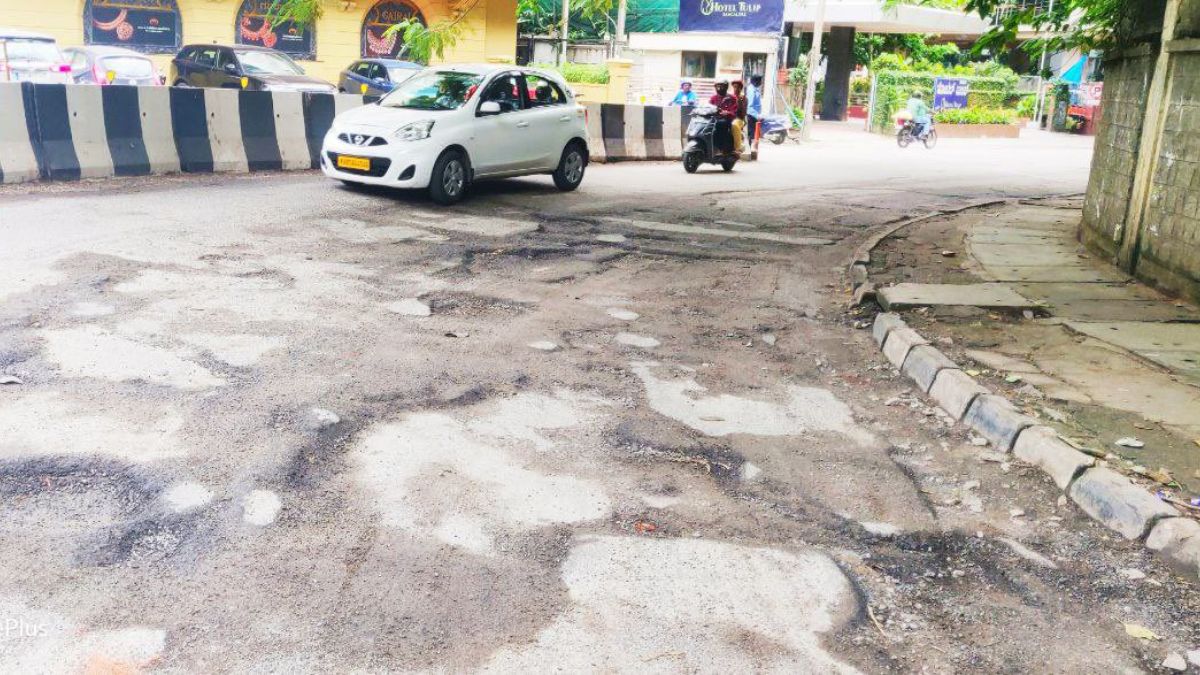
Bengaluru has become synonymous with potholed roads, clogged drains, dilapidated footpaths, garbage mounds, and piles of traffic.
The formation of five city corporations and a change in nomenclature from Bruhat Bengaluru Mahanagara Palike (BBMP) to Greater Bengaluru Authority (GBA) has done little to change the state of the roads, drains, or traffic.
A week after Blackbuck co-founder and CEO put out a post on social media declaring his intent to “move out” of Bengaluru citing the pathetic city roads—especially the Outer Ring Road—social media was abuzz with debates on the rampant corruption and political apathy plaguing the city.
Corporate leaders Kiran Mazumdar Shaw and Mohandas Pai joined the chorus to flag the issues and reminded the government that the city was one of the highest tax contributors with a global presence.
Deputy chief minister D.K. Shivakumar, also Bengaluru's development minister, dared the companies to move out and also claimed that the state of roads across the country was the same and Bengaluru was no exception.
“I was in Delhi and noticed the road in front of the Prime Minister’s residence is also chipped off. Whoever wants to leave the city is welcome,” said Shivakumar, leading to major backlash from citizens and opposition parties.
This week, a comprehensive review meeting chaired by the Chief Secretary saw various stakeholders—including corporate leaders and urban planners—take part. The meeting has drawn up a 90-day action plan to rid the city of potholes and clean up the garbage and debris by October 31.
Meanwhile, the deputy chief minister has announced a grant of Rs 750 crores for pothole filling, after the civic body identified as many as 9,973 potholes on the ward-level roads and 4,400 potholes on arterial and sub-arterial roads.
The pothole menace has led to a political slugfest, drowning the real issues of quality control, transparency, and accountability in road development works.
Over the last two and a half years (May 2023 to August 2025), the BBMP claimed to have developed 874km of arterial and sub-arterial roads at a cost of Rs 5,032 crores. It also spent Rs 130 crores for the maintenance of ward-level roads and other projects.
Bengaluru has a total of 2900km of roads, including ward-level, sub-arterial, and arterial roads. The ward-level roads have to be asphalted once every five years, but it is an open secret that the roads are asphalted in a hurry just before the elections.
Even as corporate leaders and urban planners have flagged the poor quality of roads and pothole filling, the "commission (bribe) culture" is directly responsible for the shoddy work, the contractors confided.
The blatant violation of norms (Indian Road Congress rules) in the blacktopping of roads or laying of footpaths is what is conveniently skipped in every discourse and debate over substandard civic works in the city.
A major anomaly is the BBMP contractors openly flaunting the road specification laid down by the Indian Road Congress and the Ministry of Road Transport and Highways for asphalting, experts say.
"The first rule is to avoid road work during the monsoon (June to December). But most road works are carried out in the rain and the roads are washed away as expected. Some contractors use kerosene instead of standard emulsion meant for bitumen roads, which reacts with water and the roads develop cracks. The use of soft gravel instead of rocky results in weathering over time. A major issue is the BBMP engineers who are authorised to inspect the quality of work skipping work. It is mandatory for engineers to check the quality of raw material used at the bitumen mix plants and to ensure that the temperature of the bituminous mix is between 110°C to 140°C. But they never visit the plants or the construction sites," rued former corporator N.R. Ramesh, who is pushing for pilot projects in the Yediyur ward to prove that it was possible to build cost-effective and long-lasting roads.
Also, BBMP has not had a single quality control report on roads. None of the 27 bitumen mix plants of the asphalting contractors are inspected for quality issues by the engineers.
The BJP leader and activist feels that rampant corruption in the civic body is stalling adoption of advanced technology which can end the pothole menace.
Citing the example of CGBM (Cement Grouting Bituminous mixture) technology, which was patented by a BBMP engineer, Ramesh says:
“CGBM technology helps bring down the cost of white-topping roads from Rs 20 crore per km to Rs 5 crore and the road can last for 25 years. While Ahmedabad has adopted the technology, Bengaluru is deprived of the modern technology owing to the contractor mafia.”
Are quality standards followed?
Simply flipping through the IRC manual would tell an engineer that properly laying a road involves following certain norms, like preparing a base where the subgrade and base layers are well compacted, drained and cleaned.
Applying a prime coat helps in better bonding of layers, and the right grade of bitumen and properly-graded aggregates need to be mixed at specified temperatures, before laying the mix evenly with a mechanical paver at the designed thickness and temperature.
The rolling is crucial—initial (smooth wheel), intermediate (pneumatic tyre) and final (steel wheel) rolling—to achieve the requisite density and smoothness.
After the road is laid, the surface needs to be checked for evenness, density, and binder content, and should be allowed to cool before being opened up for traffic movement.
A political whodunit
Union Minister H.D. Kumaraswamy slammed the state government and said: “Bengaluru and Karnataka are suffering under the grip of the corrupt. Every step is a death trap with potholes. Is this what is called Greater Bengaluru?” he asked.
Attacking the BBMP for “swallowing” taxpayers’ money while doing nothing, Kumaraswamy sadly said that the city was earning infamy as the “city of potholes”.
“The state government has rocket speed in levying taxes, but moves at the pace of a tortoise in filling potholes. It shows mad looting and sheer neglect towards development. State’s development was sacrificed for election guarantees. Greater Bengaluru is collapsing," Kumaraswamy said, blaming the chief minister and deputy chief minister for this disgrace.
The opposition BJP, which staged a “gundi mucchi” (fill up potholes) campaign and filled potholes across many constituencies—including the ones outside the deputy chief minister’s residence—alleged that the siphoning off of funds had led to the poor state of the roads.
“Roads across Karnataka have become death traps, causing daily casualties and injuries. The state government claims Rs 5,000 crores has been allocated for road asphalting. Then why do potholes still remain,” asked LOP R. Ashok.
“Is the road asphalting complete or was the money siphoned off? Nearly 60 per cent of funds seem to have been misappropriated. The government must repair and relay the roads properly and not just cover the potholes, which is a temporary solution,” demanded Ashok.
While deputy CM Shivakumar attributed the pothole menace to the misrule of the previous BJP government in the state and the failure of the BJP-led central government to give funds for Bengaluru’s development, Transport minister Ramalinga Reddy alleged BJP legislators in 2019 had got more funds than Congress legislators to develop the roads.
“BJP legislators in Bengaluru had granted Rs 6,116.73 crores under the Nava Nagarothana Scheme in 2019 against Rs 740 crores provided to Congress legislators. BJP carried out substandard work,” alleged Reddy.
“Once a road is built, it should last at least 10 years. If potholes appear within three years, the contractor must undertake maintenance work. But this rule was not followed during BJP’s rule,” explained Reddy, who did not elaborate on the roads developed or asphalted post-2023, when the Congress was in power in the state.
M. Maheshwar Rao, chief commissioner of the GBA, stated that each corporation was filling around 300 potholes daily and added that the civic body had its own hot mix plant and enough stock of hot and cold mix and eco-fix material, along with a jetpatcher machine too.
“A new app is being developed to collect public feedback after potholes are repaired,” said Rao.
Recently, the civic body also launched the ‘Raste Gundi Gamana’ app to help citizens report potholes.
The GPS-enabled app allows users to upload photographs of potholes and the reports will be reviewed by BBMP and the Bengaluru traffic police, who will then update the status of the reported issues.
Another initiative is the deployment of 15 AI-enabled vehicles to capture images and monitor city roads for potholes, damaged streetlights, and footpaths.
Even as the government is flaunting new technology and funds, citizens are hoping the assurance will translate to action and Bengaluru gets to cruise along a smoother road to development.
